



Ukrainian and Russian Bride dating advices - CQMI blog

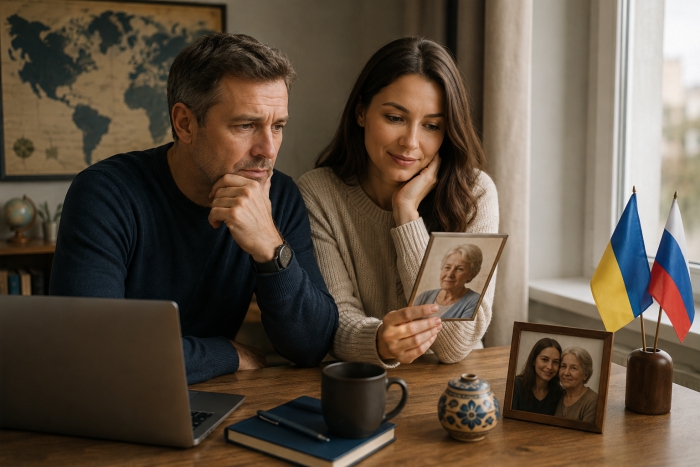 Caring for Aging Parents: Why Ukrainian Women Never Really Leave Their Mother Behind
Agence CQMI
Caring for Aging Parents: Why Ukrainian Women Never Really Leave Their Mother Behind
Agence CQMI
Caring for Aging Parents: Why Ukrainian Women Never Really Leave Their Mother Behind
A comparative study, by Antoine Monnier, founder of the CQMI international matchmaking agency
By our experience at the agency, here's a topic that catches almost every North American man off guard a few months into a relationship: his Ukrainian or Russian partner keeps sending money to her mother every month, calls her daily, and seriously talks about bringing her over one day. Many men initially read this as an unhealthy attachment to the family of origin. In reality, what we've observed for years at the agency is nothing unusual back home, it's simply the norm. This next chapter of our sociological series, after divorce, tackles the question of aging parents: who takes care of elderly relatives in Canada, the US, Russia, and Ukraine, and why is it almost always the mother rather than the father who receives that support?
In Canada and the US, Support for Aging Parents Exists, but Mostly Kicks In Later
Both Canada and the US allow adult children to sponsor a parent for immigration, but the paths look very different in 2026. In the United States, parents of a US citizen qualify as "immediate relatives," meaning there's no annual visa cap and no waiting list at all, processing typically takes 10 to 15 months, and the sponsor only needs to show household income at 125% of the federal poverty guideline, around $25,000-27,000 for a household of two. In Canada, the Parent and Grandparent Program (PGP) works completely differently: it's capped, invitation-only, and paused entirely for 2026 under Ministerial Instructions 89. Even when open, sponsors must meet a Minimum Necessary Income around $47,500 to $65,000 for three straight tax years and sign a 20-year support undertaking (10 years in Quebec). Many Canadian families fall back on the Super Visa instead, a multi-entry visitor visa now allowing stays of up to 5 years per visit, with roughly 8-week processing. Day-to-day, both countries lean heavily on assisted living and nursing homes as the default model, family financial help usually activates once a parent's own means are exhausted, not as a routine monthly commitment.
In Russia and Ukraine, Supporting Parents Is a Reflex, Not a Last Resort
The contrast is striking. A study of Ukrainian labor migrants across the EU found that 66.3% of people sending money home direct it primarily to their parents, well ahead of their own children (26.6%) or siblings (19.9%). On average, a Ukrainian migrant sends around 3,300 euros a year to family, through several transfers annually. According to the National Bank of Ukraine, the country received $11.4 billion in diaspora remittances in 2023 alone. This isn't aid triggered by a crisis, it's a monthly commitment treated as completely normal, regardless of the parents' actual income. By our experience, this reflex stays deeply rooted in Russian and Ukrainian women, even years after settling in North America.
Why It's Almost Always the Mother, Rarely the Father
This is a question a lot of our clients quietly wonder about but rarely ask out loud: why does the father almost never come up in these family support stories? The answer is largely demographic, something we documented at length in our analysis of Russia's gender imbalance. Male life expectancy runs 10 to 13 years shorter than female life expectancy in Russia, and around 12 years shorter in Ukraine, largely due to alcoholism and accidents. In practical terms, by the time a Russian or Ukrainian woman turns 40 or 50, it's not unusual for her father to have already passed while her mother is still very much alive. It isn't a matter of favoritism, it's very often simply a statistical reality: there's no father left to support.
Bringing a Parent to North America: A Real Administrative Journey
This is something many North American men discover too late: contrary to what they assume, US and Canadian family sponsorship rules for parents work in very different ways, and neither is as simple as it sounds. In the US, only citizens (not permanent residents) can petition for a parent, and the household income threshold is comparatively modest. In Canada, the PGP is currently paused, capped when open, and comes with a steep income bar plus a 20-year financial commitment, pushing many families toward the Super Visa as a practical workaround. Many Russian and Ukrainian women are aware of this complexity long before they even meet a North American partner, and it's often a genuine, quiet source of worry that rarely comes up in the first few months of a relationship.
What the Psychology of Family Support Reveals, East vs. West
We often observe that the North American model draws a fairly clear line between emotional and financial responsibility toward parents, you love your parents, but you don't automatically treat their monthly financial support as a given. The Slavic model merges the two far more closely: loving your parents means, almost by default, supporting them financially as soon as you're able, without waiting for a crisis. This isn't excessive dependency, and it isn't a lack of trust in a new household, it's a deeply rooted moral commitment that geographic distance never really suspends.
The Most Common Mistakes North American Men Make on This Topic
- Reading regular money sent to a mother as a lack of trust in the relationship: it's a pre-existing family commitment, not a judgment on the couple.
- Underestimating how complex parent sponsorship really is in Canada or the US, and discovering the PGP pause or the income thresholds too late.
- Being surprised that the father never comes up in family conversations without realizing the statistical odds of his early passing.
- Treating this financial support as temporary or negotiable: it's a lasting commitment best factored into the couple's budget from the start.
Two Real Stories From the Agency
James, from Toronto, initially struggled with his Ukrainian girlfriend sending part of her paycheck to her mother every month. He changed his view the day he learned that same mother, widowed for fifteen years, had never once asked for it, it was his girlfriend who insisted on sending it, out of respect and love, not obligation.
Robert, from Chicago, started the process to sponsor his Russian mother-in-law. He was surprised by the paperwork involved, but even more struck by his girlfriend's quiet gratitude, she hadn't even dared bring it up herself for fear of seeming demanding.
Comparison Table: Support for Aging Parents in Canada, the US, Russia, and Ukraine
| Criteria | Canada | United States | Russia | Ukraine |
|---|---|---|---|---|
| Nature of financial support | Mostly reactive, means-based | Mostly reactive, means-based | Spontaneous cultural reflex | Spontaneous cultural reflex |
| Share of remittances sent to parents | Not nationally tracked | Not nationally tracked | High, not systematically measured | ≈ 66% of diaspora remittances |
| Typical amount sent | Varies | Varies | Variable, often regular | ≈ €3,300/year per migrant |
| Default solution for elders | Assisted living / nursing home | Assisted living / nursing home | Aging at home, extended family | Aging at home, extended family |
| Sponsoring a parent | PGP (paused 2026), Super Visa alternative | Immediate relative, no cap, 10-15 months | - | - |
Frequently Asked Questions
Is it normal that my Ukrainian girlfriend sends money to her mother every month?
Yes, this is an extremely common and culturally valued practice in Ukraine, regardless of the parents' actual standard of living. It's not a sign of financial instability or a lack of trust in your relationship.
Can I sponsor my future Russian or Ukrainian wife's mother to come to Canada or the US?
In the US, yes, once you're a citizen, parents qualify as immediate relatives with no annual cap. In Canada, the PGP is currently paused and capped when open, with a Super Visa as a common interim option. Requirements differ significantly between the two countries.
Why does the father almost never come up in these family stories?
Male life expectancy is notably shorter in Russia and Ukraine than in North America, largely due to alcoholism. It's statistically common for the father to have already passed away by the time the question of supporting aging parents comes up.
Should I be concerned if my girlfriend talks about bringing her mother to live with us someday?
No, this is a very common and legitimate aspiration among Russian and Ukrainian women. Talking about it openly and planning the paperwork together builds trust rather than undermining it.
Our Take at CQMI
What this comparison shows is that a Russian or Ukrainian woman's attachment to her parents isn't excessive or concerning, it's simply a different cultural norm, as solid as it is misunderstood in North America. At the international matchmaking agency CQMI, we've helped serious men across Canada and the United States meet verified profiles of Russian and Ukrainian women since 2014, with more than 350 successful marriages to date. Understanding this family commitment before moving in together, rather than discovering it along the way, avoids a lot of unnecessary friction in a cross-cultural couple. And let's say it one more time: these women are looking for marriage, a real and lasting union, not a fling. If that's not your plan, please don't reach out.
Our $350 CAD monthly subscription gives you access to 10 verified contacts of women genuinely motivated to build a lasting family. Take a look at our process and subscription options.
Questions? Write to us directly at This email address is being protected from spambots. You need JavaScript enabled to view it..
For more on this topic, read our article on why Russian and Ukrainian women divorce or our piece on Russia and Ukraine's gender imbalance.
Latest from Antoine Monnier
- Marriage in the West and the East: Why One Institution Is Fading While the Other Holds
- Raising Kids: Canada, the US, Russia, and Ukraine Do It Differently
- Divorce in Russia, Ukraine, Canada and the US: What the Sociology Shows
- Ukrainian Woman Asks You for Money: Scam or Sincere?
- Ukrainian Refugee Women: Why Their Host Country Changes Everything