



Ukrainian and Russian Bride dating advices - CQMI blog

 Marriage in the West and the East: Why One Institution Is Fading While the Other Holds
Agence CQMI
Marriage in the West and the East: Why One Institution Is Fading While the Other Holds
Agence CQMI
Marriage in the West and the East: Why One Institution Is Fading While the Other Holds
A comparative study, by Antoine Monnier, founder of the CQMI international matchmaking agency
By our experience at the agency, this third chapter of our sociological series answers a question we hear almost weekly: why does marriage feel so fragile in Canada and the US, while it still holds strong in Russia and Ukraine? After exploring divorce and comparative family sociology, it was time to close this trilogy with the most fundamental question of all: is marriage itself even perceived the same way on both sides? The data says clearly no.
The Historic Decline of Marriage in North America: The Numbers
In the United States, the refined marriage rate has fallen 54% from its 1920 peak of 92.3 per 1,000 unmarried women to 31.5 in 2024, and the share of married-couple households dropped from 78.8% in 1949 to just 47.1% in 2024. Only 67% of 12th graders in 2023 said they were likely to marry one day, down from 80% three decades earlier. In Canada, the crude marriage rate fell from 8.8 per 1,000 people in 1970 to under 4 by 2019, and only 44% of Canadians aged 15 and older were married in 2021, down from 54% in 1991. The average age at first marriage has climbed from roughly 23 in 1970 to around 30-35 today. A recent Angus Reid survey even found that 53% of Canadians say a public wedding ceremony is "not that important" to them.
The Influence of Feminism and Individualism on Marital Disengagement
Family sociology has documented this shift since the 1980s under the name "second demographic transition" (Van de Kaa, Lesthaeghe): as women gain economic independence and access to higher education, marriage stops being an economic necessity and becomes one option among others, frequently postponed or replaced by cohabitation. This is neither a criticism nor a value judgment, it's an established sociological finding: the financial autonomy North American women have gained over the past decades has mechanically reduced the material incentive to marry young. The well-documented corollary is a growing emphasis on personal fulfillment and career, sometimes at the expense of building a household early in life.
In Russia and Ukraine, Marriage Remains a Living Institution
The contrast is striking. Even though the annual number of marriages has also declined in Russia over the past thirty years, the average age at first marriage stays notably lower: around 25 for women in Moscow and Saint Petersburg, compared to 30-35 in Canada or the US. According to the Levada analytical center, the national average was even lower, just 22 for women and 24 for men. Social pressure to marry and start a family remains, by our experience and several first-hand accounts, considerably stronger than in North America: "Are you married yet?" is asked of a young woman there almost as often as "How are you?"
The Financial Gap: Why Getting Married Costs Far More in North America
This factor is too often overlooked in the comparison, yet it weighs heavily on the decision to marry at all. The average wedding costs about $32,899 in the United States in 2025 (median $18,231), and 28% of American couples go into debt to pay for it. In Canada, the average wedding runs between $30,000 and $39,000 CAD. Compare that to Ukraine, where a complete wedding averages around 4,500 euros, and Russia, around 5,000 euros, roughly 6 to 8 times cheaper. That gap alone explains part of the retreat from marriage in North America: when the ceremony becomes a five-figure financial undertaking, the decision to take the plunge gets pushed back, sometimes for years.
Traditions Around Marriage and the In-Laws
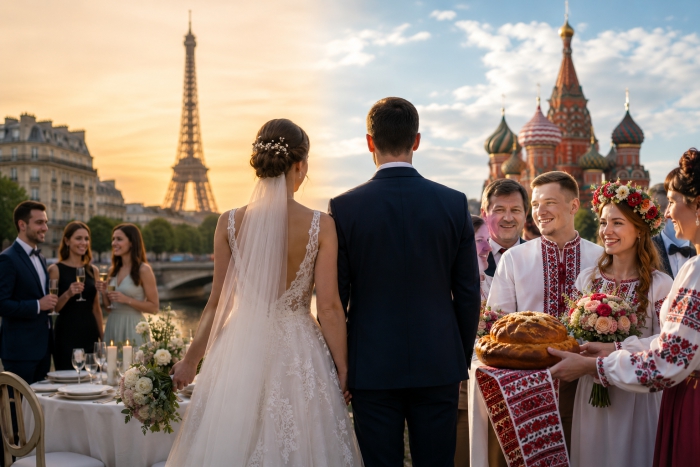
The difference isn't only in the numbers, it also touches the role of the extended family. In Canada and the US, young couples today largely build their lives independently of their respective families. In Russia and Ukraine, the involvement of the in-laws stays much stronger: the mother-in-law, called svekrov on the husband's side or tyoshcha on the wife's side, often plays a central role, and family approval, without being an absolute veto, genuinely matters in the choice of a partner. The ceremonies themselves stay rich in family symbolism: the karavai, a large round bread shared by the couple, where whoever tears off the bigger piece symbolically becomes head of the household, or the role of the tamada, the master of ceremonies who leads the toasts and keeps the evening's energy alive. A North American man who takes the time to genuinely engage with his partner's family earns, by our experience, considerable respect.
What the Psychology of Marital Choice Reveals, East vs. West
We often observe that modern North American marriage follows a logic of personal achievement, you marry once you feel "ready," after stabilizing your career and independence. Slavic marriage follows more of a shared-life-project logic, built early and carried collectively by both families. Neither logic is objectively better, but they produce very different expectations in a future spouse, and ignoring that difference is one of the leading sources of friction in a cross-cultural couple.
The Most Common Mistakes North American Men Make on This Topic
- Reading a Russian or Ukrainian woman's desire to marry quickly as rushed or impulsive: it's simply the cultural norm back home.
- Underestimating how much the in-laws' approval matters, especially the mother's.
- Assuming a cheaper wedding means a less serious commitment: it's the opposite, money spent has never measured the sincerity of a union.
- Projecting the North American late-marriage timeline onto a future wife who grew up with a completely different family timeline.
Two Real Stories From the Agency
James, from Toronto, waited twelve years before marrying his first Canadian partner, "until everything was stable." He was surprised to learn his future Ukrainian wife had always seen marriage as a natural step to build together from the start, without waiting for career perfection.
Robert, from Chicago, planned a quiet, low-key wedding. He was moved to discover his Russian girlfriend's mother had personally baked the traditional karavai, and that the entire extended family had mobilized for weeks ahead of the ceremony.
Comparison Table: Marriage in Canada, the US, Russia, and Ukraine
| Criteria | Canada | United States | Russia | Ukraine |
|---|---|---|---|---|
| Marriage rate trend | 8.8 (1970) to under 4 (2019) | 92.3 (1920 refined) to 31.5 (2024) | Declining, but higher | Declining, but higher |
| Average age at 1st marriage (women) | ≈ 30-35 | ≈ 28-30 | ≈ 22-25 | ≈ 22-25 |
| Average wedding cost | $30,000-$39,000 CAD | $32,899 USD | ≈ 5,000 € | ≈ 4,500 € |
| Role of the in-laws | Limited, couple autonomy | Limited, couple autonomy | Strong, approval valued | Strong, approval valued |
| Alternative to marriage | Common-law widespread | Cohabitation rising | Marginal | Marginal |
Frequently Asked Questions
Why do Russian and Ukrainian women marry younger than in Canada or the US?
Family social pressure, a different life timeline, and the absence of an alternative to marriage as widespread as cohabitation all contribute to this gap. It's not a lack of reflection, just a different cultural norm.
Is feminism responsible for the decline of marriage in North America?
Family sociology identifies women's growing financial and educational independence as one of the main drivers of the second demographic transition, alongside individualism and the rise of cohabitation. It's one documented factor among several, not a single explanation.
Should I budget more for a wedding if my wife is Ukrainian and the ceremony takes place in Ukraine?
No, generally the opposite: a complete wedding in Ukraine averages around 4,500 euros compared to over $32,000 in the US, while keeping rich, memorable traditions.
Should I expect heavy involvement from the in-laws in planning the wedding?
Yes, that's very common in Russia and Ukraine. The bride's mother in particular often plays a central role, and her involvement should be seen as an honor rather than an intrusion.
Our Take at CQMI
This sociological trilogy, from divorce to raising children to marriage itself, points to the same conclusion: two profoundly different visions of the couple, both legitimate within their own context. At the international matchmaking agency CQMI, we've helped serious men across Canada and the United States meet verified profiles of Russian and Ukrainian women since 2014, with more than 350 successful marriages to date. Understanding these differences before committing, rather than discovering them mid-conflict, is often what separates a lasting union from one that unravels over avoidable cultural misunderstandings. And let's say it one more time: these women are looking for marriage, a real and lasting union, not a fling. If that's not your plan, please don't reach out.
Our $350 CAD monthly subscription gives you access to 10 verified contacts of women genuinely motivated to build a lasting family. Take a look at our process and subscription options.
Questions? Write to us directly at This email address is being protected from spambots. You need JavaScript enabled to view it..
To complete this trilogy, read our article on why Russian and Ukrainian women divorce or our comparison of the difference between a Russian woman and a Ukrainian woman.
Latest from Antoine Monnier
- Raising Kids: Canada, the US, Russia, and Ukraine Do It Differently
- Divorce in Russia, Ukraine, Canada and the US: What the Sociology Shows
- Ukrainian Woman Asks You for Money: Scam or Sincere?
- Ukrainian Refugee Women: Why Their Host Country Changes Everything
- Ukrainian or Russian Woman: 7 Signs She Is Truly Single and Serious About Marriage

 +1 514 794-5053