



Ukrainian and Russian Bride dating advices - CQMI blog

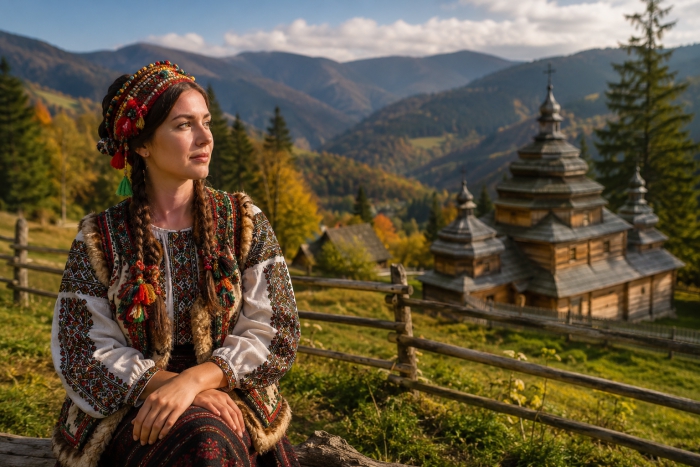 Hutsul Women of the Ukrainian Carpathians
Agence CQMI
Hutsul Women of the Ukrainian Carpathians
Agence CQMI
Hutsul Women of the Ukrainian Carpathians: 9 Myths Debunked
Quick answer: a Hutsul woman is neither a generic "Ukrainian woman" nor a folklore postcard. She comes from the Carpathian Mountains, in the far west of Ukraine, mainly from the Ivano-Frankivsk, Chernivtsi and Zakarpattia regions. She belongs to a highland ethnographic group that has preserved, in relative isolation for centuries, some of the richest embroidered folk costumes in Europe, its own dialect, its own healers called molfars, and a wooden church architecture now listed as UNESCO World Heritage. If you are only looking for a one-night stand, please look elsewhere: a Hutsul woman, like the vast majority of Ukrainian women we work with, is not looking for a fling but for marriage and a lifelong union.
Article by Antoine Monnier, director and founder of CQMI International Matchmaking Agency, specialist in serious relationships between Western men and women from Russia, Eastern Europe, the Caucasus and Central Asia since 2014.
The people who lived apart from the rest of Ukraine
A few months ago, I published an article on Altaian women from the mountains of southern Siberia, a highland people shaped by isolation and a strong sense of identity. My wife Boryslava, Ukrainian co-founder of CQMI, who is herself originally from the Carpathian region of western Ukraine, made a comment that stuck with me: "Antoine, you write about mountain women from the Caucasus and Siberia, but you have never written about the mountain women of my own country." She was right. Because if there is one Ukrainian population distinctive enough to deserve its own article, far from the usual clichés about Ukrainian women, it is the Hutsuls of the Carpathians.
The Hutsuls ("Гуцули" in Ukrainian) are an ethnographic group of highlanders who have lived for centuries in the south-eastern Carpathians, mainly across the Ivano-Frankivsk, Chernivtsi and Zakarpattia regions. Their exact origin is still debated among ethnographers: some see them as direct descendants of ancient tribes settled in the Carpathians, others believe they descend from Slavs who fled into the mountains during the 13th-century Mongol invasions, and a third school sees a mix with Romanian and Hungarian populations. Even the etymology of the word "Hutsul" has divided linguists for over a century: some trace it to a word for "nomad," others to a Turkic origin linked to the Cumans or Pechenegs, others still to a 9th-century Moravian prince. What ten years of matchmaking experience have taught us, Boryslava and I: the exact origin matters less than the fact that this people built, in the relative isolation of its valleys, a cultural identity of rare richness — and a Hutsul woman is proudly its heir.
Did you know? In 2013, UNESCO inscribed sixteen wooden churches of the Carpathians on its World Heritage List, several of them built in Hutsul style, notably at Nyzhniy Verbizh and Yasynia in the Ivano-Frankivsk region — log-built structures with a tripartite plan echoing the three peaks of a mountain ridge.
Myth #1 — "Hutsul is just another word for Ukrainian, there's no real difference"
This is false, and actually the opposite is true. A Hutsul woman belongs to a clearly identified ethnographic group within Ukraine, alongside the neighbouring Boykos and Lemkos of the western Carpathians. The Hutsul way of life has historically had little in common with that of the Ukrainian lowland majority: its own dialect, its own costume, its own music, its own architecture. A German researcher who spent years documenting this culture put it well: Hutsul life is so shaped by tradition that a local resident once described their whole life as simply "a tradition." Of course, a Hutsul woman today speaks standard Ukrainian in the city, in Ivano-Frankivsk or Kolomyia, but the Hutsul identity remains a strong cultural marker, passed down through generations.
Verdict: FALSE. A Hutsul woman is Ukrainian, but she belongs to an ethnographic group as distinct within Ukraine as, say, a Basque woman is from an Alsatian woman within France.
Myth #2 — "Traditional costumes are dead folklore, only seen in museums now"
This is largely false in the Hutsul region, and it is exactly what surprises our clients most when they travel to Ivano-Frankivsk. The Hutsul costume remains worn at weddings, religious feasts and major family events. It is one of the richest folk costume ensembles in Europe: the embroidered shirt with geometric motifs, often centred on the rhombus, a solar symbol; the keptar, a reversed sheepskin vest, richly ornamented; the zapaska, a woven wool apron; postoly, leather shoes with distinctive lacing; and an abundance of colourful beaded jewellery. For women, the headwear indicates marital status: unmarried girls wear their hair uncovered, braided with coloured wool threads, while married women cover their heads with a kerchief or a woven headdress called a peremitka. Every embroidery pattern carries meaning: the tree of life, the starry sky, the Carpathian sun. A Hutsul embroiderer passes her craft from mother to daughter across generations, often singing while she works, by firelight in the evening.
Verdict: FALSE. The Hutsul costume is not extinct folklore: it is still worn, embroidered and passed down alive, especially at weddings, which remain a central event of Hutsul culture.
Myth #3 — "Molfars are just legends from old Soviet films"
This deserves a serious, nuanced answer, because the subject is genuine even though it has been heavily romanticised. The molfar is a traditional Hutsul figure: a healer, seer and magician believed to hold supernatural powers linked to nature, heir to a syncretism between pre-Christian beliefs and Christian Orthodox or Greek Catholic practice. This tradition gained huge visibility thanks to Mykhailo Kotsiubynsky's 1911 novel "Shadows of Forgotten Ancestors," later adapted into a 1964 film by Sergei Parajanov — initially censored by Soviet authorities before becoming an internationally acclaimed classic. The last widely recognised molfar, Mykhailo Nechay, was murdered in 2011; since then, the tradition has largely faded from public life, although the village of Verkhovyna, considered the cultural centre of the Hutsul region, still hosts a museum entirely dedicated to this Carpathian magic. What we observe at CQMI: a Hutsul woman today obviously does not consult a molfar in daily life, but she grows up with a rich family folklore of superstitions, stories and respect for nature that quietly shapes her sensibility.
Verdict: MIXED. Molfars genuinely existed and still exist in marginal cases, but the figure has also been heavily popularised and amplified by 20th-century literature and cinema.
Myth #4 — "These women live completely cut off from the world, with no real outlook"
This is a caricature that does not survive contact with 2026 reality. It is true that geographic isolation shaped Carpathian history for a long time, and some mountain villages remain hard to reach in winter. But young Hutsul women today study and work in large numbers in Ivano-Frankivsk, in Lviv, and sometimes abroad, while keeping a strong bond with their home region, to which they return for holidays and weddings. A researcher specialised in the region confirms this: young Hutsuls today look toward the West while remaining fiercely proud of their cultural identity. This dual belonging — urban modernity and proudly claimed mountain roots — is precisely what makes a Hutsul woman so distinctive in the landscape of international dating.
Verdict: FALSE. Geographic isolation shaped Hutsul history, but it no longer describes the daily life of most women from this region today, who are fully connected to modern Ukrainian life.
Myth #5 — "A Hutsul wedding is exactly like any standard Ukrainian wedding"
No, and this is one of the most fascinating aspects of this culture. The traditional Hutsul wedding, still practised in its full form in some villages today, remains ceremonially rich: the bride and groom are called "prince" and "princess" for the day, crowned with headdresses adorned with ribbons and sometimes feathers. A decorated pine tree is planted near the house and stays there until its needles fall naturally. Guests sometimes arrive on horseback, in procession, wearing embroidered costumes specific to their home village, each region having its own patterns. Under her embroidered blouse, the bride traditionally wears a woven red sash believed to protect her. During matchmaking, the young woman offers the groom's emissaries hand-embroidered towels — a gesture that, by tradition, seals the families' agreement. The wedding usually takes place in spring, before Lent, respecting the Orthodox or Greek Catholic calendar. A Hutsul woman today will not necessarily experience the full ceremony, but the idea that marriage is a sacred commitment, prepared and carried by the family, remains deeply rooted.
Verdict: TRUE. The Hutsul wedding has its own ritual codes, far more elaborate and symbolic than the average contemporary Ukrainian wedding.
Myth #6 — "Hutsuls are Muslim or animist, this isn't really a Christian culture"
This is false. Hutsuls are Christian, overwhelmingly Greek Catholic or Ukrainian Orthodox, like the rest of western Ukraine. What sets their practice apart is the coexistence, still noticeable today in the most remote villages, between this Christianity and pre-Christian beliefs rooted in an ancient relationship with nature and the forest: fear of evil spirits, storm-related superstitions, protective wedding rituals. This is precisely the syncretism that gave rise to the molfar figure discussed above. Hutsul religious architecture is a strong symbol of this: the tripartite wooden churches, now on the UNESCO World Heritage List, visually embody the Holy Trinity while fitting naturally into the Carpathian mountain landscape.
Verdict: FALSE. Hutsuls are Christian, either Orthodox or Greek Catholic; only certain pre-Christian folk superstitions have survived on the margins of that religious practice.
Myth #7 — "A Hutsul woman is necessarily a peasant, with no education"
This is a common confusion between rural origin and level of education. A Hutsul woman in 2026 can very well hold a degree from Ivano-Frankivsk, work in tourism, teaching or business, while remaining deeply attached to her home region. Tourism in the Carpathians, especially around Verkhovyna, Vorokhta and the Bukovel ski resort, has actually created many skilled jobs that keep part of the local youth in the region, unlike the rural exodus seen elsewhere in Ukraine. Hutsul folklore has even become an openly embraced tourism asset, which has reinforced rather than weakened the identity pride of younger generations.
Verdict: FALSE. Mountain origin has nothing to do with education level; many Hutsul women today are highly educated and professionally active, while still cultivating their regional heritage.
Myth #8 — "Hutsul folklore is nice, but nothing special compared to the rest of Ukraine"
This underestimates a very real international recognition. Beyond the wooden churches listed by UNESCO in 2013, Kosiv ceramics, produced in the Hutsul region and known for its colourful patterns in green, yellow and brown, also appears on UNESCO's Intangible Cultural Heritage list. The trembita, a long spruce-wood horn that can reach several metres, used for signalling between shepherds, at weddings and at funerals, is a musical symbol that has travelled well beyond Ukraine's borders. The folklore of Dovbush, the 18th-century Hutsul outlaw who robbed Polish nobles to redistribute to the poor — often compared to England's Robin Hood — remains a popular folk hero whose memory lives on through hiking trails, rock formations and even films, including a recent 2023 adaptation. Few Ukrainian regions can claim such a documented and internationally recognised cultural ecosystem.
Verdict: FALSE. Hutsul folklore enjoys rare international heritage recognition, making it far more than a simple regional quirk.
Myth #9 — "A woman from the Carpathians will never adapt to urban life in Canada, the UK, the US or Australia"
I answer this with the same honesty we apply to every nationality we work with at CQMI: cultural differences exist, but in our experience they are never the real obstacle to a couple's success. What ten years of matchmaking experience have shown us, Boryslava and I: couples who fail almost never stumble over folklore or geographic origin. They stumble over the man's lack of genuine curiosity about what matters to her. A Hutsul woman who grew up between mountain tradition and modernity generally adapts very well to a new country, provided her partner shows a real — not performed — interest in her family and regional history.
Verdict: MIXED. Differences exist but are manageable; they only become a real obstacle for a man who refuses to take a genuine interest.
What we often observe among our members from the Carpathians
In our experience, after more than ten years at CQMI International Matchmaking Agency, we find that a woman from the Carpathians often approaches relationships with a mix of mountain pragmatism and a very strong attachment to the extended family. We often observe that these women, used since childhood to a harder way of life than in Ukraine's big cities, particularly value stability, reliability and a man's ability to "keep his word" — a direct legacy of a culture where a spoken promise, in mountain villages, long carried more weight than a written document. The main success factor with a Hutsul woman, as with any Ukrainian woman, is never to flatter regional folklore, but to show genuine interest in the person and her family.
The CQMI method for approaching a Hutsul woman
- Learn about the Ukrainian Carpathians specifically, not just Ukraine in general. Knowing that Ivano-Frankivsk and Verkhovyna are her geographic reference points, rather than reducing everything to Kyiv, shows genuine interest.
- Never reduce her identity to tourist folklore. Molfars and embroidered costumes are fascinating, but an isolated compliment about this folklore, without interest in her actual life, rings hollow.
- Value the extended family. For a woman from the Carpathians, the bond with parents and grandparents is often stronger than in the city.
- Show your seriousness from the start. As with all our Ukrainian members, a relationship treated as a casual fling will be dismissed immediately.
- Go through a serious matchmaking agency. Women from mountain regions, less frequently approached than those in big cities, deserve rigorous, verified support.
The 5 mistakes men make with Hutsul women
- Confusing folklore with real identity. Gushing only over costumes or molfar legends without ever showing interest in her actual life comes across as superficial.
- Ignoring the weight of the extended family. Underestimating the opinion of parents or grandparents can cause lasting offence, even with a woman who lives in the city.
- Equating a mountain region with a lack of education. This is a common and hurtful misjudgement.
- Rushing without clarifying your intentions. As with all Ukrainian women we work with, ambiguity about the seriousness of the relationship is the number one cause of failure from the very first exchanges.
- Skipping proper travel logistics. Ivano-Frankivsk is easily reached by train from Lviv (roughly 2 hours), but improvising a trip without planning is a frequent source of disappointment.
Two stories from the field
Robert's geography lesson. Robert, our client from Edinburgh, thought he knew Ukraine well after several trips to Kyiv. During a video call, his match explained, with quiet pride, that she came from a village near Verkhovyna where her grandmother still embroiders her own shirts by hand. "Antoine," he told me, "I discovered there was an entire Ukraine I never knew existed, just a couple of hours by train from Lviv."
James and the costume photo. James, our client from Toronto, saw a photo of an embroidered Hutsul costume on his member's profile and clumsily wrote: "Is that a traditional costume, like a costume-party outfit?" She replied, with humour: "It's not a costume, my grandmother embroidered it for my wedding." James had the good sense to laugh at his own mistake and ask genuine questions about the embroidery. He credits that exchange with changing the whole tone of their conversation.
Hutsul woman, urban Ukrainian woman, Russian woman: the real differences
| Criterion | Hutsul woman (Carpathians) | Urban Ukrainian woman (Kyiv, Kharkiv) | Russian woman (European Russia) |
|---|---|---|---|
| Geographic origin | Carpathians: Ivano-Frankivsk, Chernivtsi, Zakarpattia | Major lowland cities | Varies by region |
| Religion | Greek Catholic or Ukrainian Orthodox | Ukrainian Orthodox, variable practice | Russian Orthodox |
| Relationship to folklore | Costume, embroidery and music alive, passed down in the family | Folklore mostly festive, less part of daily life | Varies by region |
| Cultural symbol | Molfars, trembita, UNESCO-listed wooden churches | Borsch, national vyshyvanka | Varies by region |
| Relationship to family | Very present extended family, village heritage | Nuclear family often more independent | Varies by region |
| Travel logistics | Ivano-Frankivsk: direct train from Lviv (~2h) | Kyiv, Lviv: direct access | Depends on the city |
Frequently asked questions about Hutsul women
Does a Hutsul woman speak a different language from Ukrainian?
She speaks standard Ukrainian daily, but often grows up with the Hutsul dialect of her region and an oral familiarity with certain local expressions specific to the Carpathians.
Do I need to travel to Ivano-Frankivsk to meet a Hutsul woman?
Not necessarily, since many live or study in Lviv or other major cities, but Ivano-Frankivsk, about 2 hours by train from Lviv, remains the natural gateway to this region.
Are Hutsul women very different from other western Ukrainian women?
Culturally, yes: distinct costume, music and architecture. On the fundamentals of couple values, they share the common foundation of Ukrainian women: loyalty, family focus, and a desire for a serious commitment.
Is an age gap an issue with a woman from the Carpathians?
As with all our Ukrainian members, a gap of 5 to 10 years is the optimal success zone, with a reasonable maximum of 15 years.
Is the Carpathian region safe for a matchmaking trip?
The Ivano-Frankivsk region is in western Ukraine, far from conflict zones. We always recommend being guided by a serious agency to organise your visit under the best conditions.
What you really need to understand about Hutsul women
A Hutsul woman is not simply a regional variant of the Ukrainian woman: she carries the legacy of a mountain people that preserved, in the relative isolation of the Carpathians, a living heritage recognised as far as UNESCO — embroidered costumes, music, architecture, legends. What the experience of CQMI International Matchmaking Agency confirms, after more than 350 successful marriages since 2014:
- Her regional identity, however rich, should never become a mere object of folkloric curiosity.
- Her bond with the extended family is often stronger than in the city; it deserves respect, not workarounds.
- Like the vast majority of Ukrainian women, she is looking for a serious marriage, not a fling.
If you are a serious man — in Canada, the UK, the US or Australia — looking to build a real life project with a verified Ukrainian woman, including one from the Carpathians, our overview of Russian and Ukrainian women registered with CQMI is the best starting point, along with our article on the subtle difference between a Russian woman and a Ukrainian woman to better understand the full Slavic mosaic we represent.
Ready to meet a serious Ukrainian woman?
CQMI Agency has been operating since 2014. Our membership — $350 CAD/month — gives you access to 10 verified contacts of women genuinely motivated to build a lasting relationship. More than 40% of female applications are rejected during our screening process.
350+ successful marriages · Divorce rate < 7% · 1,750 verified members · No chatbots, no ghost translators
Questions? Write directly to Antoine: This email address is being protected from spambots. You need JavaScript enabled to view it.
Further reading
Latest from Antoine Monnier
- Turkmen Women: 9 Myths Debunked — What You Never Knew About Women from Turkmenistan
- Kabardino-Balkarian Women: Two Peoples, One Republic in the Caucasus
- Albanian Women: 9 Myths Debunked About the Balkans' Only Non-Slavic People
- Macedonian Women: The Overlooked Balkan Charm Between Slavic and Mediterranean
- Azerbaijani Women from the South Caucasus: 9 Myths Debunked

 +1 514 794-5053