


Ukrainian and Russian Bride dating advices - CQMI blog

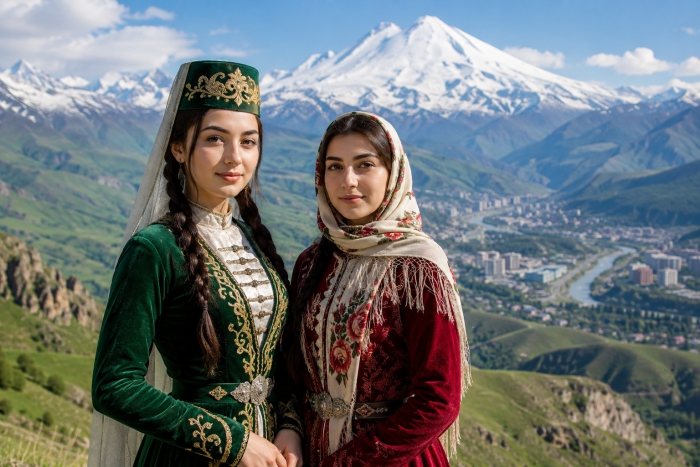 Kabardino-Balkarian Women
Agence CQMI
Kabardino-Balkarian Women
Agence CQMI
Kabardino-Balkarian Women: Two Peoples, One Republic in the Caucasus
Dear Friend,
A few months ago, one of our members, Robert, in his fifties, a former amateur mountaineer, wrote to me after seeing photos of Mount Elbrus on a travel forum: "Antoine, I found a member who comes from a republic I had never even heard of — Kabardino-Balkaria. Is that just one more Caucasus ethnicity in your agency, or is there a real difference from the Chechen and Dagestani women you've already written about?" Based on our experience, after years in the matchmaking business, I can tell you this question comes up almost every time we introduce a new nationality — and here, the answer is particularly interesting, because this Republic is not home to a single people, but to two, who share neither the same language, nor the same origin, nor the same history.
1. Is "Kabardino-Balkarian" a single ethnicity? No — two distinct peoples
The most common mistake is assuming the Republic's compound name refers to a single ethnic group. In reality, Kabardino-Balkaria takes its name from two separate titular peoples. Kabardians make up roughly 57% of the population: they belong to the wider Circassian (Adyghe) family, much like the Adyghean women we introduced recently, and speak Kabardian, a Northwest Caucasian language with no relation to Russian whatsoever. Balkars, meanwhile, represent only about 14% of the population: they are Turkic-speakers, close cousins of the Karachays, whose language belongs to the Kipchak group — the same family as Crimean Tatar or Bashkir. Two languages, two origins, one Republic: that's the first thing to understand before writing to a member from this region.
2. Is a Kabardian woman basically the same as a Circassian woman from Adyghea?
Almost, but not quite. Kabardians are indeed a branch of the broader Circassian world, like the Adyghean women we covered in our previous article on Circassian women. They share the same ancestral code of honour, the Xabze, which governs politeness, respect for elders, and hospitality. But centuries of geography have set them apart: Kabardians settled further east, at the foot of Mount Elbrus, and developed their own dialect, their own local traditions, and a strong regional identity distinct from their Adyghean cousins.
3. Are Balkars just "mountain Tatars"?
No, and this loose approximation genuinely bothers the women concerned. Balkars form a fully distinct Turkic mountain people, with a tragic history little known in the West: in 1944, Stalin accused the entire Balkar people of collaborating with Nazi Germany and ordered their mass deportation to Central Asia — exactly what happened to the Chechen women we've written about before. Their territory was then renamed the Kabardin ASSR, and it wasn't until 1957 that Balkars were rehabilitated and allowed to return home. A Balkar woman often carries, quietly, the memory of this family ordeal.
4. Muslim, therefore submissive and reserved? The most persistent cliche
This is probably the misconception that comes up most often in our conversations with Western men. The reality is very different: Kabardino-Balkaria went through seven decades of enforced Soviet secularism, and local Sunni Islam is largely lived as a moderate, cultural practice rather than a strict one. Women in Nalchik, the capital, attend university, hold responsible positions, drive, travel, and choose their own relationships freely. We often observe that Western men are the ones most surprised by their confidence and independence of character.
5. A "mountain girl" bound to be simple and unsophisticated?
Another misleading shortcut. Nalchik is a lively university city, home to a state university well regarded across the Russian North Caucasus. The members from this region we support are generally educated, urban, perfectly comfortable with contemporary life — while remaining deeply attached to their family and their mountain roots.
6. Does the family decide the marriage, with no say for her?
Family influence remains real in this region, more so than in a typical Russian city: parental blessing matters, and ignoring that would be careless. But this absolutely does not mean an arranged or imposed marriage. As always, the key factor is your own seriousness: a Kabardian or Balkar family that senses honest matrimonial intentions from a Western man generally becomes a valuable ally rather than an obstacle.
7. Should you expect a dowry or an outrageous "bride price"?
No, this is a myth we regularly have to debunk, including with our members from the neighbouring Republic of Dagestan. Some families keep a symbolic ritual of gifts to the bride's family during traditional engagements, but this is in no way a commercial transaction, and the vast majority of women registered with the agency want above all to remain financially independent in their future household.
8. Is she automatically descended from warrior horsemen?
A small, funny story on this exact point: one of our clients, fascinated by the legendary Kabardin horse breed — capable of covering 80 km a day through the mountains — asked his correspondent whether she rode "like her ancestors." She replied, laughing hysterically, that she had only ridden a horse once, on a tourist outing, and much preferred her Lada. Caucasus folklore is fascinating, but the daily life of a software developer from Nalchik in 2026 has little to do with the steppes of old.
9. Is it impossible to communicate without speaking Kabardian or Balkar?
Not at all. Russian remains the common language, fully mastered by every generation educated since Soviet times. Our translation assistants handle the entirety of the correspondence, and, as always, a few words of Russian sprinkled into a message remain a nice, appreciated touch — never an obligation.
What we really observe at the agency
The most striking psychological trait among women from this dual Republic is the natural coexistence of two loyalties: a deep attachment to their community of origin (Kabardian or Balkar) and a fully embraced Russian-speaking identity. For a Western man, the real challenge is therefore not to choose "which culture" to favour, but to understand that this dual belonging is a richness, not a contradiction to resolve. Here's an anecdote to illustrate this with a smile: one of our coordinators recalls a Kabardian member invited to her best friend's Balkar wedding who had to learn three different dances in a single evening "so as not to offend anyone" — a sign that, despite their differences, the two peoples generally coexist warmly in this region.
The practical method for approaching a woman from this region
- First find out her precise background — Kabardian or Balkar — before using a generic term that might come across as careless.
- Show genuine interest in local history (Mount Elbrus, Nalchik, the university) rather than folkloric cliches.
- Never bring up the 1944 deportation first — let her raise this family topic herself if she wishes to.
- Ask about her current life, studies, or career: this is what she will value most quickly.
- Stay patient with the pace of correspondence: trust builds gradually, as with any serious member of the agency.
Mistakes you should never make
- Systematically confusing Kabardian and Balkar, or worse, simply calling her "Russian" with no nuance.
- Assuming she wears a veil or needs family permission to talk with you.
- Making remarks about an alleged "bride price" in the first exchanges.
- Reducing her identity to images of horsemen or Caucasus warriors.
- Underestimating how important family remains in her life, even when she is fully independent.
Kabardino-Balkaria compared to neighbouring North Caucasus republics
| Criterion | Kabardino-Balkaria | North Ossetia | Dagestan |
|---|---|---|---|
| Titular peoples | Kabardians (Circassian) and Balkars (Turkic) | Ossetians (Iranian) | About thirty distinct peoples |
| Majority religion | Sunni Islam | Orthodox Christianity | Sunni Islam |
| Common language | Russian | Russian | Russian |
| Capital | Nalchik | Vladikavkaz | Makhachkala |
| Distinct feature | Mount Elbrus, Kabardin horse | Only Orthodox republic in the North Caucasus | Record ethnolinguistic diversity |
Frequently Asked Questions
Do a Kabardian woman and a Balkar woman share the same culture?
They share the same Republic and the same Russian-speaking daily life, but their roots, languages, and some family traditions differ clearly. It is best never to assume that one is the same as the other.
Do Kabardino-Balkarian women speak English or French?
Rarely fluently, but this is not an obstacle: CQMI international matchmaking agency provides translation assistants to support the entire correspondence, all the way up to your first in-person meeting.
Should I expect strong family influence in the relationship?
Family really does matter in this region, but a serious man who is transparent about his intentions is generally welcomed rather than blocked.
Is there a higher scam risk with this nationality?
No, the risk does not depend on nationality but on the seriousness of the approach and the platform used. CQMI Agency applies the same strict verification to every member, regardless of origin.
How many marriages has CQMI Agency celebrated with women from the North Caucasus?
CQMI Agency has supported over 350 mixed marriages since its founding in 2014, with a divorce rate below 7%, across all regions including the North Caucasus.
The formula that truly makes the difference
At CQMI Agency, we don't hand you hundreds of profiles to scroll through endlessly. Our subscription — 350 CAD for 1 month — gives you access to 10 contacts of members who are genuinely interested in a serious relationship, whether Kabardian, Balkar, or from any other region we cover. It's this human selection process, not an algorithm, that has made our difference since 2014. Discover our process and subscription options here.
To conclude: Kabardino-Balkaria is not "just another Caucasus ethnicity" to tick off a list. It is a two-faced Republic, Kabardian and Balkar, whose women combine mountain pride with full Russian-speaking modernity. Let's be clear about one thing: these members are not looking for a one-night fling but for a marriage and a lifelong commitment — if you are not serious in your approach, please refrain. For men ready to commit sincerely, our CQMI international matchmaking agency is here to help you meet our verified members. Questions? Write to us directly at This email address is being protected from spambots. You need JavaScript enabled to view it..
Latest from Antoine Monnier
- Albanian Women: 9 Myths Debunked About the Balkans' Only Non-Slavic People
- Macedonian Women: The Overlooked Balkan Charm Between Slavic and Mediterranean
- Azerbaijani Women from the South Caucasus: 9 Myths Debunked
- Armenian Women From the South Caucasus: 9 Myths Debunked
- Chuvash Women of Chuvashia: 9 Myths Debunked

 +1 514 794-5053