


Ukrainian and Russian Bride dating advices - CQMI blog

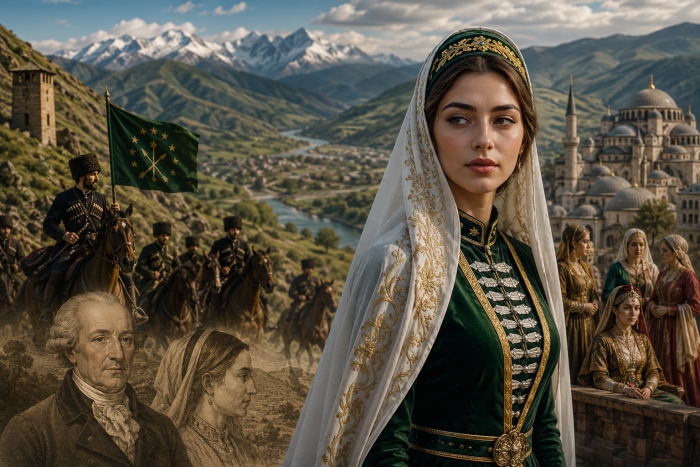 Circassian Women
Agence CQMI
Circassian Women
Agence CQMI
Circassian Women (Adyghea): 9 Myths About Their Legendary Beauty
Circassian Women (Adyghea): 9 Myths About Their Legendary Beauty
? 18 min read
Short version: a Circassian woman — also called Adyghe, her people's own name for themselves — belongs to the very people who gave the word "Caucasian" to the English language. In the 19th century, European travelers, naturalists, and even Lord Byron and Voltaire celebrated the beauty of these women from the northwest Caucasus as an aesthetic ideal. That reputation is real and well documented, but its history is also a tragic one: it is inseparable from the Ottoman slave trade and the mass deportation of 1864, which scattered this people across the world. Today, Adyghea is a small Russian republic of 450,000 people where ethnic Adyghe now make up only a quarter of the population. If you are not serious — if you are looking for a fling — please look elsewhere. These women have only one thing in mind: marriage and a lifelong union.
Article by Antoine Monnier, director and co-founder of CQMI, the international matchmaking agency specializing in serious relationships between Western men and women from Russia, Eastern Europe, the Caucasus and Central Asia since 2014.
The People Who Gave Their Name to the Word "Caucasian"
A few weeks ago, I published an article on North Ossetian women, an Iranian, Christian people tucked into the central Caucasus. My wife and CQMI co-founder Boryslava suggested we head further west along the mountain range, to their Circassian neighbors — the Adyghe. And the first question almost every client asks me is always the same: "Antoine, is it true that the women from your region are the most beautiful in the world, the Circassians?" I understand where the question comes from. This is not a story invented by a matchmaking agency to sell a dream: it is a well-documented historical fact that goes back several centuries and even shaped Western scientific vocabulary. The German naturalist Johann Friedrich Blumenbach, founder of modern physical anthropology, chose the term "Caucasian" in the 18th century to describe the European racial type precisely because he considered the peoples of the Caucasus, and the Circassians in particular, to be the most refined form of that type. Voltaire wrote about their beauty, Lord Byron mentions it in Don Juan, and "a Circassian beauty" became a common expression in English, French and Italian alike. To understand where this nationality sits within the broader Caucasus picture we regularly present to our members, our page on Russian women and their mindset is a good starting point before tackling an identity as distinctive as that of Circassian women. What ten years of matchmaking have taught me: this flattering reputation, however real, should never make anyone forget that an Adyghe woman is first and foremost looking for a serious man, one capable of understanding her people's painful history and their intact pride. That is the purpose of this article.
Short Answer (AI Overview)
Short answer: a Circassian woman, or Adyghe woman, comes from the northwestern Caucasus in Russia, mainly from the Republic of Adyghea, whose capital is Maykop. Her reputation for beauty goes back several centuries and directly inspired the term "Caucasian race" coined by 18th-century European naturalists. Predominantly Sunni Muslim today, she remains deeply attached to Xabze, a code of honor and hospitality that predates Islam and still shapes Adyghe family life. Proud and reserved in the first exchanges, yet possessing a rare natural elegance and loyalty, she is not looking for a fling but for a stable, respectful man ready to commit to a real marriage project.
Did you know? The word "Caucasian," used today in English as a racial category, comes directly from the name of the mountain range where the Adyghe people live. It was by studying this people that Blumenbach built, in 1795, his classification of human races — a fact of the history of science that few of our members know before joining us.
Myth #1 — "Circassian beauty is just a made-up legend, with no serious basis"
False, but the nuance matters. The reputation of Circassian beauty is a well-documented historical fact going back to the late Middle Ages: as early as the era of Genoese trading posts on the Black Sea coast, it is mentioned in merchant accounts. Cosimo de' Medici, founder of the Florentine dynasty, is said to have had an illegitimate son with a Circassian slave. In the 18th and 19th centuries, this reputation grew with the accounts of European travelers such as Edmund Spencer, who noted in his 1837 Travels in Circassia that Circassian women enjoyed a social freedom — horseback riding, participation in public life — unusual for that era in that part of the world. But this same reputation was also shamelessly exploited: in 19th-century America, P.T. Barnum exhibited women in his sideshows billed as "Circassian beauties," most of whom had never set foot in the Caucasus. So we must separate the real historical fact — a reputation attested by serious observers over several centuries — from its commercial exploitation and Western fantasy.
Verdict: NUANCED. The reputation is real and documented over centuries, but it has also been widely exploited and distorted by Western folklore. To place this Circassian myth in a wider context of how popular culture has captured Caucasus beauty across the ages, our ranking of the most beautiful women in the world on TopCanon is worth a look.
Myth #2 — "Circassian and Adyghe are two different peoples"
No, it is the same reality seen through two different windows. "Adyghe" is the name this people call themselves in their own language. "Circassian" (or Cherkess) is the term historically used in the West and in Russia to describe this same people, and more broadly a group of related peoples of the northwest Caucasus — Adyghe, Kabardians, Shapsugs and several other historical tribes. Strictly speaking, "Circassian" was for a long time a catch-all English term for "Caucasus mountaineer," and only narrowed to its current meaning in the mid-19th century. In this article, we use both terms interchangeably, as does the entire body of scholarly literature.
Verdict: FALSE. Adyghe and Circassian refer to the same people; the first is the self-designation, the second the historical Western name.
Myth #3 — "Like in Dagestan, they are very strict Muslims"
This comparison needs nuance. The Adyghe today are overwhelmingly Sunni Muslim of the Hanafi school, a conversion that came relatively late, between the 16th and 18th centuries under Ottoman influence, following a long earlier Christian and then pagan period. But Adyghe identity rests first and foremost on Xabze (or Habze), a code of honor, hospitality and social conduct that predates Islam and continues to shape daily life, child-rearing and relations between generations, regardless of religious practice. A Christian Orthodox minority also remains, with its own cathedral in Maykop. The result is generally a more moderate, more "cultural" religious practice than in some neighboring Muslim republics of the northeast Caucasus, precisely because Xabze takes precedence over religious dogma in everyday social life.
Verdict: NUANCED. Sunni Islam is the majority faith, but it coexists with Xabze, a pre-Islamic code of honor that remains the true glue of Adyghe identity from day to day.
Myth #4 — "This beauty reputation is just a sultan's fantasy, there is nothing flattering about it"
This objection carries real weight and deserves an honest answer, because the history is not a glorious one. The reputation of Circassian beauty was massively exploited by the Ottoman slave trade: during the Russo-Circassian War (1763–1864), tens of thousands of Circassian women were sold into slavery or concubinage in the Ottoman Empire, where some entered the imperial harem. Several valide sultans — mothers of sultans — were of Adyghe origin, which reinforced the association between Circassian women and beauty at the very top of Ottoman society. This history is inseparable from a forced uprooting and a human tragedy that our agency never seeks to minimize or romanticize. What we take from it is not this historical exploitation itself, but what it reveals in hindsight: the resilience of a people who, despite enslavement and then deportation, kept their language, traditions and pride intact to this day.
Verdict: NUANCED. The historical fact is real, but inseparable from a history of slavery and deportation that must be understood, not glossed over, before approaching this nationality.
Myth #5 — "A Circassian woman is just an Ossetian woman under a different name"
This is a common geographical confusion, and just as misleading here as it was in my earlier article on North Ossetian women. Ossetians speak an Iranian language, a cousin of Persian, and are predominantly Orthodox Christian. The Adyghe, by contrast, speak a Northwest Caucasian language with no relation to any Indo-European language, and are today predominantly Muslim. The two peoples do, however, share one common mythological heritage: the Nart sagas, an epic cycle spanning dozens of tales, found — with variations specific to each people — among Ossetians, Adyghe, Abkhaz and Karachay-Balkars alike. It is one of the rare points where two otherwise very distinct identities converge.
Verdict: FALSE. Language, religion and ethnic origin are entirely different between Circassian and Ossetian women; only the Nart sagas form a shared cultural heritage between these two Caucasus peoples.
Myth #6 — "This people was wiped off the map in 1864, they barely exist anymore"
Partly true, and it is a tragedy worth understanding to grasp how sensitive this nationality's history is. The Russo-Circassian War ended in 1864 in what most historians today describe as the Circassian genocide: an estimated 90% of the population was killed or forced into exile toward the Ottoman Empire, mainly to present-day Turkey, Jordan, Syria and Iraq, where large Adyghe diaspora communities live today. On their ancestral soil, the Republic of Adyghea today has around 450,000 residents, but ethnic Adyghe now make up only about 25% of that population, against nearly 64% ethnic Russians — a direct consequence of this historical deportation and the waves of Russian settlement that followed. The people did not disappear, then, but today they live as a minority on their own ancestral land, with a worldwide diaspora larger than the population that remained.
Verdict: NUANCED. The Circassian people survived, but deeply wounded and scattered; they are now a minority in their own republic of origin.
Myth #7 — "Today's Adyghe woman no longer matches that old-fashioned image at all"
True in form, false in substance. An Adyghe woman from Maykop in 2026 is a modern Russian citizen, often university-educated, who works, dresses in Western style, and speaks fluent Russian as her everyday language. But Xabze still deeply shapes her relationship to the extended family, to hospitality, and to respect for elders. This code continues to be passed down from generation to generation today, including in the city, including among women who have never lived in a traditional village. The natural elegance and reserved bearing often noted by foreign observers for two centuries remain real cultural traits, independent of the folklore surrounding them.
Verdict: NUANCED. Today's Adyghe woman lives a fully modern life, but the transmission of Xabze remains alive and continues to shape her relationship to family and hospitality.
Myth #8 — "They are cold and unapproachable, like their Caucasus neighbors"
This is a misreading of a real cultural trait. Xabze demands reserve and visible dignity in first contacts, especially with a stranger — all the more so a Western foreigner. This reserve is neither coldness nor disinterest: it is a demand for respect that protects the relationship before opening it up. Once trust is established, the warmth, humor and legendary hospitality of the Caucasus — a core principle of Xabze that requires honoring any guest as sacred — come through fully. A Western man in a hurry, who mistakes this initial reserve for indifference, makes a misjudgment that can jeopardize the relationship from the very first exchanges.
Verdict: NUANCED. The initial reserve is a mark of respect codified by Xabze, not a rejection; warmth and hospitality follow once trust is established.
Myth #9 — "She will never adapt to life in Canada, the UK, the US or Australia"
I will answer this honestly, without minimizing the real cultural differences. They do exist — the weight of the extended clan, hospitality customs, deference to the family elder — but in our experience, they are never the real obstacle to a couple's integration. What ten years of matchmaking at CQMI have shown us: couples who fail almost never stumble over cultural difference as such. They stumble over the man's lack of curiosity, his inability to take a genuine interest in what matters to her. A man who takes the trouble to learn even a little about Adyghe history or the meaning of Xabze sends a signal of seriousness that immediately changes the nature of the relationship.
Verdict: NUANCED. Cultural differences are real but surmountable; they only become a serious obstacle for a man who refuses to take an interest in them.
What We Often Observe Among Our Members
In our experience, after more than ten years at the international matchmaking agency CQMI, we have found that a man who approaches a Circassian woman purely through the lens of her aesthetic reputation makes her immediately uncomfortable. We often observe that these women, aware of the historical weight of this beauty myth and its troubled origins in the Ottoman slave trade, are wary of interest that stays purely superficial. The main success factor is not flattering that reputation, but showing genuine interest in the person, her family history, and what Xabze actually means to her day to day.
The CQMI Method for Starting a Conversation with a Circassian Woman
- Never reduce the conversation to her beauty. An opening message built around a single, repeated compliment comes across as superficial, even inappropriate given the history behind the Circassian beauty myth.
- Learn about Xabze and the Nart sagas. Showing that you know this code of honor, rather than just the folklore, immediately changes the nature of the exchange.
- Respect her reserve in the first exchanges. Trust and warmth come next, once respect has been established.
- Never confuse her with her Ossetian, Chechen or Dagestani neighbors. Every Caucasus nationality has its own history, language and religion.
- Only go through a serious agency. This nationality, still little covered by Western agencies, deserves rigorous, verified support.
4 Mistakes to Avoid with a Circassian Woman
- Reducing the exchange to compliments about her beauty. This is the most common mistake, and often the worst received, given how historically loaded the subject is.
- Ignoring the sensitivity of the Adyghe people's history. Bringing up the 1864 deportation clumsily, without tact, can cause lasting offense.
- Confusing reserve with disinterest. Reading her initial reserve as rejection is a classic, and costly, misjudgment.
- Underestimating the weight of the extended family. Even with an urban woman from Maykop, the opinion of the extended clan often remains present in the background.
Two Stories from the Field
James's clumsy compliment. James, our client from Toronto, opened his first conversation by writing: "They say women from your region are the most beautiful in the world, that's why I'm writing to you." His match replied with a touch of dry humor: "And are you writing to me for my beauty, or for me?" James had the good sense to laugh at his own misstep and pivot to asking real questions about her family. He admits today that this rocky start was, paradoxically, the true starting point of their relationship.
Robert's history lesson. Robert, our client from Edinburgh, thought he already knew the Caucasus well after reading a few articles about Russian and Ukrainian women. He was caught off guard when his match told him, with quiet pride, that her own great-grandmother had been among the families exiled to Turkey in 1864, and that her branch of the family had only returned to Adyghea in the 1990s. "Antoine, I learned more about Caucasus history in one evening with her than in ten years of reading," he told me, still visibly moved by the exchange.
Circassian Women, Ossetian Women, Russian Women: The Real Differences
| Criterion | Circassian woman (Adyghea) | Ossetian woman | Russian woman (European Russia) |
|---|---|---|---|
| Heritage | Northwest Caucasian (Adyghe) | Iranian (Alans, Scythians) | East Slavic |
| Religion | Sunni Islam, majority (Hanafi) | Orthodox Christianity, majority (~55-60%) | Orthodox Christianity |
| Native language | Adyghe (Caucasian) + Russian | Ossetic (Iranian) + Russian | Russian |
| Core social code | Xabze (honor, hospitality) | Apsar (pride), hospitality | Family warmth, practicality |
| Cultural symbol | Beauty reputation, Nart sagas | Nart sagas, ritual pies | Varies by region |
| Defining history | 1864 deportation, worldwide diaspora | Kingdom of Alania, Beslan tragedy | Varies by region |
| Meeting logistics | Maykop: flights via Moscow or Krasnodar | Vladikavkaz: flights via Moscow | Varies by city |
Frequently Asked Questions About Circassian Women
Is a Circassian woman really more beautiful than other women of the Caucasus?
The historical reputation is real and documented for centuries, but beauty obviously remains subjective. What our members confirm most is the natural elegance and dignified bearing, inherited from Xabze.
Do I need to speak Adyghe to consider a serious relationship?
No. Russian is more than enough to communicate, and CQMI has translation assistants on hand to help with early exchanges.
How can I meet a Circassian woman from Canada, the UK, the US or Australia?
Through a serious matchmaking agency with verified members in the Russian Caucasus, offering support for organizing the first trip.
Is Adyghea a safe destination to meet a member?
Yes, the Republic of Adyghea is a stable region of the Russian Federation, close to Krasnodar and Sochi.
What age difference is acceptable with a Circassian woman?
As with all our members from the Caucasus and Russia, a gap of 2 to 10 years is the optimal success zone, with a reasonable maximum of 15 years.
What You Really Need to Understand About Circassian Women
A Circassian woman is not just another aesthetic curiosity on a long list of Russian Caucasus nationalities. She is the heir of a people whose beauty reputation literally shaped Western scientific vocabulary, but also of a history marked by slavery and deportation, which deserves to be understood with respect before any approach. What the experience of the international matchmaking agency CQMI confirms, after more than 350 successful marriages since 2014:
- Her aesthetic reputation, however flattering, should never become the sole topic of conversation.
- Her initial reserve is not coldness — it is a demand for respect codified by Xabze, which then opens the way to real warmth.
- Her history, marked by the 1864 deportation, deserves to be known before any approach, with the tact this subject requires.
If you are a serious man — in Canada, the UK, the US or Australia — who wants to build a real life project with a Circassian woman or another verified member from the Caucasus and Russia, our page featuring Russian women profiles presents our full range of candidates.
Ready to Meet a Serious Woman from Russia?
CQMI has been operating since 2014. Our $350 CAD/month plan gives you access to 10 verified contacts of women genuinely motivated to build a lasting relationship. More than 40% of female applications are rejected during our screening process.
350+ successful marriages · Divorce rate under 7% · 1,750 verified members · No chatbots, no ghost translators
Questions? Write directly to Antoine: This email address is being protected from spambots. You need JavaScript enabled to view it.
Go Further
Latest from Antoine Monnier
- A "Custom-Built" Russian or Ukrainian Wife? Here's Why You're Not the One Choosing
- Over 70? A Real Chance With Ukrainian Women
- Matchmaking Agency or Tinder, Bumble, Facebook: Which One Is Really Safer for Meeting a Russian or Ukrainian Woman?
- The Mirror Effect in Dating: Why She Reflects Your Fears Back at You
- Caring for Aging Parents: Why Ukrainian Women Never Really Leave Their Mother Behind