


Ukrainian and Russian Bride dating advices - CQMI blog

 Mordvin Women
Agence CQMI
Mordvin Women
Agence CQMI
Mordvin Women of Mordovia: Erzya, Moksha, 9 Myths Debunked
In brief: A Mordvin woman does not belong to a single people, but to one of two distinct peoples, the Erzyas and the Mokshas, who share the same Republic yet speak two different Finno-Ugric languages that are barely mutually intelligible. A minority even in their own homeland — barely a third of the population of the Republic of Mordovia — the Mordvins nevertheless gave the world a celebrated sculptor, Stepan Erzia, and gave football a sun-shaped stadium that hosted four matches of the 2018 World Cup, including the opening game Peru vs Denmark. If you are not serious — if you're looking for a one-night stand — stay away right now. These women want one thing only: marriage and a lifelong union.
Article by Antoine Monnier, director and co-founder of CQMI, an international matchmaking agency specializing in serious relationships between Western men and women from Russia, Eastern Europe, the Caucasus and Central Asia since 2014.
The people who lent their capital to the World Cup without ever ruling their own republic
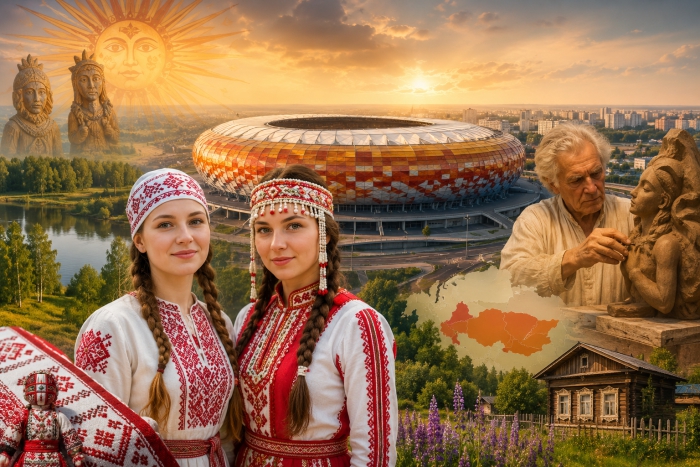
In more than ten years running CQMI, I've learned to be wary of nationalities that seem, at first glance, the easiest to sum up. Mordovia is a perfect example. James, our client from Toronto, wrote to me one day after watching a rerun of the 2018 World Cup on television: "Antoine, I saw a sun-shaped stadium in Saransk — is that even in Russia?" Yes, James, and that stadium — the Mordovia Arena — carries within it the entire story of this little-known people. Its round, radiating shape was deliberately designed after the sun, the central symbol of ancient Mordvin mythology, and it hosted four group-stage matches in June 2018, including the opening game between Peru and Denmark. Saransk, the capital of the Republic of Mordovia, with roughly 300,000 residents, was in fact the smallest host city of the entire tournament. To place this nationality within the broader Slavic and Finno-Ugric landscape we usually present to our members, our page dedicated to Russian and Eastern European women remains the best starting point before diving into a republic as singular as Mordovia.
What ten years of matchmaking have taught me is that the men who succeed with a woman from such a little-known nationality are the ones who accept to learn before trying to seduce. That's what this article is about.
Short answer: a Mordvin woman is a Russian citizen belonging to one of two Finno-Ugric peoples of the Volga region, the Erzyas or the Mokshas, each with its own language. Predominantly Orthodox, she most often lives outside the Republic of Mordovia itself — only a third of Mordvins still live there — scattered across neighboring Volga regions or even abroad. She is not looking for a passing adventurer, but a stable man, capable of patience and respect for an identity she must constantly reaffirm.
Myth #1 — "All Mordvins are one and the same people"
This is the most common mistake, and it deserves to be corrected first. The term "Mordvin" is actually a generic label covering two distinct peoples: the Erzyas, mainly settled in the eastern part of the Republic, and the Mokshas, present in the southern and western parts. Each has its own literary language, standardized in writing in the early twentieth century using the Cyrillic alphabet — in 1922 for Erzya, in 1933 for Moksha. In practice, a Mordvin woman will almost always introduce herself first as Erzya or as Moksha, rarely as simply "Mordvin," a term that is more of a Russian administrative exonym than a name this people uses for itself.
Verdict: FALSE. Mordvins are made up of two peoples with distinct languages, the Erzyas and the Mokshas, and personal identity is almost always built around this precise affiliation rather than a shared label.
Myth #2 — "Erzya and Moksha are just two accents of the same language"
This is a misleading approximation. Linguists generally treat Erzya and Moksha as two separate languages within the Mordvinic group, itself part of the western branch of the Uralic family, alongside Mari, Sami and the Finnic languages. Their degree of closeness is often compared to that of Finnish and Estonian: close enough for the kinship to be obvious, distant enough that everyday mutual understanding is not easy. Culturally, the influence isn't identical either: certain physical traits and elements of Moksha culture carry an ancient Persian imprint, while Erzya culture and appearance are considered closer to the Baltic peoples.
Verdict: NUANCED. Erzya and Moksha are sister languages, related but distinct, much like the Finnish-Estonian pair — not simple dialectal variants of a single tongue.
Myth #3 — "Mordvin women are the majority in their own Republic"
This is false, and it's actually one of the most striking paradoxes of this nationality, not unlike neighboring Karelia which I covered in a previous article. Erzyas and Mokshas combined now make up only about a third of the population of the Republic of Mordovia, vastly outnumbered by an ethnic Russian population that settled in several waves since the sixteenth century. A woman who claims an Erzya or Moksha identity in this context is therefore asserting a minority, deliberate affiliation, within a territory where she is no longer statistically at home.
Verdict: FALSE. Native Mordvins are a demographic minority in their own Republic, which makes an Erzya or Moksha identity all the more conscious and proudly claimed by those who assert it.
Myth #4 — "Most Mordvins live in Mordovia"
This is a widespread geographic misconception among Westerners. In reality, barely a third of Mordvins — Erzyas and Mokshas combined — currently live in the Republic that bears their name. The rest are scattered across neighboring Volga regions — Samara, Penza, Orenburg, Ulyanovsk, Nizhny Novgorod — and there are even Mordvin communities established in Kazakhstan, Ukraine and Uzbekistan, a legacy of the great migrations and deportations of the twentieth century. Meeting a woman of Mordvin origin can therefore perfectly well happen outside the Republic of Mordovia itself, anywhere across the wider Volga basin.
Verdict: FALSE. The majority of Mordvins do not live in the Republic of Mordovia but are scattered across neighboring regions, one of the most pronounced dispersion patterns among all Finno-Ugric peoples of Russia.
Myth #5 — "Saransk is just a dull provincial town with nothing to offer"
I understand where this image of an obscure capital comes from — Saransk was founded in 1641 as a simple fortress on the southeastern border of the Russian Empire — but it's badly out of date. The city, home to roughly 300,000 people, was named a host city for the 2018 World Cup despite its modest size, precisely because its infrastructure had already been planned for the millennium celebration of the union between the Mordvin people and the other peoples of Russia, marked in 2012. Saransk is also home to Ogarev Mordovia State University, founded in 1957, regularly ranked among the top 100 Russian universities and attended by students from across Russia and abroad.
Verdict: FALSE. Saransk is a modern regional capital, home to a nationally recognized university and developed enough to have hosted four official matches of the 2018 World Cup.
Myth #6 — "Saransk's stadium has nothing to do with Mordvin culture"
This is false, and actually quite the opposite. The Mordovia Arena, designed by German architect Tim Hupe, was deliberately shaped as a radiating solar disc, directly echoing the red sun featured on the Republic's flag and the sun's central place in Mordvin founding myths. With a capacity of 45,000 during the 2018 World Cup, it hosted four group-stage matches — Peru vs Denmark, Colombia vs Japan, Iran vs Portugal, and Panama vs Tunisia — before being scaled down to about 28,000 seats to become the permanent home of the local club, FC Mordovia Saransk. This stadium is therefore not just a piece of sporting infrastructure imported from abroad: it's a Mordvin cultural symbol built at the heart of the capital.
Verdict: FALSE. The architecture of the Saransk stadium draws directly on the solar symbolism of Mordvin mythology, making it a marker of regional identity as much as an international sports venue.
Myth #7 — "Every Mordvin woman still wears the traditional costume day to day"
This is a romanticized image that needs nuance rather than outright dismissal. The traditional Mordvin women's costume, richly embroidered and adorned with large earrings and numerous necklaces, long visually distinguished Mordvin women from their Russian neighbors — a detail striking enough to have been documented by major Western encyclopedias. Today, this costume is no longer worn daily: it's reserved for folk festivals, traditional weddings, and regional museums in Saransk. But its aesthetic influence — the embroidery, the red-and-white geometric patterns — still runs through local craftsmanship and remains a source of cultural pride passed down through generations.
Verdict: NUANCED. The traditional costume now belongs to festive occasions rather than everyday life, but its aesthetic legacy remains a very much alive source of identity and pride.
Myth #8 — "A Mordvin woman has nothing to offer next to a Russian woman from Moscow"
This is reductive, and deserves a more nuanced explanation. A Mordvin woman is, administratively and culturally, fully Russian: she speaks Russian daily, is most often Orthodox, and shares with women from Moscow or Saint Petersburg the same attachment to family values that I regularly describe in my articles about Russian women. But her regional history — belonging to a minority Finno-Ugric people, the memory of a rural culture patiently preserved, the very example of the sculptor Stepan Erzia, who chose that pseudonym in tribute to his Erzya people rather than using his birth name, Stepan Nefedov — gives her a particular sense of rootedness and endurance, less immediately visible than a major Russian metropolis, but every bit as real.
Verdict: NUANCED. A Mordvin woman shares the common Russian cultural foundation, but with a Finno-Ugric identity and rural endurance that set her apart from a woman from the big cities.
Myth #9 — "She will never adapt to life in Canada, the UK, the US or Australia"
Let me answer honestly, without downplaying the real cultural differences. They exist, and it would be dishonest to pretend otherwise. The history of a people long in the minority, accustomed to preserving its identity within a larger whole, often shapes a patient, discreet and loyal mindset, sometimes more reserved at first than a woman from southern Russia. What ten years of matchmaking at CQMI have shown me: couples who fail almost never trip over cultural difference as such. They trip over the man's lack of curiosity, his inability to genuinely take an interest in what matters to her. A man who takes the trouble to learn, even briefly, about the difference between Erzya and Moksha, or about the history of the Mordvin people, sends a signal of seriousness that immediately changes the nature of the relationship.
Verdict: NUANCED. Cultural differences are real and deserve respect, but they are only an obstacle for a man who refuses to take an interest in them.
Mordvin woman, Mari woman, Russian woman: the real differences
| Criterion | Mordvin woman (Erzya/Moksha) | Mari woman (Mari El) | Russian woman (European Russia) |
|---|---|---|---|
| Heritage | Finno-Ugric, Volgaic branch | Finno-Ugric, Volgaic branch | East Slavic |
| Subgroups | Two distinct peoples: Erzya and Moksha | Meadow, Hill, Eastern Mari | No equivalent |
| Religion | Predominantly Orthodox | Orthodoxy and Mari paganism | Orthodox |
| Native language | Russian (Erzya/Moksha declining) | Russian (Mari declining) | Russian |
| Distribution | Only a third live in Mordovia | Mostly live in Mari El | Varies by region |
| Core value | Endurance, loyalty, quiet pride | Connection to nature, resilience | Family warmth, practicality |
| Cultural symbol | Sun (mythology, Saransk stadium) | Embroidery, polyphonic singing | Varies by region |
| Meeting logistics | Saransk: flights via Moscow | Yoshkar-Ola: flights via Moscow | Varies by city |
How to start a conversation with a Mordvin woman: the CQMI method
- Ask about her exact identity first. Never assume she is "just Mordvin": ask respectfully whether she considers herself Erzya or Moksha. This simple, sincere question is seen as a rare sign of genuine consideration.
- Learn about Saransk and the 2018 World Cup. Mentioning the sun-shaped stadium or the opening match Peru vs Denmark shows you've made the effort to place her region on the map.
- Avoid hasty comparisons with Finland or other Finno-Ugric peoples. Every Finno-Ugric nationality in Russia has its own history; conflating them erases what makes each one distinctive.
- Take an interest in Stepan Erzia. Bringing up this sculptor, who chose his artist name as a tribute to his people, is an appreciated cultural entry point rarely used by other suitors.
- Only go through a serious agency. This nationality, still little covered by Western agencies, is a prime target for fake profiles.
The 4 mistakes to avoid with a Mordvin woman
- Treating her as "just another Russian from the provinces." Her Erzya or Moksha identity is not an administrative detail — it's a full-fledged affiliation.
- Believing Erzya and Moksha are basically the same thing. Confusing the two in front of her can come across as a sign of ignorance or indifference.
- Underestimating her geographic dispersion. She doesn't necessarily live in Mordovia: she could live in Samara, Penza, or elsewhere in the Volga basin.
- Going through unverified platforms. Our article on Pay Per Letter (PPL) dating scams gives you the keys to tell the real from the fabricated, a topic that matters even more with a nationality that's still relatively unknown.
Two stories from the field
Robert's sun. Robert, our client from Edinburgh, set up his first video call with a member from Saransk without knowing anything about the city. Spotting a photo of the stadium on her wall in the background, he asked, a bit confused: "Is that some kind of temple?" She burst out laughing and proudly explained it was her city's stadium, designed as a sun in tribute to the mythology of her Erzya people. That moment of spontaneity relaxed the whole conversation. They now talk almost every day.
James's geography lesson. James, our client from Toronto, thought he'd done his homework by complimenting his match on "her beautiful Finland," convinced that all Finno-Ugric peoples came from there. She corrected him with a smile: "I'm Moksha, from Mordovia, not Finnish!" Far from being offended by the mistake, she spent their next call patiently and good-humoredly explaining the difference. James now admits that this honest slip-up was actually the real starting point of their relationship.
Frequently asked questions about Mordvin women
Do I need to speak Erzya or Moksha to have a serious relationship with a Mordvin woman?
No, not at all. Russian is more than enough to communicate, and CQMI has translators on staff. Knowing the difference between Erzya and Moksha, however, and which one your match identifies with, is a much-appreciated sign of respect.
How can I meet a Mordvin woman from Canada, the UK, the US or Australia?
The safest route remains a serious matchmaking agency, which verifies the identity, civil status and intentions of every member before any introduction. Saransk is generally reached via a connecting flight through Moscow.
Is a Mordvin woman culturally close to a Russian woman from Moscow?
Administratively and religiously, yes: she's a Russian citizen and most often Orthodox. But her Erzya or Moksha identity, a minority even within her own Republic, gives her a distinct cultural rootedness and endurance.
What age difference is acceptable with a Mordvin woman?
As with the Slavic and Finno-Ugric women we present overall, a gap of 2 to 10 years is the optimal success zone, with a maximum of about 15 years depending on your age. We cover this topic in detail in our dedicated article on age difference.
Is Saransk easy to reach from Canada, the UK, the US or Australia?
There are no direct flights from these countries: you'll generally need to connect through Moscow. A well-prepared first trip remains the best way to move a serious relationship forward.
What you really need to understand about Mordvin women
A Mordvin woman is not just another exotic nationality to add to a list from the Russian Federation. She is the heir to one of two peoples — Erzya or Moksha — who managed to preserve their language and identity while becoming a minority in their own Republic, and whose capital, for one month in June 2018, welcomed the entire world around a sun-shaped stadium. What CQMI's experience confirms, after more than 350 successful marriages since 2014:
- Her initial reserve is not coldness — it's a modesty built over centuries of minority life, which later gives way to unwavering loyalty.
- Her Erzya or Moksha identity is not an administrative detail — it's a proud affiliation that deserves respect and genuine understanding.
- Her geographic dispersion, far from being an obstacle, means you might meet her just as easily in Samara or Penza as in Saransk itself.
If you're a serious man — in Canada, the UK, the US or Australia — who wants to build a real life with a woman from Russia, our page dedicated to verified Russian women presents our full membership base, including some members originally from the Volga basin.
Ready to meet a serious woman from Russia?
CQMI has been operating since 2014. Our formula — $350 CAD/month — gives you access to 10 verified contacts with women genuinely motivated to build a lasting relationship. More than 40% of female applications are rejected during our screening process.
350+ successful marriages · Divorce rate under 7% · 1,750 verified members · No chatbots, no ghost translators
Questions? Write directly to Antoine: This email address is being protected from spambots. You need JavaScript enabled to view it.
Further reading
Latest from Antoine Monnier
- Caring for Aging Parents: Why Ukrainian Women Never Really Leave Their Mother Behind
- Marriage in the West and the East: Why One Institution Is Fading While the Other Holds
- Raising Kids: Canada, the US, Russia, and Ukraine Do It Differently
- Divorce in Russia, Ukraine, Canada and the US: What the Sociology Shows
- Ukrainian Woman Asks You for Money: Scam or Sincere?