


Ukrainian and Russian Bride dating advices - CQMI blog

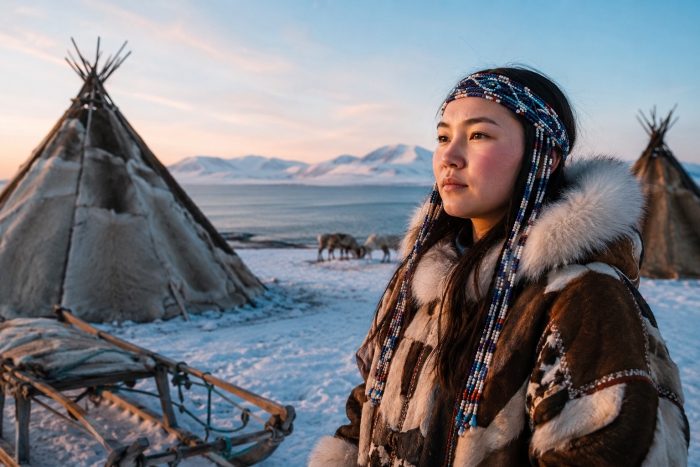 Women of Chukotka
Agence CQMI
Women of Chukotka
Agence CQMI
Women of Chukotka: 9 Myths Debunked — What You Really Don't Know
In brief: A woman of Chukotka is not an Eskimo, not the naive heroine of old Soviet jokes, and not an illiterate herder lost in the tundra. She is the heiress of a Paleo-Siberian people who crossed the Bering land bridge millennia ago, a distant relative of Native Americans, and a citizen of the Russian Far North: a territory as large as France and Sweden combined for barely 50,000 inhabitants, where the thermometer drops to minus forty, where generosity toward strangers is a sacred law, and where women, long kept in the background, are today doctors, teachers and administrators. Before you put her in a box, read on.
Article by Antoine Monnier, director and founder of the international marriage agency CQMI, specialist in serious relationships between Western men and women from Russia, Eastern Europe, the Caucasus and Central Asia since 2014.
Let me be direct with you.
When I mention Chukotka to my clients - men from Canada, the UK, the US or continental Europe looking for a serious relationship - the reaction is almost always the same: a polite silence, then the question. « Chukotka... where exactly is that? » It is the extreme northeastern tip of Russia, that finger of frozen land that almost touches Alaska, separated from the United States by just 88 kilometres of sea. Almost no one knows who the women of this region really are. And that is a shame, because behind this name that people can barely pronounce lies one of the most fascinating and most misunderstood cultures in the whole of Russia.
Chukotka is a world apart: the least densely populated region in all of Russia, tundra stretching to the horizon, winters that last ten months, and a people - the Chukchi - who held off the Russian Empire for nearly a century before signing a peace as equals. It is also, beneath the Slavic majority that has populated its towns since Soviet times, a land where hospitality is not a courtesy but an absolute duty. To understand this region, you first have to grasp that a Russian woman of the Far North bears no resemblance to the image of Russia we hold from Moscow or Saint Petersburg.
James, a Canadian client of mine, 51, called me after his first video call with a member from Anadyr, the regional capital. « Antoine, I expected a woman from the end of the world - fragile, out of place. Instead I find a head nurse who runs an entire ward, who tells me about summers spent at her grandmother's sewing reindeer-skin boots, and who bursts out laughing when I confuse Chukotka with Siberia. She was gentle and solid at the same time. I had never felt anything like it. »
What James glimpsed, I am going to explain to you - verified data in hand, more than ten years of experience at CQMI, and nine myths to take apart one by one. If you are not serious, move along: these women are not looking for a one-night stand, but for a marriage and a union for life.
Short answer
Women of Chukotka are Russian citizens of the Far North, a region with a Slavic majority whose cultural identity comes from the indigenous Chukchi people, a distant relative of Native Americans. They speak Russian fluently, are overwhelmingly literate, often university-educated, and carry a culture in which generosity and loyalty hold a central place. Far from the cliches, these are resilient women, forged by one of the harshest climates on the planet.
Myth no.1 - « A woman of Chukotka is an Eskimo »
Where the confusion comes from
Chukotka almost touches Alaska. Far-North faces, dog sleds, sealskin: the Westerner instinctively lumps it together with the Inuit, the « Eskimos » of the school textbooks. The image is convenient. It is inaccurate.
What language and history show
The Chukchi do share their peninsula with a small Eskimo people, the Yupik. But they are distinct from them. Their language, Chukchi, belongs to the Chukotko-Kamchatkan (Paleo-Siberian) family - a group that has nothing to do with the Eskimo-Aleut languages, nothing to do with Slavic Russian, and nothing to do with Chinese. It is a linguistic family of its own, among the oldest and most complex in the world.
Ethnographically the distinction is sharp: the Chukchi have historically been divided into two groups, the nomadic reindeer herders of the interior and the marine-mammal hunters of the coast. They call themselves Luoravetlan, « the real people ». A fascinating fact: genetically and culturally, they are distant relatives of the Native American peoples, a legacy of the era when Beringia linked Asia to America.
Myth no.2 - « The Chukchi are the simpletons of Russian jokes »
The prejudice of the fool
No people in the post-Soviet space has been the subject of as many jokes as the Chukchi. The « Chukcha » of Russian anecdotes is a naive simpleton who speaks in broken syntax and understands nothing of the modern world. Many Westerners, without realising it, inherit this cliche.
What reality shows
These jokes say nothing about the Chukchi - they say everything about the one telling them. Ethnographers have shown it: if Russians began mocking this people, it was precisely because they did not know it (one ridiculed a people so remote that no one risked ever meeting it), and because the Soviet authorities had an interest in portraying it as « incapable of organising its own life » in order to justify colonising its land and extracting the gold and tin from its soil.
The reality? The Chukchi are the only people of Siberia the Russian Empire never managed to subdue militarily: after decades of war, Saint Petersburg gave up and negotiated. And the finest rebuke to these jokes is named Yuri Rytkheu (1930-2008), the son of a Chukchi hunter who became the father of his people's literature, translated into German and Japanese, and who handled the Russian language better than most of those who made Chukchi jokes. So much for the « simpleton ».
Myth no.3 - « A woman of Chukotka is just trying to escape the cold and poverty »
The economic-migration theory
Chukotka is harsh and poor by Western standards. Some conclude that any woman open to an international relationship must be after a passport and some warmth first.
What the facts contradict
Let us be honest: yes, the region is tough. Life expectancy among the lowest in Russia, extreme isolation, ten-month winters. But that is exactly what makes the cliche absurd. Chukotka is a closed border zone: you cannot even enter or leave it freely without a special permit, there are no international flights, and every journey goes through Moscow thousands of kilometres away. A woman who simply wanted to « leave » would not pick the most inaccessible corner of the planet to do it.
Those who commit to a serious international path therefore do so out of deep conviction, never out of convenience. And what I observe systematically is a visceral attachment to their land: to the tundra, to the reindeer, to the summers at the grandparents'. A woman of the Far North who chooses a Western man is not fleeing her country - she is choosing a man worthy of what she carries.
Myth no.4 - « Chukchi women are submissive and mistreated »
The weight of an old history
The 19th-century ethnographic records describe a society in which the Chukchi woman ate after the men, received the worst cuts and sometimes suffered domestic violence. The cliche of the effaced woman of the Far North finds there a kernel of historical truth.
What modern reality shows
I am not going to lie to you to sell you a dream: in traditional nomadic society, women's status was indeed inferior to men's. She could, however, own her own reindeer herds and divorce an abusive husband - which was no small thing at the time. But above all, that world has vanished. The Soviet 20th century, for all its brutality elsewhere, abolished that status: compulsory schooling, access to university, legal equality. Historically, a large share of the region's doctors were women, and today the woman of Chukotka is an administrator, a teacher, a head nurse, an accountant.
The woman you will meet therefore has nothing of the silent wife of the old accounts. She is gentle but solid, welcoming but clear-eyed, and mistaking her for a trophy would be the fastest mistake to backfire on you.
Myth no.5 - « Women of Chukotka still practise wife-swapping »
A stubborn rumour
Anyone who digs a little quickly stumbles on the Chukchi « group marriage », in which male friends sometimes shared their wives. From there to imagining that it still happens is a short and quickly taken step.
What anthropology shows
Let us be precise, because the subject deserves better than a fantasy. Group marriage did exist: it was a survival strategy in a setting of extreme isolation. By linking several families - a sea hunter, a reindeer herder - one created solid economic alliances and ensured the genetic diversity vital for small groups cut off from the world. Ethnography notes an important nuance, moreover: it was often the Chukchi women themselves who resisted this custom the most.
Above all, this practice completely disappeared by the middle of the 20th century, swept away by sedentarisation, modernisation and changing ways of life. The woman of Chukotka today lives the same conjugal reality as a Russian or Ukrainian woman in any large city: monogamy, loyalty, a couple's project.
Myth no.6 - « They are illiterate herders »
The bias of the world's end
Tundra, reindeer, dog sleds: we instinctively imagine a people cut off from school and knowledge. The cliche is persistent.
What the figures show
Brace yourself for a surprise. The Chukchi today are almost 100% literate, and they all speak Russian fluently (fewer than a hundred people report not speaking it at all). Many hold university degrees: among them are poets, writers, teachers, doctors and political figures. The irony of the famous joke about the « Chukcha writer, not reader » is complete when you know that a Chukchi, Yuri Rytkheu, wrote works translated around the world.
For an English speaker, the practical advantage is twofold: you have in front of you a cultured and clear-headed interlocutor, who shares the common language of communication of the entire former Soviet space. A few words of Russian on your part will be, as always, a much-appreciated seduction asset.
Myth no.7 - « Chukchi beauty is just one more Asian face »
The dead end of aesthetic boxes
Neither the Slavic type nor the classic East Asian type: the woman of Chukotka escapes the usual grids, and some hastily conclude she has an « undefined » beauty.
What observation reveals
The beauty of the Far North is an open-air beauty, shaped by millennia of life under the Arctic sky: high cheekbones, warm complexion, deep black hair, a frank and present gaze. Vitality rather than fragility. But what strikes my clients most goes beyond the physical: it is the quality of presence and welcome.
For in Chukotka, hospitality is not a courtesy - it is a sacred law. In a setting where refusing shelter or food to a traveller could be a death sentence for them, generosity became the heart of morality: it is forbidden to let anyone leave hungry, the community looks after orphans and widows, and stinginess is considered the worst of flaws. That kind of generosity, few cultures still know with such intensity.
Myth no.8 - « Communication is impossible, their language is incomprehensible »
The barrier of the frozen-steppe tongue
Chukchi is reputed to be among the most complex languages in the world - polysynthetic, baffling. The Westerner imagines an insurmountable wall.
What practical reality shows
The complexity of Chukchi is real, but it does not concern you. The woman of Chukotka you will meet through the agency speaks Russian fluently - it is in fact, alas for linguists, the dominant language of the region, Chukchi now being an endangered language. You will therefore communicate exactly as with any Russian woman: in Russian, in English depending on the generation, and with the support of translator-assistants who remove the obstacle from the very first exchanges without ever coming between you.
One word of caution before you go searching alone on dubious platforms: first read our analysis of the Pay Per Letter (PPL) scams that proliferate in online dating with women from the East.
Myth no.9 - « A woman of Chukotka will never leave her tundra »
An identity forged in the vastness
Chukotka has an identity of rare intensity, forged by isolation, the reindeer and resistance. A people so attached to its land - how could its women agree to leave?
What history shows
The attachment is real, but it does not mean immobility - quite the opposite. Here is a people that crossed Beringia, survived forced collectivisation, the gulags installed on its land, then the economic collapse of the 1990s. Adapting to the most hostile environment on the planet is written into its culture as a matter of survival. From that school, the woman of Chukotka emerges with a resourcefulness and a composure that work wonders abroad.
A woman of the Far North who chooses to leave has thought it through at length - you do not leave such a corner of the world on a whim. And she brings with her a treasure: a sense of family, a tried-and-tested loyalty, and a collective memory that gives weight to every commitment. To place the Russian woman in relation to her neighbours, our article on the age difference that comes with a price tag will also give you honest benchmarks on real expectations.
Woman of Chukotka, Russian, Ukrainian: the real differences
| Criterion | Woman of Chukotka | Russian (European Russia) | Ukrainian |
|---|---|---|---|
| Cultural heritage | Paleo-Siberian (Chukchi) + Slavic majority | East Slavic, Eurasian culture | East Slavic, European culture |
| Religion | Orthodoxy + living ancestral shamanism | Orthodox | Orthodox |
| Temperament | Solid gentleness + Arctic resilience | Warm once trust is established | Expressive, direct, warm |
| Education | Near-total literacy, Russian-speaking | Highly educated | Highly educated |
| Language bridge | Russian (universal), English variable | Russian, English variable | Ukrainian/Russian, English variable |
| Access / logistics | Closed border zone, permit required | Visa required (restrictions since 2022) | Schengen visa-free (short stay) |
| Attitude to marriage | Central, rooted in family and land | Strong, varies by individual | Central, clearly stated |
The 5 mistakes men systematically make with women of Chukotka
- Taking her for an Eskimo or a « good Russian joke ». She is a Russian citizen, heiress of an undefeated and literate people. Throwing a simpleton cliche at her is the most damning mistake there is.
- Confusing hospitality with submission. She welcomes you like a king because receiving is sacred in her culture. That does not mean she will stay silent. Answer her generosity with respect, never with condescension.
- Underestimating her intellect. A woman of the Russian Far North is often educated and clear-headed. Come as a partner, not as a professor here to « save » a girl from the world's end.
- Not being serious from the start. A woman who enters an international process from a place this remote knows exactly what she is looking for: a marriage, a union for life. If that is not your project, do not waste her time.
- Going through unverified platforms. The sector is saturated with Pay Per Letter scams and fake profiles. Always verify before spending a single dollar.
Two stories from the field
The reindeer-skin boots
James, our Canadian client, receives a parcel a few weeks after his first exchanges with his member from Anadyr: a pair of reindeer-skin slippers, hand-sewn by the grandmother. He, who heats his home with wood back in Ontario, understands the message better than anyone. He calls me, his voice tight: « Antoine, I thought I was getting a gift. In fact it is her family telling me that I am welcome. » They met in Moscow this spring.
The blackout and the composure
Another client, Robert, 56, from Edinburgh, was telling me about his first meeting trip. A city-wide power cut one winter evening, minus thirty outside. He was panicking a little; his interlocutor, a 43-year-old accountant, calmly lit two candles, took out a camping stove, made tea and carried on the conversation as if nothing had happened. « That evening I understood, » he told me, « that I was not looking for a woman to reassure, but a woman with whom I would never be afraid of anything. That was exactly her. »
Frequently asked questions about women of Chukotka
Is a woman of Chukotka Russian or Eskimo?
She is a Russian citizen. The region has a Slavic majority (around 54%), and the indigenous people, the Chukchi, are a Paleo-Siberian people distinct from the Yupik Eskimos. Her everyday language of communication is Russian.
Do you need to speak Chukchi to meet a woman of Chukotka?
No. Everyone speaks Russian fluently in the region, Chukchi having become an endangered language. CQMI provides translator-assistants. A few words of Russian remain an appreciated seduction asset.
What religion do women of Chukotka practise?
Mostly Russian Orthodoxy, often combined with an ancestral shamanism still alive among the Chukchi people, centred on the spirits of nature and animals.
What age difference is acceptable with a woman of Chukotka?
Between 2 and 10 years is the optimal success zone, with a maximum of around 15 years depending on your age. Beyond that, expectations evolve and deserve an honest discussion.
Where can you seriously meet a Russian woman from Canada, the UK or the US?
Through a serious marriage agency such as CQMI, which verifies every profile, supports the meeting and organises the trips. Discover our process and formula below.
What you really need to understand about women of Chukotka
A woman of Chukotka is neither an Eskimo, nor the naive figure of Russian jokes, nor an effaced herder of the tundra. She is the heiress of the Russian Far North: a unique Paleo-Siberian soil, an undefeated and literate people, a land where hospitality is sacred and resilience a second nature. That history has forged a remarkably coherent psychology: solid gentleness and quiet pride, generosity raised to a duty and composure under any circumstance, a sense of family and an assumed independence.
What the experience of the international marriage agency CQMI, after more than 350 successful marriages since 2014, confirms everywhere in Russia:
- Her generosity is not naivety - it is a hospitality that expects respect in return.
- Her resilience does not make her cold - it makes her reliable, on good days and bad.
- Her attachment to her land and family is deep - lived, never proclaimed.
If you are a serious man in search of a true shared life project, a Russian woman - from the Far North or elsewhere - deserves your full attention.
Ready to meet a serious Russian woman?
CQMI has been operating since 2014. Our formula - $350 CAD/month - gives you access to 10 verified contacts of women genuinely motivated to build a lasting relationship. More than 40% of female applications are rejected during our selection.
This is not a dating site. It is a marriage agency with a strict ethical charter.
350+ successful marriages | Divorce rate < 7% | No chatbots, no ghost translators
Questions? Write directly to Antoine: This email address is being protected from spambots. You need JavaScript enabled to view it.
Latest from Antoine Monnier
- How to Verify a Russian or Ukrainian Woman's Photo Online
- Why There Is a Real Shortage of Men in Ukraine and Russia Since the War
- Orthodox Ukrainian Woman or Muslim Kazakh/Uzbek Woman: What's the Real Difference for Marriage?
- Dating a Russian or Ukrainian Woman: Why Your Playbook Won't Work
- Why a Russian or Ukrainian Woman Sees You as Just Another Man

 +1 514 794-5053