


Ukrainian and Russian Bride dating advices - CQMI blog

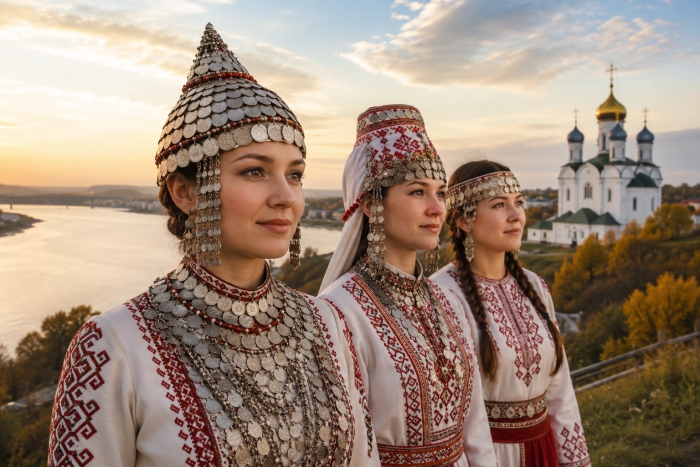 Chuvash Women of Chuvashia
Agence CQMI
Chuvash Women of Chuvashia
Agence CQMI
Chuvash Women of Chuvashia: 9 Myths Debunked
Chuvash Women of Chuvashia: 9 Myths Debunked
? 20 min read
Short version: a Chuvash woman belongs to a people unlike any other on Earth — the only large Turkic-speaking people whose majority converted to Orthodox Christianity rather than Islam. She lives in the Republic of Chuvashia, on the Volga River, roughly halfway between Moscow and Kazan, and speaks a language so different from the rest of the Turkic family that linguists once mistook it for a Finno-Ugric tongue. Her traditional costume features a conical headdress, the tukhya, covered in silver coins that could weigh up to 15 kilograms — a sign she was of marrying age. If you are looking for a fling with no follow-through, neither this article nor our agency are for you.
By Antoine Monnier — director and co-founder of CQMI Matchmaking Agency. Since 2014, our matchmaking agency has guided serious men from Canada, the US, the UK and Australia toward marriage with women from Eastern Europe and the Russian Federation. Based on our field experience, a man who is misinformed about a woman's real identity starts at a disadvantage from his very first message. So, as we did for our article on Kalmyk women and our Mordvin women of the Volga, here are 9 myths about Chuvash women, debunked one by one.
1. "A Chuvash woman is basically just a Tatar woman under a different name"
False — and probably the most common confusion of all. Tatars and Chuvash do share a common Turkic root and live in neighboring republics on the Volga — Tatarstan and Chuvashia border each other. But the religious history of the two peoples diverged radically. Tatars of Tatarstan, as we explained in our article on Tatar women, have been Muslim since the 10th century and the era of Volga Bulgaria. The Chuvash also descend from the Volga Bulgars, but the majority were forcibly Christianized in the mid-18th century under the tsars — a religious shift that makes them, according to ethnologists, the only large Turkic-speaking Christian people in all of Russia and the former USSR.
2. "A Turkic-speaking woman from Russia is necessarily Muslim"
It is precisely the Chuvash exception that disproves this generalization. Most practicing Chuvash today are Russian Orthodox, with a minority remaining faithful to Sunni Islam (a legacy of long-standing contact with the Tatars) or to a pre-Christian folk religion called Vattisen Yaly, which preserves elements of the old Turkic sky-god cult, Tура. A Chuvash woman you meet will therefore celebrate Orthodox Easter and Christmas like any Russian woman, while carrying a surname and patronymic whose sound hints at her Turkic origin. It is a genuine dual identity, rarely understood from the outside.
3. "The coin headdress is just decorative folklore with no real meaning"
On the contrary, it is one of the most precise social codes in all of Russian culture. Among the Chuvash, an unmarried girl wore the tukhya, a pointed, helmet-shaped headdress entirely covered in beads and silver coins, as soon as she reached marrying age. A married woman wore the khushpu, open at the top with a long "tail" hanging down the back. These jewels, passed down through generations, could weigh up to 15-16 kilograms and served both as a talisman against evil spirits and as a public declaration of marital status — a louder, heavier version of our Western wedding ring. Much of this silver heritage was unfortunately confiscated by the Soviet state during industrialization and World War II, melted down to help pay for tractors and tanks.
Nadezhda, director of the Chuvash Embroidery Museum in Cheboksary, explains that the coins on these headdresses were chosen for their sound: with every step, a Chuvash woman made her past, her dowry, and her status ring out loud, and that sound was meant to frighten away evil spirits. Imagine the effect on a shy suitor who could hear her coming before he ever saw her.
4. "The Chuvash never produced any figure known on a world scale"
False — and the example is a spectacular one. Andriyan Nikolayev, the third Soviet cosmonaut to fly into space (Vostok 3, 1962) and the first man to set an orbital endurance record of several days, was a full-blooded Chuvash, born in a village in the Republic. He is considered history's first cosmonaut of Turkic origin. In 1963, he married Valentina Tereshkova, the first woman in space — a marriage staged entirely by Khrushchev for Soviet propaganda purposes, with little real affection between the two. The couple divorced 19 years later. It's a useful reminder: even two national heroes cannot build a happy marriage on a political decision rather than genuine compatibility — the exact opposite of the method we apply at CQMI Agency, where every match starts from real compatibility, never from an external calculation.
5. "Chuvash is just a dialect of Tatar"
Linguistically, it is almost the opposite of obvious. Chuvash is the only surviving language of the entire Oghur branch of the Turkic languages — a branch so ancient and so divergent that 19th-century linguists first classified it as a Turkified Finno-Ugric language, until the work of linguist August Ahlqvist in 1856 clarified its true nature. A Tatar or Kazakh speaker understands almost nothing of spoken Chuvash: the sounds have diverged to the point where "r" corresponds to the common "z" of other Turkic languages, and "l" to their "š". Some researchers even see a link to the extinct language of the Huns. In other words, marrying a Chuvash woman means touching one of the rarest and oldest languages in all of Eurasia.
6. "Chuvashia is a poor, backward region cut off from the world"
The reality is far more nuanced. The capital, Cheboksary, is a modern city of around 500,000 people on the banks of the Volga, a few hours by train from Moscow and Kazan. The Republic has over a million inhabitants, roughly two-thirds Chuvash, the rest mostly Russian. The country underwent a genuine cultural and linguistic revival in the 18th-19th centuries, with educator Ivan Yakovlev creating an adapted Cyrillic alphabet in 1871 and the first Chuvash-language newspaper appearing in 1906. Language transmission has weakened since the 2000s, however, as younger urban generations increasingly favor Russian — a pattern of Russification also seen in neighboring Volga republics, as with the neighboring Mari people.
7. "Chuvash women are submissive and self-effacing"
This is the exact opposite of what traditional Chuvash culture reveals. A local saying holds that "the mother is kébé — one does not argue with her": the mother figure is considered sacred and beyond reproach. Historically, Chuvash women worked full-time in the fields and in craftwork while also running the household, never reduced to a purely decorative role. Based on our experience at the agency, women from the Volga republics — Chuvash, Mordvin, or Mari alike — share this common trait: a de facto independence born of historical necessity, far removed from the passive "Slavic woman" cliché some Western men still imagine before their first correspondence.
8. "A Chuvash woman would accept any arranged marriage without question"
We just saw with Nikolayev and Tereshkova that an externally imposed marriage — even between two national icons — guarantees nothing. This is the exact opposite of our philosophy at CQMI Agency: we never "marry off" anyone by force. We match two people based on genuine compatibility criteria — values, life goals, seriousness of intent — and it is then up to both adults to decide whether or not to build a relationship. A Chuvash woman engaged in a serious matchmaking process is looking for exactly the same thing as any Slavic or Caucasian woman we accompany: a freely chosen commitment, not a formality.
9. "Marrying a Chuvash woman means settling in the middle of an isolated steppe"
Once again, geography disproves the cliché. Chuvashia is neither Siberia nor the Kazakh steppe: it is a densely populated region at the heart of European Russia, on one of the country's major river routes, a few hundred kilometers from Moscow. Cheboksary has modern infrastructure, universities, and an airport. The real cultural distance with a Western man has less to do with geography than with language and social codes — which is exactly what our personalized support and translating assistants are there to bridge.
Psychological analysis: what we observe in the field
Based on over ten years of experience at CQMI Agency, we observe a recurring trait among women from the Turkic and Finno-Ugric republics of the Volga: a surface-level emotional reserve that hides strong loyalty and a deep sense of family duty. We often notice that these women test a man's consistency before opening up emotionally — a mechanism rooted in a history marked by Russification, loss of social status, and the necessity of preserving family identity against the odds. The main takeaway for a serious Western man: patience and consistency matter more than grand declarations.
How to approach a Chuvash woman with confidence: a 5-step method
- Learn the difference between her Chuvash identity and a general Russian identity — she will appreciate that you don't confuse the two.
- Never assume she is Muslim: ask about her faith respectfully rather than guessing.
- Show genuine interest in her language and culture without excessive exoticism — sincere curiosity, not postcard folklore.
- Demonstrate your marriage-oriented seriousness from your very first exchanges — women from the Volga republics quickly spot men who "collect" profiles.
- Go through a serious matchmaking agency rather than a general dating site, to avoid cultural and linguistic misunderstandings from the start.
Mistakes to absolutely avoid
The first mistake is systematically confusing a Chuvash woman with a Tatar or "just another Russian" — the fastest way to alienate her from your very first message. The second is underestimating the importance of her mother in family decisions: as we've seen, the maternal figure is nearly untouchable in this culture, and a man who criticizes or belittles her commits a serious error. The third mistake, common across all our international matchmaking journeys, is rushing toward marriage or cohabitation before building genuine trust.
One of our members, on a video call with a woman of Chuvash origin, sent her a photo of a traditional headdress found online, complimenting her on her "coin hat." She burst out laughing: it wasn't a Chuvash tukhya at all, but a completely different headdress from another Volga people. Since then, he always double-checks his research before trying to impress anyone — a useful lesson in humility for all our members.
Chuvash women and women from other Volga republics: comparison table
| People | Language family | Majority religion | Capital |
|---|---|---|---|
| Chuvash | Turkic (Oghur branch, unique) | Orthodox Christianity | Cheboksary |
| Tatars | Turkic (Kipchak) | Sunni Islam | Kazan |
| Bashkirs | Turkic (Kipchak) | Sunni Islam | Ufa |
| Mari | Finno-Ugric | Orthodoxy / Mari folk religion | Yoshkar-Ola |
| Mordvins (Erzya/Moksha) | Finno-Ugric | Orthodox Christianity | Saransk |
FAQ — Chuvash Women
Does a Chuvash woman necessarily speak the Chuvash language?
Not necessarily on a daily basis. In large cities like Cheboksary, Russian dominates public life, even though Chuvash remains alive within families and in rural areas. Most Chuvash women are fully bilingual in Russian and Chuvash.
Is Chuvashia easy to reach from the West?
Cheboksary is a few hours away from Moscow by train or domestic flight, with regular air connections. It is not an isolated region like Siberia or Russia's Far East.
Are Chuvash women registered with CQMI Agency?
Our 1,750 verified members come from across the Russian Federation, Eastern Europe, the Caucasus and Central Asia, including republics like Chuvashia. Every profile is individually verified according to our anti-scam charter.
Should I worry about too great a cultural gap?
That gap exists, as it does with any woman from a culture different from your own, but it is bridged through communication, patience, and serious support — which is precisely the role of our translating assistants and personalized coaching.
As you can see, a Chuvash woman carries a dual heritage — Turkic and Orthodox — unlike any other in all of Eurasia. Since 2014, CQMI international matchmaking agency has guided serious men toward lasting unions with verified women across the Russian Federation and Eastern Europe — 350+ successful marriages to date, with a divorce rate below 7%. If you are ready to commit to a serious relationship, our $350 CAD/month subscription gives you access to 10 verified contacts of women genuinely motivated by marriage. It's not a magic formula, but it's the method that has worked for over a decade. Questions? Write to us directly at This email address is being protected from spambots. You need JavaScript enabled to view it..
Latest from Antoine Monnier

 +1 514 794-5053