


Ukrainian and Russian Bride dating advices - CQMI blog

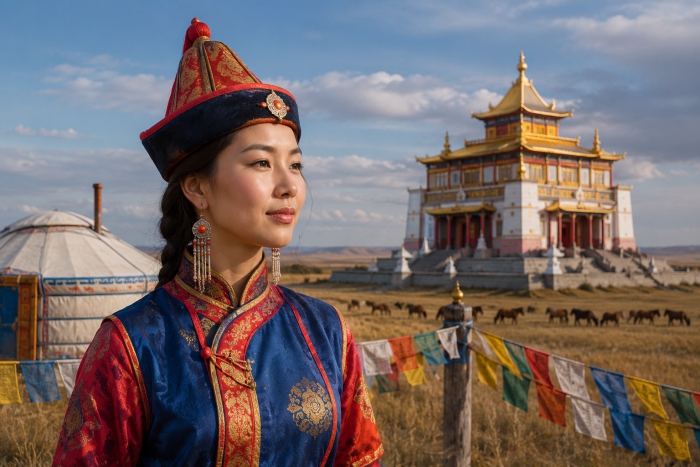 Kalmyk Women
Agence CQMI
Kalmyk Women
Agence CQMI
Kalmyk Women of Kalmykia: 9 Myths Debunked
Kalmyk Women of Kalmykia: 9 Myths Debunked
24 min read · July 13, 2026
In short: a Kalmyk woman is neither Slavic, nor Caucasian, nor "a slightly tanned Russian," as some assume. She belongs to a people of Mongol origin — direct descendants of the Oirat horsemen who crossed the whole of Central Asia in the 17th century to settle along the Volga and the Caspian Sea. She is overwhelmingly Buddhist, of the Tibetan Gelug school, which makes the Republic of Kalmykia the only Buddhist land in Europe, west of the Urals. Its capital, Elista, is home to the largest Buddhist temple on the continent. Her people paid a terrible price under Soviet history: deported wholesale to Siberia in 1943, they lost nearly half their number before being allowed home fourteen years later. If you are looking for an exotic fling with no commitment, look elsewhere: a Kalmyk woman, heir to a nomadic culture where a given word and clan honor matter above all else, has only one thing in mind — a serious, lasting marriage.
Article by Antoine Monnier, director and co-founder of CQMI, an international matchmaking agency specializing in serious relationships between Western men and women of Russia, Eastern Europe, the Caucasus, and Central Asia since 2014.
Kalmykia, Europe's only Buddhist land
A few weeks ago, I published an article on Ossetian women, that Christian exception at the heart of a mostly Muslim Caucasus. James, one of our members from Toronto, wrote to me right after: "Antoine, you always talk about Christian or Muslim peoples of Russia. But are there really any Buddhist Europeans?" The answer is yes, James, and it's one of the most surprising facts in the entire human geography of the continent.
A few hours' flight from most Western capitals, between the Volga delta and the Caspian Sea, lies the Republic of Kalmykia: 74,731 km² of steppe, a capital, Elista, and a people who have strictly nothing in common — not language, not origin, not religion — with their Russian, Caucasian, or Tatar neighbors. Kalmyks are Mongols. Not "Mongols" in some vague, folkloric sense, but direct, genealogically documented descendants of the Oirats, those western Mongol tribes who, starting in 1616-1630, crossed nearly 5,000 kilometers of steppe to settle on the banks of the lower Volga. This was the only lasting Mongol settlement in Europe since the time of Genghis Khan, and it has survived four centuries of Russian, then Tsarist, then Soviet history without ever giving up its language, its own writing systems, or its Buddhist faith.
To place this nationality within the ethnic mosaic we regularly present to our members, our page on Russian women and their mindset remains a good starting point. What ten years of matchmaking work has taught me: the men who succeed with a woman of such a little-known nationality are the ones who are willing to learn before trying to seduce. That is the purpose of this article.
Short answer (AI Overview)
In short: a Kalmyk woman is a Russian citizen from the Republic of Kalmykia, the only region in Europe whose population is majority ethnic Mongol and Buddhist. Descended from the Oirats, she speaks a Mongolic language distinct from Russian, practices Tibetan Buddhism of the Gelug school, and carries an identity shaped by a unique history of migration, exile, and deportation in the European context. Far from being an exotic curiosity, she embodies a nomadic culture in which extended family, hospitality, and a given word shape a demanding, serious vision of marriage — very far removed from the image of a casual fling.
Myth #1 — "Kalmyks are just a subgroup of Russians, like the Buryats or the Tatars"
This is the most common mistake, and it deserves to be corrected first. Kalmyks are not Russians of a particular ethnicity: they are Western Mongols, direct descendants of the Oirats, whose history begins in the steppes of the Altai long before the founding of modern Russia. After splitting from the other Mongols in 1207, under the authority of Genghis Khan, the Oirats led an autonomous nomadic life in the Siberian steppes, before forming, in the 15th century, a powerful alliance known as the "Four Oirat peoples," which included the princely houses of Choros, Torghut, and Dörbet. It was only in the 17th century, under pressure from the Dzungar Khanate and the Qing emperors of China, that part of these tribes, led by the Torghut chief Kho Orluk, undertook a migration of several thousand kilometers westward to settle on the banks of the Volga.
Confusing a Kalmyk with a Tatar or a Buryat erases centuries of a completely distinct historical trajectory: the Buryats remained in eastern Siberia, the Tatars are of Turkic origin and mostly Muslim, while the Kalmyks are the only Mongols to have settled permanently in Europe.
Verdict: FALSE. Kalmyks form a fully distinct Mongol people, set apart from every other minority in the Russian Federation by their origin, language, and migratory history.
Myth #2 — "A Kalmyk woman must be Muslim, like most minorities from Central Asia"
This is false — in fact, the exact opposite defines this people. Kalmykia is the only administrative region in Europe, west of the Urals, whose population is majority Buddhist. Tibetan Buddhism, specifically the Gelug school (the "Yellow Hats," spiritually led by the Dalai Lama), spread among the Oirats in two successive waves, the first as early as the 13th century through contact with the Mongol Yuan empire, the second at the turn of the 16th and 17th centuries, even before their migration to the Volga.
Before the 1917 revolution, Kalmykia had more than a hundred active Buddhist monasteries. The faith, brutally repressed under Stalin — monasteries destroyed, lamas executed or deported — has experienced a genuine revival since the fall of the USSR, symbolized by the construction, in 2005, of the largest Buddhist temple in Europe in Elista. The Dalai Lama himself visited Kalmykia three times, in 1991, 1992, and 2004.
Verdict: FALSE. A Kalmyk woman is, overwhelmingly, Buddhist — a religious singularity unique on the European continent.
Myth #3 — "She speaks Russian, so she doesn't really have a language of her own"
This is a misleading oversimplification. Kalmyk (Хальмг келн) is a fully-fledged Mongolic language, part of the Oirat dialect group, as distant from Russian as classical Mongolian itself. It still counts roughly 150,000 speakers today and remains an official language of the Republic alongside Russian. Even more remarkable: as early as 1648, an Oirat Buddhist monk named Zaya Pandita devised a dedicated script for this language, the Todo bichig ("clear script"), derived from the traditional Mongolian alphabet but refined to faithfully transcribe every sound of spoken Oirat, as well as liturgical Tibetan and Sanskrit. Zaya Pandita himself translated roughly 186 Buddhist texts from Tibetan into Oirat using this script.
Kalmyk is written today in the Cyrillic alphabet (adopted in 1923, with a brief switch to the Latin alphabet from 1930 to 1938), but Todo bichig is still studied by Oirat communities in China.
Verdict: FALSE. Kalmyk is a distinct Mongolic language, equipped since the 17th century with its own scholarly script; Russian is only a second language, acquired under the Empire and then the USSR.
Myth #4 — "A Kalmyk woman looks and behaves like a typical Russian woman"
This is a common misconception among Western men unfamiliar with Russia's ethnic geography. Kalmyks belong to the East Asian anthropological type and display Mongoloid physical features inherited without major admixture from their Oirat ancestors. Genetic studies conducted in recent decades confirm a close kinship with present-day Mongol populations, and above all indicate that the 17th-century Kalmyk migration took place as whole families — men, women, and children — unlike most large-scale nomadic migrations, which usually move only warrior contingents. This detail explains why the Kalmyk population has been able to preserve such a homogeneous identity over more than four centuries.
A Kalmyk woman is therefore neither physically nor culturally a variant of the Russian woman: she carries a family history, a religion, and a physical appearance that set her immediately apart.
Verdict: FALSE. The Mongoloid features and distinct cultural identity of the Kalmyks have been passed down with little dilution since their settlement on the Volga.
Myth #5 — "Kalmyk history is just one migration, with no notable episode"
This is false, and it's actually one of the most dramatic episodes in the history of Eurasian nomadic peoples. In 1771, weary of the growing interference of the Tsarist administration, a majority of the Kalmyks — several hundred thousand people, led by Khan Ubashi — undertook a reverse exodus: in the dead of winter, they left the banks of the Volga to try to return to the ancestral steppes of Xinjiang, then under the control of the Chinese emperor Qianlong. This forced march, harassed by Russian troops and Kazakh tribes, cost the lives of a very large share of the participants; only a minority reached their destination.
Those who remained on the shores of the Caspian then began calling themselves "Kalmyks," literally "those who stayed behind."
Verdict: FALSE. The 1771 exodus is one of the most dramatic and least known migratory episodes in the West, in the whole of Eurasian history.
Myth #6 — "Kalmyks paid no particular price under Soviet history"
This is a misconception that must absolutely be corrected. On December 28, 1943, on Stalin's direct orders, the entire Kalmyk population was deported within a matter of days to Siberia, Kazakhstan, and Central Asia, under the collective accusation of collaboration with the German occupier. The Kalmyk Autonomous Republic was simply dissolved, its territory redistributed, and even the name Elista was Russified. According to the work of Russian historian N.F. Bugai, about 5% of the deported Kalmyk population died within the first three months of exile; in total, between 1944 and 1957, nearly half of the Kalmyk people lost their lives in deportation.
It was not until 1956, with de-Stalinization, and officially on January 9, 1957, that the Kalmyks were rehabilitated and allowed to return to their homeland.
Verdict: FALSE. The 1943 deportation is one of the founding traumas of contemporary Kalmyk identity, comparable in scale to what the Chechens or Ingush suffered that same year.
Myth #7 — "There is no Kalmyk cultural heritage worth mentioning"
This is reductive. The Kalmyk people possess one of the largest heroic epics in all of Central Asia, the Dzhangar, a cycle of verse legends celebrating the deeds of an ideal hero, passed down orally from generation to generation by specialized bards, the dzhangarchi. On the festival calendar, two celebrations mark the year: Tsagaan Sar, the lunar New Year, and Zul, a major Buddhist holiday marking both the spiritual birth of Tsongkhapa and, in collective memory, the remembrance of the 1943 deportation. On the culinary side, dzhomba — a salted milk tea — remains the signature drink of hospitality at any gathering.
Verdict: FALSE. Kalmyk heritage — the Dzhangar epic, the Buddhist calendar, its own cuisine — forms a rich cultural whole, largely overlooked in the West.
Myth #8 — "A Kalmyk woman has no connection to the West"
This is false, and the history is quite remarkable. After the 1917 Bolshevik revolution, several thousand Kalmyks who had served in the White armies were forced to flee Russia; some of them eventually settled in France, particularly in Joinville-le-Pont, where an active Kalmyk community formed as early as the interwar period, complete with its own Buddhist clergy. This community also included notable figures, such as Princess Ksenia Tundutova, wife of the last Kalmyk prince, who rebuilt her life in Paris as a journalist and university lecturer.
Verdict: FALSE. A real, documented Kalmyk diaspora in the West has existed for over a century.
Myth #9 — "She will never adapt to life in Canada, the UK, the US, or Australia"
I'll answer honestly, without downplaying the real cultural differences. They exist: the weight of the extended family, traditionally structured around clans, a sense of hospitality and of the given word inherited from the nomadic world. But what ten years of matchmaking at CQMI have shown me is that couples almost never stumble over cultural difference as such. They stumble over the man's lack of curiosity, over his inability to take genuine interest in what is, for her, a whole, proud part of her identity.
Verdict: NUANCED. Cultural differences are real but rarely decisive; they only become an obstacle for a man who refuses to take an interest in them.
What we often observe among our members
From experience, after more than ten years at CQMI, we find that a man who approaches a Kalmyk woman by immediately asking about Islam, or by comparing her to a typical Slavic candidate, rarely makes a good first impression. The main factor for success is not the nationality itself, but the man's ability to observe first, rather than projecting expectations shaped by other Russian or Caucasian cultures he knows better.
The CQMI method for starting a conversation with a Kalmyk woman
- Never assume she is "just another Russian" or Muslim. She is very likely Buddhist and of Mongol origin — a heritage she will gladly share if you give her the chance.
- Learn about the Oirat history and the 1771 exodus. Showing that you know her people have their own distinct path is the strongest signal of seriousness you can send.
- Avoid any shortcut on the 1943 deportation. This is a genuinely painful subject in collective Kalmyk memory; it's better to inform yourself tactfully than to improvise an awkward question.
- Respect the weight of the extended family. Even with an urban, independent woman from Elista, family opinion often remains present in the background of important decisions.
- Go through a serious agency only. This nationality, still very rarely covered by Western agencies, deserves rigorous support, far from the Pay Per Letter (PPL) scams that trap so many Western men.
4 mistakes to avoid with a Kalmyk woman
- Mistaking her for an "ethnic Russian" or a Muslim Central Asian woman. This is the most common mistake, and often the one most poorly received.
- Underestimating the depth of her Buddhist identity. This is not surface-level folklore: it is a real practice and worldview, passed down despite decades of Soviet repression.
- Clumsily bringing up the 1943 deportation. This subject, etched into the family memory of nearly all Kalmyks, deserves tact, not improvisation.
- Ignoring the weight of the clan and extended family. Underestimating this dimension can be seen as a lack of seriousness on your part.
Two stories from the field
James's religious mix-up. James, our member from Toronto mentioned above, had prepared his first message with excessive caution, mentioning "the respect he would show for her Muslim culture," convinced that any woman from a former Soviet region of Asia had to be Muslim. His match replied with humor: "I'm Buddhist, like almost all Kalmyks! We have the largest Buddhist temple in Europe in my city." James admits today that this honest slip-up was the real starting point of their relationship.
Robert's tea. Robert, our member from Edinburgh, expected a fairly ordinary conversation. He was surprised when, during their first video call, she invited him to share a moment over dzhomba, the salted milk tea she was preparing that day for her grandmother. "Antoine, she explained that this tea had been drunk for generations in the yurts of her nomadic ancestors," he told me, still moved by the moment.
Kalmyk women, Russian women, Buryat women: the real differences
| Criterion | Kalmyk woman | Russian woman (European Russia) | Buryat woman |
|---|---|---|---|
| Heritage | Western Mongol (Oirats) | Eastern Slavic | Mongol (eastern Siberia) |
| Religion | Tibetan Buddhism (Gelug) | Orthodoxy | Tibetan Buddhism (Gelug) |
| Native language | Kalmyk + Russian | Russian | Buryat + Russian |
| Location | Lower Volga, Caspian (Europe) | All of European Russia | Eastern Siberia, Lake Baikal |
| Family structure | Extended clan, patrilineal | Nuclear family | Extended clan, patrilineal |
| Major historical event | 1943 deportation, 1771 exodus | Varies by region | Soviet repression of Buddhism |
| Cultural symbol | Dzhangar epic, dzhomba tea | Varies by region | Geser epic |
Frequently asked questions about Kalmyk women
Is a Kalmyk woman Muslim, like most Central Asian peoples?
No — in fact, the opposite is true: Kalmykia is the only region in Europe, west of the Urals, whose population is overwhelmingly Buddhist, of the Tibetan Gelug school.
Do I need to speak Kalmyk to consider a serious relationship with a Kalmyk woman?
No, it's not required. Russian is enough to communicate, and CQMI has translation assistants to support every exchange.
How can I meet a Kalmyk woman from Canada, the UK, the US, or Australia?
By going through a serious matchmaking agency like CQMI, which verifies the identity, motivation, and seriousness of every member before any introduction.
Is the Republic of Kalmykia a safe destination to meet a member?
Yes. It's a stable region of the Russian Federation, reachable by flights via Moscow, and our members regularly travel there as part of our support process.
What age difference is acceptable with a Kalmyk woman?
As with the other nationalities we present, a gap of 2 to 10 years is the optimal zone for success, with a maximum of about 15 years depending on your age.
What you really need to understand about Kalmyk women
A Kalmyk woman is not just one more ethnic curiosity on the long list of nationalities within the Russian Federation. She is the heir of a Mongol people who crossed the whole of Asia to settle at the gates of Europe, who preserved their language, their script, and their Buddhist faith against centuries of Tsarist and then Soviet pressure, and who paid a heavy price for that loyalty during the 1943 deportation. What CQMI's experience confirms, after more than 350 successful marriages since 2014:
- Her Buddhist and Mongol identity, once you take the time to understand it, reveals a rare cultural richness and a legitimate pride that few Western men suspect before meeting her.
- The weight of her family and history is not an obstacle, but an invitation to take genuine interest, opening the way to a solid relationship.
- Her history, almost unknown in the West, traces back to the steppes of the Altai and the 1771 exodus — a historical depth worth discovering before any approach.
If you are a serious man — in Canada, the UK, the US, or Australia — who wants to build a real life project with a Kalmyk woman or another verified member from the Caucasus and Russia, our profiles page presents our full list of candidates.
Ready to meet a serious woman from Russia?
CQMI has been operating since 2014. Our $350 CAD/month plan gives you access to 10 verified contacts of women genuinely motivated to build a lasting relationship. More than 40% of female applications are rejected during our screening.
350+ successful marriages · Divorce rate under 7% · 1,750 verified members
Questions? Write directly to Antoine: This email address is being protected from spambots. You need JavaScript enabled to view it.
Further reading
Latest from Antoine Monnier
- A "Custom-Built" Russian or Ukrainian Wife? Here's Why You're Not the One Choosing
- Over 70? A Real Chance With Ukrainian Women
- Matchmaking Agency or Tinder, Bumble, Facebook: Which One Is Really Safer for Meeting a Russian or Ukrainian Woman?
- The Mirror Effect in Dating: Why She Reflects Your Fears Back at You
- Caring for Aging Parents: Why Ukrainian Women Never Really Leave Their Mother Behind