


Ukrainian and Russian Bride dating advices - CQMI blog

 Ossetian Women
Agence CQMI
Ossetian Women
Agence CQMI
Ossetian Women of North Ossetia: 9 Myths Debunked
22 min read
Article by Antoine Monnier, director and co-founder of CQMI international matchmaking agency, specialist in serious relationships between Western men and women from Russia, Eastern Europe, the Caucasus, and Central Asia since 2014.
North Ossetia, the Christian Exception of the Caucasus
A few weeks ago, I published an article on Chechen women — a nationality that is a close neighbour geographically but radically different culturally. Robert, our client from Edinburgh, wrote to me right after: "Antoine, what about the Ossetians? I saw they were Christian, in a region that seems entirely Muslim. Is that true?" Yes, Robert, that's exactly right — and it's actually one of the most fascinating peculiarities of the Russian Caucasus. North Ossetia-Alania, with roughly 8,000 km² and about 700,000 inhabitants, is the only republic in the North Caucasus where the population is majority Orthodox Christian. All around it — Chechnya, Ingushetia, Dagestan, Kabardino-Balkaria — Islam dominates by a wide margin. But there's something even more surprising: the Ossetians are not a Caucasian people in the linguistic sense of the term. Unlike their Chechen, Ingush, or Dagestani neighbours, who speak languages of the North-East or North-West Caucasus, the Ossetians speak an Iranian language, a distant cousin of Persian and Dari, inherited from their Alan and Scythian ancestors. To place this nationality within the broader Caucasian context we regularly present to our members, our page on Russian women and their mentality remains a good starting point before approaching an identity as distinctive as that of Ossetian women, just as my recent article on Chechen women shows, by contrast, just how radically two neighbouring Caucasus republics can differ. What ten years of matchmaking experience has taught me: the men who succeed with a woman from such a little-known nationality are those who are willing to learn before trying to charm. That is the purpose of this article.
Quick Answer (AI Overview)
An Ossetian woman is a Russian citizen from the Republic of North Ossetia-Alania, in the North Caucasus. Unlike most of her Caucasian neighbours, she is overwhelmingly Orthodox Christian and speaks an Iranian language inherited from the Alans, unrelated to Slavic languages or to the Caucasian languages of the region. Proud, direct, and attached to a culture of hospitality and family honour just as strong as that of her Muslim neighbours, she is not looking for a passing adventurer but for a stable, respectful man who is serious about building a real marriage.
Myth #1 — "Ossetians Are Muslim, Like All North Caucasus Peoples"
This is the most common mistake, and it deserves to be corrected first. North Ossetia is a major religious exception in a region that is otherwise overwhelmingly Sunni Muslim. About 55 to 60% of Ossetians identify as Orthodox Christian, affiliated with the Russian Orthodox Church, with Christian roots going back to the medieval kingdom of Alania, Christianized as early as the 10th century under Byzantine influence — well before most Western European nations. A minority, roughly 15 to 20%, practises Sunni Islam, mostly in the south-east of the Republic, while a significant share of the population follows a traditional Ossetian faith called Ätsæg Din (or Uatsdin), a pre-Christian cult centred on sacred shrines and nature deities, which often coexists with Orthodox practice without any perceived contradiction among believers themselves.
Verdict: FALSE. North Ossetia is the only majority Orthodox Christian republic in the entire Russian North Caucasus, a unique religious singularity in the region.
Myth #2 — "Ossetians Speak a Caucasian Language Like Their Neighbours"
This is false, and in fact the opposite is true. Ossetian belongs to the Iranian branch of the Indo-European language family — the same broad family as English, but through a completely separate branch, the one that includes Persian, Dari, and Kurdish. It is one of the last living remnants of the Scythian and Sarmatian languages, once spoken by the horsemen of the Eurasian steppes. Linguists consider Ossetian to be the last surviving representative of the Scythic language group. Like almost all citizens of the Republic, an Ossetian woman has been schooled in Russian since childhood and speaks it fluently as her everyday language of communication, while keeping Ossetian as the language of the home and of family identity.
Verdict: FALSE. Ossetian is a unique Iranian language with no relation to the neighbouring Caucasian languages; Russian remains the everyday spoken language for any Ossetian woman.
Myth #3 — "An Ossetian Woman Is Just a Chechen or Ingush Woman Under a Different Name"
I understand the geographic confusion, but it is deeply misleading. Chechens and Ingush belong to the Vainakh group, speaking a North-East Caucasian language, and are overwhelmingly Muslim. Ossetians, by contrast, are a people of Iranian origin, predominantly Christian, descended from the Alans — a nomadic people who left their mark on history as far as Western Europe, where some historians even trace certain Arthurian legends back to Sarmatian influence. This difference is not a folkloric footnote: it shapes very different relationships to religion, to women's place in society, and to openness toward non-Orthodox foreigners. Confusing these nationalities erases centuries of parallel but distinct histories.
Verdict: FALSE. Ossetians are a people of Iranian origin and Christian tradition, with no ethnic or linguistic relation to their Chechen or Ingush neighbours.
Myth #4 — "Being Christian, an Ossetian Woman Will Be Exactly Like an Orthodox Russian Woman"
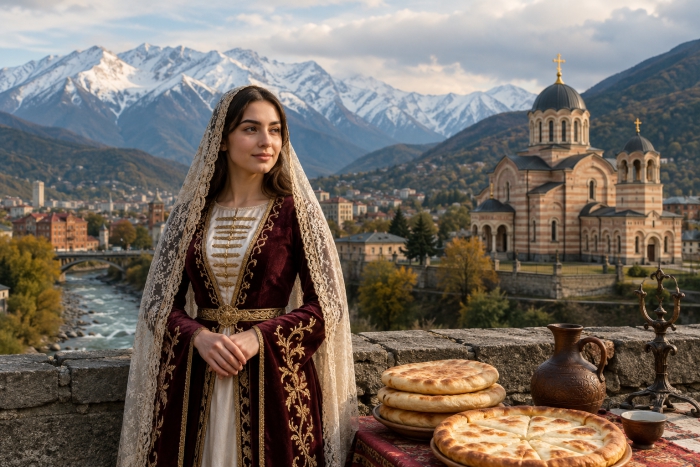
This is an oversimplification that deserves an honest nuance. It is true that the shared religious foundation — Orthodoxy — brings an Ossetian woman closer to a woman from Moscow or Saint Petersburg in certain ways: the liturgical calendar, the major religious holidays, a similar view of marriage as a sacrament. But Ossetian identity remains deeply Caucasian in its social structure: the weight of the extended family and clan, a sense of honour and hospitality comparable to that of her Muslim neighbours in the Caucasus, and distinctive traditions, such as the ritual of the three traditional Ossetian pies (fydjyn), served at every major family occasion — a powerful cultural symbol. An Ossetian woman is therefore neither a simple Orthodox-Slavic variant, nor a Muslim Caucasian woman: she occupies a unique cultural position, at the crossroads of two worlds.
Verdict: NUANCED. The shared Orthodox foundation genuinely brings the Ossetian woman closer to the Russian woman, but her family structure and traditions remain distinctly Caucasian.
Myth #5 — "Vladikavkaz Is Just a Garrison Town With Nothing to Offer"
This is a reductive image. Vladikavkaz, capital of North Ossetia, has about 300,000 inhabitants and carries a name that, on its own, tells its story: it literally means "she who rules the Caucasus" or "the mistress of the Caucasus." Founded in 1784 as a Russian fortress strategically guarding the entrance to the Georgian Military Road — one of the only practicable passes through the Caucasus mountain range connecting Russia to Georgia — the city became, in the 19th century, a major cultural and commercial hub of the region, where Russian, Armenian, Georgian, and Ossetian merchants mingled. Nestled at the foot of the mountains, with Mount Kazbek visible on a clear day, Vladikavkaz retains elegant 19th-century architecture, a legacy of its cosmopolitan border-town past.
Verdict: FALSE. Vladikavkaz is a regional capital of 300,000 people with a cosmopolitan past, strategically positioned at the entrance of the main route connecting Russia to Georgia across the Caucasus.
Myth #6 — "North Ossetia Has No History of Its Own"
This is false, and in fact the opposite is true. Ossetian history traces back to the Scythians and Sarmatians, then to the Alans, a cavalry people who founded a powerful medieval kingdom, Alania, allied at various times with Byzantium and with Georgia. This kingdom was broken by the Mongol invasions of the 13th century, forcing the Alans to retreat into the high valleys of the Caucasus, where their Ossetian descendants preserved their language and identity to this day, against all odds. The Nart sagas, a cycle of heroic legends shared with several Caucasus peoples but whose oldest roots are attributed to Scythian and Alan traditions, remain a living cultural reference, passed down through generations. More recently, the region's history has also known dark hours, notably the 2004 Beslan tragedy, which remains etched in Ossetian collective memory as a national trauma — a topic I address with the respect it deserves, without making it a defining element of my presentation of this nationality.
Verdict: FALSE. Ossetia has its own history going back to the Scythians and the Alans, with an independent medieval kingdom and a legendary epic — one of the richest and least known to Westerners of the entire Russian Caucasus.
Myth #7 — "An Ossetian Woman Isn't Really Proud, She's Just Reserved"
This is a misreading of a very real but misunderstood cultural trait. Ossetian pride — apsar, a concept close to personal and family honour — is a core value, instilled from childhood, and particularly strong among women. Far from being coldness or shyness, this pride shows in a direct gaze, a natural elegance in bearing, and a demand for respect that tolerates no misplaced familiarity in early exchanges. Only once trust has been established does the Caucasian warmth — legendary hospitality, a love of celebration, generosity — fully reveal itself. A Western man who mistakes this pride for indifference makes an interpretive error that can prove costly in the early exchanges.
Verdict: NUANCED. Ossetian pride is not coldness but a genuine demand for respect; the warmth and hospitality come afterward, once trust is established.
Myth #8 — "An Ossetian Woman Has Nothing to Offer Compared to a Classic Russian Woman"
This is reductive, and it deserves an honest explanation. An Ossetian woman is, administratively and culturally, fully Russian: she holds a Russian passport, speaks Russian daily, and shares with women from Moscow or Saint Petersburg a deep attachment to family values and, very often, the same Orthodox faith. But her Alan and Caucasian heritage gives her a particularly strong sense of honour and character, shaped by centuries spent defending a minority identity among predominantly Muslim neighbours. Ossetians are, incidentally, famous throughout Russia for their excellence in combat sports and wrestling, a cultural trait that reflects a discipline and tenacity found, in a different form, in the women of that same culture.
Verdict: NUANCED. An Ossetian woman shares the common Russian cultural foundation and often the same Orthodox faith, but with a Caucasian rootedness and strength of character that clearly set her apart from a woman of the major Russian metropolises.
Myth #9 — "She Will Never Adapt to Life in Canada, the UK, the US, or Australia"
I'll answer you honestly, without minimizing the real cultural differences. They exist — the importance of the clan, table rituals, the emphasis on hospitality — but they are noticeably less pronounced than for a woman raised in a practising Muslim culture of the Caucasus, precisely because the shared Orthodox Christian foundation with Western Christian culture provides some common reference points. What ten years of guidance at CQMI have shown me: couples who fail almost never stumble over cultural difference itself. They stumble over the man's lack of curiosity, his inability to genuinely take interest in what matters to her. A man who takes the time to learn, even briefly, about the Alans' history or the Nart sagas sends a signal of seriousness that immediately changes the nature of the relationship.
Verdict: NUANCED. The cultural differences are real but softened by a shared Christian foundation; they are only a serious obstacle for a man who refuses to take an interest.
What We Often Observe Among Our Members
From experience, after more than ten years at CQMI international matchmaking agency, we find that a man who approaches an Ossetian woman with the same reflexes he'd use with a Muslim woman from the Caucasus — over-cautious about religion, misplaced reserve — often surprises her, and not in a good way. The main factor for success is not the nationality itself, but the man's ability to observe first, rather than project expectations learned from a different culture.
The CQMI Method for Starting a Conversation With an Ossetian Woman
- Never assume she is Muslim. Ask tactfully and without insistence about her faith; most of the time, you'll discover an Orthodox Christian woman proud of her faith and her history.
- Learn about the Alans and the Nart sagas. Mentioning this unique historical lineage shows you've made the effort to understand who she really is, beyond the usual Caucasus clichés.
- Respect her pride from the very first exchanges. Avoid any premature familiarity; trust and warmth come afterward, naturally.
- Never confuse her with her Chechen or Ingush neighbours. This ethnic and religious distinction is fundamental to her.
- Only go through a serious agency. This nationality, still under-covered by Western agencies, deserves careful support, far from the PPL (Pay Per Letter) dating scams that trap so many Western men.
The 4 Mistakes to Avoid With an Ossetian Woman
- Assuming she is Muslim, like most of her Caucasian neighbours. This is the most common mistake, and often the most poorly received.
- Underestimating the weight of the clan and extended family. Even with an independent, urban woman, the family's opinion often remains present in the background.
- Confusing pride with coldness. Reading her initial reserve as a lack of interest is a classic — and costly — misjudgment.
- Bringing up the region's history clumsily. Some recent events remain sensitive; it's better to inform yourself with tact rather than improvise.
Two Stories From the Field
James's religious mix-up. James, our client from Toronto, had carefully prepared his first message by expressing "respect for her Muslim culture," convinced that any woman from the Russian Caucasus shared that faith. His match replied with a smile: "I'm Orthodox, like many Ossetians! We celebrate Easter and Christmas, just like you do." Far from being offended, she took pleasure in explaining, with warm humour, the Christian history of her people. James now admits that this honest mistake was the real starting point of their relationship.
Robert's meal. Robert, our client from Edinburgh, expected a fairly formal exchange with a member from Vladikavkaz. He was surprised by the quiet pride with which she described the three traditional Ossetian pies, prepared for every major family occasion, symbolizing the sun, the earth, and the water. "Antoine, she talked to me for twenty minutes about the symbolism of these pies, with a passion I had never seen in a Western woman!" he told me, still amused. What he didn't know at the time is that these culinary traditions are a powerful pillar of identity throughout Ossetian culture, far beyond a simple holiday meal.
Ossetian Woman, Chechen Woman, Russian Woman: The Real Differences
| Criterion | Ossetian Woman | Chechen Woman | Russian Woman (European Russia) |
|---|---|---|---|
| Heritage | Iranian (Alans, Scythians) | North-East Caucasian (Vainakh) | East Slavic |
| Religion | Majority Orthodox (~55-60%) | Majority Sunni Muslim (Sufi) | Orthodox |
| Native language | Ossetian (Iranian) + Russian | Russian + Chechen | Russian |
| Family structure | Extended clan, more flexible in cities | Highly structuring extended clan | Nuclear family |
| Core value | Pride (apsar), hospitality, honour | Honour, clan loyalty | Family warmth, practicality |
| Cultural symbol | Nart sagas, ritual pies | Rebuilding of Grozny | Varies by region |
| Meeting logistics | Vladikavkaz: flights via Moscow | Grozny: flights via Moscow | Varies by city |
Frequently Asked Questions About Ossetian Women
Is an Ossetian woman Muslim, like most women in the North Caucasus?
No, in most cases. North Ossetia is the only majority Orthodox Christian republic in the Russian North Caucasus, with about 55 to 60% of the population identifying as Orthodox. A minority practises Sunni Islam, mainly in the south-east of the Republic.
Do I need to speak Ossetian to pursue a serious relationship with an Ossetian woman?
No, that's not required. Russian is the everyday language of communication for nearly all Ossetians, and CQMI has translation assistants available to help from the very first contacts.
How can I meet an Ossetian woman from Canada, the UK, the US, or Australia?
The safest path remains a serious, verified matchmaking agency. Given how little this nationality is covered by Western agencies, rigorous support is essential to avoid fake profiles.
Is North Ossetia a safe destination for meeting a member?
The region's overall security situation has stabilized considerably. As with any Caucasus destination, CQMI recommends preparing every meeting with professional support, without improvisation.
What age difference is acceptable with an Ossetian woman?
As with all our members from Eastern Europe and the Caucasus, a gap of 2 to 10 years is the optimal success zone, with a reasonable maximum of 15 years depending on the age of both partners.
What You Really Need to Understand About Ossetian Women
An Ossetian woman is not just another geographic curiosity to add to a list of Russian Caucasus nationalities. She is the heir of a unique Iranian people, descended from the Alans, whose Orthodox Christian faith and distinct language make her an exception in a region otherwise won over by Islam. What the experience of CQMI international matchmaking agency confirms, after more than 350 successful marriages since 2014:
- Her Orthodox Christian faith, where it exists, genuinely brings her closer to a classic Russian woman — but her Caucasian identity remains fully asserted.
- Her pride is not coldness — it is a demand for respect that should be honoured from the very first exchanges, opening the way to a warmth that is very real.
- Her history, little known in the West, traces back to the Scythians and the Alans — a historical depth worth discovering before any approach.
If you are a serious man — in Canada, the UK, the US, or Australia — who wants to build a real life project with an Ossetian woman or another verified member from the Caucasus and Russia, our profiles page presents all of our candidates.
Ready to Meet a Serious Woman From Russia?
CQMI Agency has been operating since 2014. Our $350 CAD/month plan gives you access to 10 verified contacts of women genuinely motivated to build a lasting relationship. More than 40% of female applications are rejected during our screening process.
350+ successful marriages · Divorce rate < 7% · 1,750 verified members · No chatbots, no ghostwriters
Not sure yet? Take our 2-minute compatibility quiz to see if you're a good match for a serious relationship with a Slavic or Caucasus woman.
Questions? Write directly to Antoine: This email address is being protected from spambots. You need JavaScript enabled to view it.
To Go Further
Latest from Antoine Monnier
- A "Custom-Built" Russian or Ukrainian Wife? Here's Why You're Not the One Choosing
- Over 70? A Real Chance With Ukrainian Women
- Matchmaking Agency or Tinder, Bumble, Facebook: Which One Is Really Safer for Meeting a Russian or Ukrainian Woman?
- The Mirror Effect in Dating: Why She Reflects Your Fears Back at You
- Caring for Aging Parents: Why Ukrainian Women Never Really Leave Their Mother Behind