


Ukrainian and Russian Bride dating advices - CQMI blog

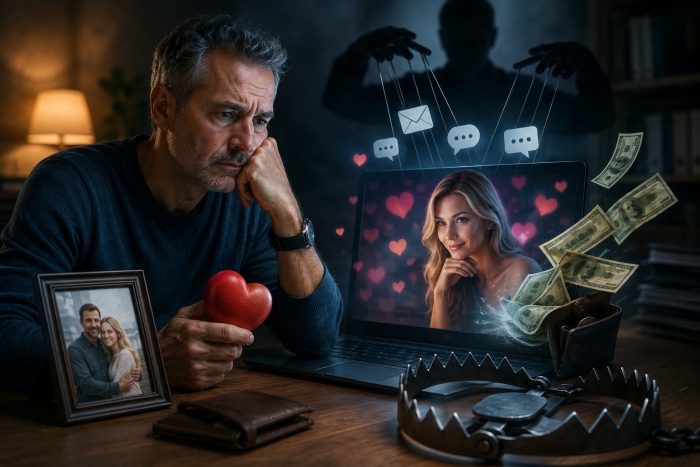 PPL Dating Scam
Agence CQMI
PPL Dating Scam
Agence CQMI
Why Men Fall Into PPL Dating Scams: The Psychology Nobody Explains to You
Men who fall into PPL sites are not naive or desperate. They are caught in powerful, well-documented psychological traps: sunk cost fallacy, intermittent reinforcement, cognitive dissonance. Understanding these mechanisms is the first step to breaking free — or never falling in. If you are serious about meeting a real Ukrainian or Russian woman, our complete guide to PPL dating scams is essential reading before you take another step.
By Antoine Monnier — Director and co-founder, CQMI Agency | July 2026
Why Men Fall Into PPL Dating Scams: The Psychology Nobody Explains to You
Let me tell you about a man I'll call David. A software engineer from Toronto, 52 years old. Divorced for four years, two adult kids, good income. The kind of man who reads the fine print before signing anything.
David lost over $12,000 CAD on a Ukrainian PPL site — five years of correspondence with a woman called "Daria." When I walked him through the mechanics of the system — the paid operators, the AI chatbots, the stolen photos — he nodded. He understood every word. And he kept writing to Daria.
That paradox is what this article is about. Not the stupidity of victims — because there is none. But the sophistication of the psychological mechanisms that trap intelligent, educated, successful men in virtual relationships that were never real. And if you want to understand the full scope of the PPL industry before reading further, start with our complete breakdown of PPL dating scams.
Men fall into PPL dating scams not from a lack of intelligence, but because these platforms deliberately exploit well-documented cognitive biases: the sunk cost fallacy, intermittent reinforcement (the same mechanism as slot machines), cognitive dissonance, narcissistic validation, and progressive emotional investment. The more time and money a man has given, the harder it becomes psychologically to leave — even when the evidence is overwhelming.
1. The Sunk Cost Fallacy: When Money Already Spent Becomes a Trap
This is arguably the most powerful mechanism of all, and it has a precise name in behavioural psychology: the Sunk Cost Fallacy.
The victim's reasoning goes like this — and it is perfectly logical within an emotionally broken logic:
"I've already spent $12,000. If I stop now, I have to admit all that money is gone — and that I was fooled for five years. If I keep going, maybe it will finally lead to something real, and my investment won't have been for nothing."
It is no longer simply a love story. It has become a desperate attempt to salvage self-esteem. The money spent stops being a financial loss and becomes a psychological argument to continue. It is exactly the same mechanism that drives compulsive gamblers to chase their losses — and destroys them.
In my years running CQMI, I have watched men who were completely certain they were being scammed continue anyway, because the alternative — admitting they had been manipulated for years — was simply too painful to face.
2. Cognitive Dissonance: Two Truths That Cannot Coexist
The human brain cannot hold two perfectly contradictory ideas without suffering. In psychology, this is called cognitive dissonance — and in PPL scams, it plays out in a remarkably predictable way.
Here are the two incompatible ideas the victim must manage simultaneously:
- "I am an intelligent, competent man who has built a successful life."
- "I may have been manipulated for five years by an AI system and a team of professional scammers."
These two statements cannot coexist. So the brain chooses. And very often, it chooses the first — because it protects the self-image. Evidence of the scam is then requalified:
- "Antoine is just trying to get me to sign up with CQMI."
- "Other guys might be scammed, but my situation is different."
- "She sent me a live selfie yesterday — proof she's real."
I personally watched David use all three arguments in the same conversation. He was not being dishonest. His brain was simply working to protect its internal consistency.
3. Intermittent Reinforcement: The Slot Machine Principle
This is where the teams behind PPL platforms show a level of professional sophistication that is both impressive and deeply troubling.
In behavioural psychology, intermittent reinforcement is the most powerful form of conditioning that exists. It underlies all addictions: alcohol, gambling, social media scrolling — and virtual romance.
The principle: the reward does not arrive predictably. Sometimes Daria goes silent for two days. Then suddenly — a burning message, a declaration, an intimate photo, a "I miss you so much." The brain receives a massive dopamine hit — precisely because the reward was unexpected. This is the exact mechanism that makes slot machines so addictive: it is the unpredictability of the reward that creates dependency, not the reward itself.
A regular viewer of my Sunday live sessions — Robert, 58, retired accountant from Edinburgh — described his PPL experience to me like this: "She would disappear for a week. And when she came back, the intensity was so overwhelming I forgot everything else. I lived for those moments." He had spent over £5,000 in 14 months. He couldn't understand why he couldn't stop. The answer is simple: his brain had been classically conditioned — like a laboratory rat — by a precisely calibrated intermittent reinforcement schedule. The operators knew exactly what they were doing.
4. Emotional Investment: Far More Than Money
After several months — and especially after several years — the man who walks away from Daria is not only losing money. He is losing:
- His daily routine: opening the site with his morning coffee, waiting for the first message.
- A future project: the trip to Kyiv planned "once things settle down," the first date imagined a thousand times.
- An identity: unconsciously, he has built a self-concept around being "a man who is in correspondence with a Ukrainian woman." That is now part of who he is.
- The only space in his life where he feels genuinely understood and desired.
That anticipated void is terrifying. And as long as the anticipated pain of leaving is greater than the current pain of the scam, the man stays. It is as simple — and as human — as that.
5. Narcissistic Validation: When the Need to Feel Desired Becomes a Vulnerability
Many of the men I see in these situations share one characteristic: they receive very few genuine compliments in their everyday lives. Work is routine. The children are grown. The ex-wife is gone. Close friends, few.
Suddenly, a woman described as a "former model, age 29" tells them:
- "You are so intelligent — you understand things no one else does."
- "I think about you all day."
- "I have never felt a connection like this with any man."
This is not pathological narcissism. It is a fundamental human need — to be seen, recognized, desired — being exploited with surgical precision by operators trained to deliver exactly this type of emotional reward on demand.
I want to be clear: this does not make these men weak. It makes them human. The people designing these systems understand human psychology better than their victims do. That is the only asymmetry that matters here.
6. Projection: Falling in Love With Yourself
Here is perhaps the most uncomfortable truth in this entire article:
The man who has been corresponding with Daria for five years does not know Daria. He has never seen her move, never heard her laugh, never touched her hand. The vague areas of her personality — her sense of humour, how she handles conflict, her actual values — have all been filled in by his own imagination.
What he loves is a character he co-constructed. A projection of his own desires onto an empty silhouette. In simple terms: he has fallen in love with a version of himself in a relationship.
That is why, when you prove to him that the person behind the messages does not exist, the grief is real. Because the loss he is mourning is not Daria's. It is his own idealized vision of himself in love.
I created a test profile on UA Dreams myself — out of professional curiosity. In under four minutes, I had received nineteen messages from women who all looked like Miss Ukraine finalists. One had already written that she felt a "special energy" from my profile. My profile was empty. My photo was blurry. My eyes weren't even visible in the picture. I still receive their messages months later, despite multiple unsubscribe attempts. The system is engineered to never let you go.
7. The Illusion of Control: "I'm Smarter Than the Average Guy"
This is the final psychological lock — and the most resistant to force.
Every man who engages with a PPL site thinks, at some point: "I'm careful. I know these scams exist. I'm not the type to get taken in."
This is exactly what every single victim thinks. Without exception. It is actually one of the early warning signs of manipulation: the firm belief that you are immune to it.
The scam operators know this too. Which is why the first weeks are so carefully constructed to feel authentic: a few small imperfections in the photos, variable response times, an occasionally clumsy phrase. Just enough apparent realism to feed the illusion of control.
8. Confirmation Bias: Seeing What You Want to See
Once the process is underway, the brain switches to selective mode. Every positive element becomes proof that the relationship is real. Every negative element is minimized, requalified, or ignored entirely.
| Objective red flag | How the victim reframes it |
|---|---|
| Cannot contact her directly — email always hidden | "She's being careful, that's a good sign" |
| Perfect English despite "barely knowing any" | "She's learning fast — that shows she cares" |
| Disguised money request for "translation fees" | "It's a small amount, it shows her good faith" |
| Same photo found on multiple profiles | "Someone must have stolen her photos" |
| No in-person meeting after two years of correspondence | "She wants to be absolutely sure before committing" |
9. Hope: The Hardest Emotion to Kill
Behind all of this, there is one thing that even the most brilliant psychologists struggle to treat: hope.
What these sites sell is not a woman. It is a new life. A second chance. The end of loneliness. A home. A family. A woman who is waiting for you.
Hope can become stronger than evidence. This is a neurological reality: the limbic system — which governs emotions and motivation — is more powerful than the prefrontal cortex — which governs reason — in situations of intense emotional charge. In plain language: when desire is overwhelming, the reasoning brain is literally outgunned.
This is why I never say that PPL victims are stupid. I say they are human. And that the designers of these platforms employ entire teams to exploit precisely that humanity.
PPL Sites vs. CQMI: Two Radically Opposed Models
I have often been told — sometimes in good faith — that CQMI is "more complicated" than PPL sites. And that is true.
| PPL sites (UA Dreams, Anastasia Date…) | CQMI Agency |
|---|---|
| Profile created in 3 minutes (only required info: your credit card) | Complete profile, verified photos, selection interview |
| Hundreds of model-quality messages in the first minutes | 10 verified contacts per month, matched to your profile |
| Every message costs money (Pay Per Letter) | $350 CAD for a full month — no per-message charges |
| No real contact possible (phones censored, emails hidden) | Direct contact with women, with coordinator support |
| Optimized for immediate reward and addiction | Optimized for real marriage — sometimes disappointing short-term |
| Real women or AI — you will never know | 1,750 verified women, civil status and criminal record checked |
The business model says everything. PPL sites make money when you stay in the virtual relationship. CQMI builds its reputation when you get married. Our interests are the exact opposite of theirs.
The 5 Mistakes That Make You Vulnerable to PPL Scams
- Seeking comfort over reality. PPL sites offer the emotional experience of a relationship with none of the risk — no rejection, no real encounter, no need to question yourself. That comfort is precisely the trap.
- Confusing quantity with quality. A hundred messages in an hour do not mean a hundred women are interested in you. They mean an automated system has been designed to make you feel desired.
- Ignoring red flags out of fear of losing "the relationship." If you are minimizing warning signs because you are afraid to discover the truth, that fear is itself the most important signal.
- Mixing financial investment with proof of love. Paying per message does not make the messages more real. Love does not have a per-letter price tag.
- Believing you are immune. If you have ever thought — even for a second — that you are too smart to fall into these traps: please reread point 7.
FAQ — Psychology of PPL Dating Scams
Can an intelligent, educated man really be trapped by a PPL site?
Yes, absolutely. Intelligence does not protect against cognitive biases — it can actually amplify them, by helping the victim construct more sophisticated rationalisations. Studies on romance fraud consistently show that victims are statistically above average in terms of education and income. The psychological mechanisms at play would affect any human being exposed to professional-grade emotional manipulation.
How do I know if I am being scammed on a dating site?
Four key questions: (1) Can I contact this woman directly, without going through the platform? (2) Have I had a real, spontaneous video call that I did not have to schedule? (3) Has she declined every suggestion to meet in person for more than three months? (4) Have I spent more money to communicate than a return flight ticket to meet her would cost? If you answer "no" to (1) or "yes" to (4), the signals are serious.
What is intermittent reinforcement in the context of a romance scam?
Intermittent reinforcement is a psychological mechanism where the reward arrives unpredictably. In PPL sites, the "woman" may disappear for days, then send an intensely warm, intimate message. That unpredictability creates a powerful dependency — exactly like a slot machine. It is one of the best-documented tools in behavioural psychology, and one of the most effective instruments of emotional addiction.
Why is it so hard to leave a virtual relationship even when you know it's fake?
Because the man is not only losing a virtual relationship. He is also losing a daily routine, a future project, an identity built around that correspondence, and the only space in his life where he feels genuinely valued and desired. The anticipated void is often more painful than the current pain of the scam. This is why emotional investment — beyond the financial — is the hardest lock to break.
What is the real difference between a PPL site and a serious matchmaking agency like CQMI?
PPL sites make money when you stay in the virtual relationship — they have every incentive to keep you hooked. CQMI builds its reputation when you get married. The business model tells you everything. Concretely: at CQMI, $350 CAD per month gives you access to 10 fully verified women, with direct contact details, no per-message fees, no AI, and real support toward marriage. Take the CQMI compatibility quiz to see if our approach is right for you.
Conclusion: Intelligence Doesn't Protect You — Knowledge Does
David, the Toronto software engineer from my introduction, eventually cut contact with Daria. Not because I convinced him the scam was real — he already knew that. But because he finally understood why he couldn't leave. Naming the mechanism released him from the mechanism.
There is no shame in having been caught in this system. It would be a shame to stay in it once you understand how it works.
If this article has resonated with you, or if you know someone in this situation, read our complete analysis of PPL dating scams — and take the step toward something real.
The Ukrainian and Russian women who join CQMI are not looking for virtual emotions. They are looking for a man ready to commit, to build, to marry. They are looking for a life partner — not a pen pal.
Ukrainian and Russian women who marry through international matchmaking agencies like CQMI are not looking for a one-night stand. They are not interested in virtual relationships. They want a real man, a real commitment, a real life together. If that is not what you are looking for, please do not apply — you would be wasting their time and your own.
If it is what you are looking for — then your place is here.
The CQMI Subscription — No Illusions, Real Results
$350 CAD for 1 month — 10 contacts of verified Ukrainian and Russian women, selected to match your profile. No per-message fees. No AI. No avatars. Real women with real intentions.
Discover the CQMI subscription
Questions? Write directly to This email address is being protected from spambots. You need JavaScript enabled to view it.
Latest from Antoine Monnier
- Ukrainian Woman Asks You for Money: Scam or Sincere?
- Ukrainian Refugee Women: Why Their Host Country Changes Everything
- Ukrainian or Russian Woman: 7 Signs She Is Truly Single and Serious About Marriage
- Ukrainian Woman and Marriage: Why It Is Her Only Real Safety Net
- Language Barrier With a Ukrainian or Russian Woman: The Complete Guide

 +1 514 794-5053