


Ukrainian and Russian Bride dating advices - CQMI blog

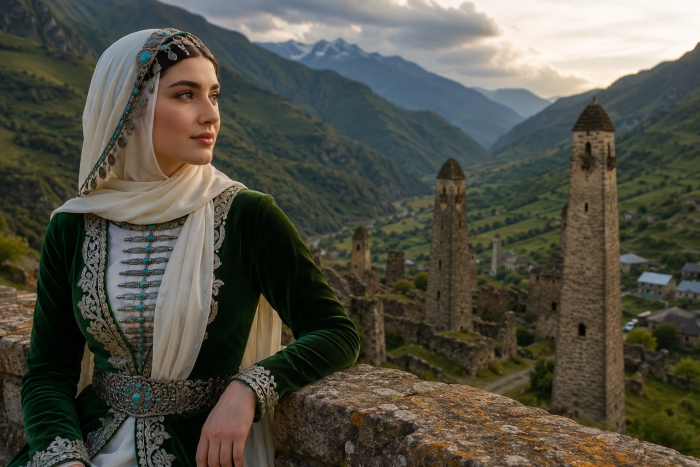 Ingush Women of Ingushetia
Agence CQMI
Ingush Women of Ingushetia
Agence CQMI
Ingush Women of Ingushetia: 9 Myths Debunked You Need to Know
In brief
An Ingush woman from the Republic of Ingushetia is neither a "Chechen by another name" nor a veiled, silent figure to tick off a checklist of exotic nationalities. She is the heir of a Vainakh people of the North Caucasus, distinct from the Chechens despite a shared language and history, living in the smallest republic of the Russian Federation (3,628 km2, roughly the size of Prince Edward Island). Her culture rests on three inseparable pillars: adat, the Caucasian customary law governing hospitality, honour and family solidarity; the teip, the patrilineal clan every Ingush belongs to from birth; and Sunni Islam, practised since the 18th century but never erasing the older codes of the Caucasus. If you are not serious - if you are looking for a one-night stand - please stay away. These women are looking for one thing only: marriage and a lifelong union.
Article by Antoine Monnier, director and co-founder of CQMI, the international matchmaking agency specialising in serious relationships between Western men and women from Russia, Eastern Europe, the Caucasus and Central Asia since 2014.
The Caucasian people almost nobody in the West has heard of
In more than ten years running CQMI, I have learned one thing: the less known a nationality is in the West, the more authentic and available the women from it tend to be, simply because nobody is looking for them yet. A few months ago, a client from Toronto - let's call him James, 51, an engineer - asked me why I had never mentioned women from the Russian Caucasus. I answered with a simple question: "Do you know what a teip is?" He didn't. Neither do the vast majority of men from Canada, the UK, Australia or the US who contact us.
And yet, a few hundred kilometres from the Caspian Sea, in the south-western corner of Russia, lives a people of about 500,000 who survived Mongol invasions, Islamisation, Stalin's 1944 deportation, two neighbouring Chechen wars and a territorial conflict with North Ossetia - without ever losing their identity. This people calls itself the Ingush, or Ghalghai, as they refer to themselves. To place this culture within the broader Slavic and Caucasian world we usually introduce our members from, our reference page on Russian women remains the best starting point before turning to a republic as singular as Ingushetia.
What ten years of matchmaking has taught me is that men who succeed with a Caucasian woman are the ones who accept learning the codes before trying to charm her. That's what this article is about.
Short answer
In short: an Ingush woman is a Russian citizen of Vainakh (Nakh) origin, a Sunni Muslim, whose social life is structured by the teip (patrilineal clan) and adat (customary law). She lives within a large, hierarchical family framework where honour, modesty and hospitality are core values - but she is also, increasingly, university-educated and employed, in a country with the highest life expectancy in all of Russia. She resembles neither the stereotype of the Slavic woman, nor the often-caricatured Western image of "the submissive Caucasus woman." She is looking for a stable man who respects her family and is capable of patience - not an adventurer.
Myth #1 - "Ingushetia is basically Chechnya, same thing"
This is the most common mistake, and it largely explains why this nationality remains invisible on the Western matchmaking market: people confuse it systematically with its larger neighbour. Ingushetia has been its own federal subject of the Russian Federation since 1992, the year the former Chechen-Ingush Autonomous Soviet Socialist Republic split in two. Today it is the smallest republic in Russia by land area - barely 3,628 km2 - with a population of roughly 500,000, over 94% of whom are ethnic Ingush.
Its capital is not even the region's best-known city. Until 2002, the capital was Nazran, today the country's largest city with about 122,000 residents. Since December 2002, political power has sat in Magas, a brand-new capital built four kilometres away. The Ingush language, Ghalghai-mott, belongs to the Nakh branch of the North Caucasian languages: it is related to Chechen, mutually intelligible to a degree, but remains a distinct language with its own literature and identity.
Myth #2 - "It's a war zone, too dangerous for a life project"
I won't brush this question aside, because it deserves an honest answer. Ingushetia's recent history has indeed been marked by violence: the October-November 1992 Ossetian-Ingush conflict over the Prigorodny district killed several hundred people and displaced tens of thousands of Ingush; in June 2004, a raid by hundreds of fighters from Chechnya struck Nazran, killing around a hundred people, mostly Ingush law enforcement officers.
But what the statistics say about daily life in the republic today runs surprisingly against the stereotype: Ingushetia has the highest life expectancy of any region in the Russian Federation, around 80.5 years, well above the national average. Demographers point to lifestyle factors - near-absent alcoholism due to religious prohibition, strong family cohesion, traditional diet. The economic reality is harsher: structurally high unemployment and heavy dependence on federal subsidies. This is a point I always raise directly with my clients, because honesty serves them better than a postcard image.
Myth #3 - "Muslim from the Caucasus means veiled and submissive"
This is the shortcut I hear most often from men discovering this nationality, and it's also the one most worth unpacking, because reality is richer than the Western media cliche of "the Caucasus Muslim woman."
The Ingush have been Sunni Muslims of the Shafi'i school since the 18th century, often linked to Sufi orders such as the Qadiriyya or Naqshbandiyya - a mystical form of Islam, focused on personal piety and respect for elders, very different from the political Islam that dominates the news. This religious framework imposes real modesty in dress and behaviour, strict respect for family hierarchy, and a central place for the household. But it coexists with adat, the customary law, which grants women a recognised role as guardian of the home and of education - respected within the clan, not ignored.
On the material side, reality also contradicts the stereotype of the uneducated woman: literacy is close to 100%, and many young Ingush women pursue higher education, notably in medicine, law and teaching, in Nazran, Vladikavkaz or Rostov. What I have observed for years is that an Ingush woman's modesty is not passive submission - it is a social code she carries with pride, not a constraint she suffers in silence.
Myth #4 - "The clan system, the teip, is folklore from another century"
This is false, and it's probably the most misunderstood element of Ingush culture among a Western audience. The teip is a patrilineal, exogamous clan grouping families descended from a common ancestor. There are dozens of them, some counting thousands of members across sub-branches. This system, inherited from adat customary law, still concretely structures social life today: it regulates marriage alliances (marrying within one's own teip is forbidden, treated as a symbolic form of incest), and it organises economic mutual aid and conflict resolution through mediation by elders rather than the courts.
For a Western man considering a serious relationship with an Ingush woman, understanding the teip is not an anthropological curiosity - it's a practical key. A union is rarely a strictly individual matter - it involves, at least symbolically, the entire extended family. This is something to factor in, not to work around.
Myth #5 - "Wedding traditions don't matter to younger generations anymore"
False, and actually the opposite is true: Ingush wedding rituals remain remarkably alive, even among young urban women in Nazran or Magas. A traditional wedding unfolds over several days, with separate celebrations for men and women; the bride wears a silver belt called datu tejxkar, set with turquoise - a symbol of purity - sometimes with emeralds or rubies. The custom known as nuskalg mot bastit ("untying the bride's tongue") has the young woman stay silent throughout the festivities while offering small gifts she has embroidered herself, as proof of her skill and patience.
Marriage rules remain strict: marrying within one's own teip is forbidden, marrying outside the ethnic group is traditionally frowned upon, and marrying a Chechen is tolerated but not always well regarded by the extended family. For a Western man, this means one very concrete thing: the relationship is never built with her alone - at some point, it is also built with her family's approval. That is not an obstacle if you anticipate it with respect - it is an obstacle if you ignore it.
Myth #6 - "She just wants to leave the country, nothing keeps her there"
I'll answer this with the same honesty I use with my clients in consultation, without dressing up the region's economic reality. Ingushetia faces structurally high unemployment and an economy heavily dependent on federal subsidies - that's no secret, and denying it would do a disservice to any of my clients. But reducing an Ingush woman's approach to an economic exit strategy would be an analytical mistake, and frankly an insult to the reality of her family culture.
In a society structured by the teip and adat, the extended family traditionally takes care of members in difficulty - the safety net is not only individual, it is collective. What Ingush women who contact us are looking for, in the vast majority of cases, is a stable man who respects their family values, in a country where divorce, male alcoholism and marital instability remain well-documented concerns across Russia as a whole. What separates a sincere approach from an exit strategy: she will talk to you about your character and your relationship with her family long before she asks about your income.
Myth #7 - "A closed culture, hostile to outsiders"
This is the exact opposite of what adat itself teaches. Unconditional hospitality towards a guest is one of the founding principles of Caucasian customary law: a guest received by an Ingush family traditionally enjoys protection and consideration that far exceed Western norms. This is not a facade - it is a matter of honour, on the same level as family solidarity or respect for elders.
What I consistently see with clients travelling to Ingushetia or meeting an Ingush family remotely: the initial welcome can feel formal, almost ceremonious, but it very quickly turns into genuine warmth once the man shows respect for the codes and the people. The initial reserve is not coldness - it is a structured politeness that precedes real hospitality.
Myth #8 - "A woman from the Caucasus is basically the same as one from Dagestan or Ossetia"
Confusing the peoples of the North Caucasus is almost automatic in the West, and it's worth correcting with precision. The Ingush belong, together with the Chechens, to the Vainakh (or Nakh) group of North-East Caucasian languages - a distinct linguistic and cultural group.
Neighbouring Dagestan, to the east, is in fact not one people but a mosaic of more than thirty distinct indigenous peoples (Avars, Lezgins, Dargins, Kumyks and many others), each with their own language - one of the most linguistically diverse territories on earth. North Ossetia, to the north-west, is home to the Ossetians, descendants of the Alans, an Iranian-origin people whose language has no link to Nakh, and who are predominantly Orthodox Christian rather than Muslim - a major religious difference from the Ingush. Three neighbouring republics, three peoples, three languages, three histories: lumping them together is like confusing a Portuguese and a Pole because they both live in Europe.
Myth #9 - "She will never adapt to life in Canada, the UK, Australia or the US"
I'll answer honestly here, without downplaying the real cultural differences. They exist, and it would be dishonest to pretend otherwise. Food, for a start: traditional dishes such as chepalgash (a flatbread stuffed with fresh cheese) or jijig-galnash (boiled meat served with wheat or corn dumplings) hold a central place in family and festive life - politely declining is no drama, but showing interest is always appreciated. The bond with the extended family, next: an Ingush woman will not cut ties with her parents and her teip to fully adapt to a Western lifestyle - that is not negotiable, and it is not a question to ask her.
What ten years of matchmaking at CQMI has shown me: couples who fail almost never trip over cultural difference as such. They trip over the man's lack of curiosity, his inability to genuinely take interest in what matters to her. A man who takes the time to learn even a little about the teip, about adat, about the history of Ingushetia sends an immediate signal of seriousness that changes the nature of the relationship.
Ingush woman, Chechen woman, Russian woman: the real differences
| Criterion | Ingush woman (Ingushetia) | Chechen woman (Chechnya) | Russian woman (European Russia) |
|---|---|---|---|
| Heritage | Vainakh (Nakh), teip and adat, smallest republic in Russia | Vainakh (Nakh), teip and adat, history marked by two wars | East Slavic, Eurasian Orthodox culture |
| Religion | Sunni Shafi'i Islam, Sufi orders (Qadiriyya, Naqshbandiyya) | Sunni Shafi'i Islam, Sufi orders very present | Orthodox Christian (practice varies widely) |
| Core value | Family honour, hospitality, discretion, respect for elders | Family honour, national pride, resilience | Family warmth, practical sense, directness |
| Social structure | Teip (patrilineal clan), marrying outside the clan required | Teip also present, comparable structure | Nuclear family, no clan system |
| Temperament | Reserved, modest, warm once trust is established | Proud, direct, very protective of family image | Warm, reserved at first contact, direct |
| Approach to marriage | Very strong commitment, multi-day rituals, family approval central | Very strong commitment, central role of family | Strong, varies by region and generation |
| Languages | Ingush + Russian (fluent) | Chechen + Russian (fluent) | Russian |
| Meeting logistics | Nazran / Magas: flights via Moscow or Vladikavkaz | Grozny: flights via Moscow | Varies by city |
The 5 mistakes men make with Ingush women
Read carefully before making first contact.
- Confusing her with a Chechen or a Dagestani woman. An Ingush woman knows exactly who she is. Showing that you know the difference - Ingushetia is not Chechnya, Magas is not Grozny - is a sign of respect she will notice immediately.
- Underestimating the weight of the teip and the extended family. A serious relationship never involves just her. Asking sincere questions about her family, her parents, her siblings, is essential - ignoring this is a mistake that is hard to undo.
- Confusing modesty with a lack of personality. Initial reserve is not submission. An Ingush woman who opens up has chosen to trust you - a choice you need to earn, not demand.
- Going through unverified platforms. This nationality, still little known to serious agencies, is a prime target for fake profiles. Our article on Pay Per Letter (PPL) dating scams will give you the tools to tell the real from the fabricated.
- Overlooking religious codes out of simple carelessness. It's not about sharing her faith, but about respecting it in practice - in gestures, in timing, in the topics you raise on a video call. A little attention avoids many avoidable misunderstandings.
Two stories from the field
The teip James learned to respect
James, our client from Toronto, had been talking with a member from Nazran for a few weeks when he called me, worried: she had told him she needed "to speak with her uncle" before agreeing to another video call. He feared a disguised rejection. I explained the role of the teip and the elders in family decisions. He waited, and asked sincere questions about this uncle on their next call. Three weeks later, she told him the family had given its approval to arrange a meeting. "Antoine, I almost ruined everything out of impatience," he told me. They have now been together for eight months.
Robert's chepalgash
Robert, our client from Edinburgh, was invited to taste chepalgash during a video call with the mother of a member, who proudly showed him how she was making it. Not knowing what it was, he asked, with a slightly embarrassed smile, how it was eaten and whether he could "get a slice through the screen." The whole family burst out laughing - a warm laugh, not a mocking one. "You're the first Western man who asked for the recipe instead of pretending he already knew," his contact later told him. They are now planning their first trip to Nazran.
Frequently asked questions about Ingush women
Do I need to be Muslim to consider a serious relationship with an Ingush woman?
No, it's not a strict requirement, but sincere respect for her religious practices and her modesty is essential. Many of our members are looking above all for a man who respects their values, not necessarily a convert.
How can I meet an Ingush woman from Canada, the UK, Australia or the US?
CQMI helps establish connections with verified members from across Russia, including the North Caucasus, with personalised support at every step.
Will the teip and the extended family be an obstacle to the relationship?
No, as long as they are respected. A man who is patient and respectful of the family's collective decisions is generally well received.
Will an Ingush woman agree to move to Canada, the UK, Australia or the US?
Yes, in many cases, provided the bond with her family is preserved through regular visits and continued respect for traditions.
What age difference is acceptable with an Ingush woman?
A gap of 2 to 10 years remains the most common success zone, as with the Russian-speaking women we work with overall. Our article on age difference covers this topic in depth.
What you really need to understand about Ingush women
An Ingush woman is not an exotic curiosity to add to a list of nationalities. She is the heir of a people of about 500,000 who survived Stalin's 1944 deportation, the 1992 split of their republic, and the violence of the 2000s - and who has been rebuilding, ever since, in the smallest republic in Russia, an identity built on family, honour and hospitality.
What CQMI's experience as an international matchmaking agency confirms, after more than 350 successful marriages since 2014:
- Her initial reserve is not coldness - it is a modesty that must be earned, and which then gives way to unwavering loyalty.
- The role of her family and her teip is not an obstacle to work around - it is a reality to respect, one that, once accepted, opens the door to a rare warmth of welcome.
- Her uniqueness - Vainakh yet distinct from the Chechens, Muslim yet shaped by Caucasian adat - is not an added difficulty. It is what makes the relationship profoundly different from anything you have known before.
If you are a serious man - in Canada, the UK, Australia or the US - looking to build a real life project with a woman from Russia or the Caucasus, our page on Russian women presents the full range of our verified members, some of whom come from the North Caucasus.
Ready to meet a serious woman from Russia or the Caucasus?
CQMI has been operating since 2014. Our plan - $350 CAD/month - gives you access to 10 verified contacts of women genuinely motivated to build a lasting relationship. More than 40% of female applicants are rejected during our screening process.
350+ successful marriages - Divorce rate under 7% - 1,750 verified members - No chatbots, no ghost translators
Questions? Write directly to Antoine: This email address is being protected from spambots. You need JavaScript enabled to view it.
Further reading
Latest from Antoine Monnier
- Ukrainian Woman Asks You for Money: Scam or Sincere?
- Ukrainian Refugee Women: Why Their Host Country Changes Everything
- Ukrainian or Russian Woman: 7 Signs She Is Truly Single and Serious About Marriage
- Ukrainian Woman and Marriage: Why It Is Her Only Real Safety Net
- Language Barrier With a Ukrainian or Russian Woman: The Complete Guide

 +1 514 794-5053