


Ukrainian and Russian Bride dating advices - CQMI blog

 Komi women
Agence CQMI
Komi women
Agence CQMI
Komi Women of the Komi Republic: 9 Myths Debunked — What You Never Knew
In brief
A Komi woman from the Komi Republic is neither Slavic, nor Siberian, nor a figure frozen in an ethnographic museum display case. She is the heir to one of the oldest Finno-Ugric peoples of European Russia — related to Finns, Estonians and Udmurts — whose people created their own written script in the 14th century, survived Stalin's purges, the Vorkuta Gulag camps, and who today resists linguistic erasure with quiet pride. A minority on her own land (roughly 23% of her republic's population), fully fluent in Russian, professionally active, and bearer of a craft tradition that predates Scandinavian knitting — yet so poorly understood by Western men who mistake her for just another woman from provincial Russia. Read what follows before forming any opinion.
Article by Antoine Monnier, director and founder of CQMI international matchmaking agency, specialist in serious relationships between Western men and women from Russia, Eastern Europe, the Caucasus and Central Asia since 2014.
Let me be direct with you.
Over more than a decade at CQMI, I have had hundreds of conversations with men from Canada, the UK, and Australia who are looking for a serious, lasting relationship. When I mention the Komi Republic, the silence that follows is almost always the same — deep, curious, slightly embarrassed. "Komi… where exactly is that?" Most of the time, the mental image that forms is somewhere between oil pipelines, frozen tundra, and perhaps — for the more historically minded — a faint memory of the Gulag railway that once served the Vorkuta labour camps.
What very few men know is that the Komi Republic is home to one of the oldest Finno-Ugric peoples in European Russia — the Komi, formerly called the Zyryans — who have their own language, their own literature, their own geometric knitting patterns recognizable a mile away, and an identity built on centuries of coexistence with Russian settlers, Novgorod merchants, Orthodox missionaries and Gulag deportees. Its capital, Syktyvkar, a city of around 245,000 people at the confluence of the Sysola and Vychegda rivers, has a State Opera and Ballet Theatre, a university, a daily airport connection to Moscow — and a Finno-Ugric cultural life unique in all of Russia, anchored by the Federal Finno-Ugric Cultural Centre that has called Syktyvkar home since 2007.
I remember James, a client from Toronto, 51 years old, who told me before his first contact with a member originally from Syktyvkar: "Antoine, I'm open to trying, but I'm worried about meeting someone completely cut off from modern life — no education, no real-world connection." Three months later, he called me back to say she had sent him a long article about the revival of Finno-Ugric languages in Europe, along with a pair of hand-knitted wool socks in traditional Komi geometric patterns, using a technique over six centuries old. "She taught me more about Russian history in two weeks than I ever learned in school," he said.
If you are not serious — if you are looking for a one-night stand or an exotic fantasy — please stop reading here. These women are not looking for casual encounters. They are looking for marriage and a lifelong union.
To place Komi women within the full diversity of Russian women as a whole — the Komi Republic is an integral part of the Russian Federation — our dedicated page is the best starting point.
Quick answer
A Komi woman is a Russian citizen of Finno-Ugric origin — fully fluent in Russian, educated, professionally active, and deeply rooted in a cultural identity that is distinct from mainstream Russian culture yet perfectly compatible with modern life. She is not Slavic, not Siberian, not a shaman in any primitive sense — and she deserves to be understood for who she actually is, not for what stereotypes would have her be.
Myth #1 — "The Komi are just another Slavic Russian people"
This is the most common error — and the most telling sign of a lack of geographic curiosity. The Komi are not Slavic. Ethnically, linguistically and genetically, they belong to the Finno-Ugric group of peoples, the same broad family as the Finns, Estonians, Hungarians, Maris and Udmurts. Their language, Komi (or Komi-Zyrian), belongs to the Permic branch of the Uralic languages — a linguistic family entirely separate from the Slavic languages to which Russian belongs. In 1379, the Orthodox missionary Stephen of Perm arrived in Komi territory to evangelise the population; remarkably, he created for them a dedicated alphabet based on traditional Komi ornamental motifs, making them one of the very first Finno-Ugric peoples to have their own written script — long before most nations of Eastern Europe. Today, around 108,000 people still speak Komi-Zyrian, and the Komi Republic has been officially bilingual (Russian and Komi) since its 1994 constitution.
Myth #2 — "The Komi Republic is a remote hole deep in Siberia"
Two mistakes in a single sentence. First, the Komi Republic is not in Siberia — it sits in the north-east of European Russia, west of the Ural Mountains, within the North-West Federal District. Second, while the geography is genuinely austere — 415,900 km² of taiga, peat bogs and tundra, roughly three-quarters the size of France — Syktyvkar, its capital, is far from an outpost of civilization. The city has a State Opera and Ballet Theatre, an academic drama theatre, a Philharmonic Hall, a National Gallery and a state university. Since 2007 it has housed the Federal Finno-Ugric Cultural Centre, which regularly hosts international academic conferences drawing researchers from Finland, Estonia and Hungary. Syktyvkar airport runs daily flights to Moscow. It is not Tokyo — but it is a modern, connected city with a genuine intellectual life.
Myth #3 — "She still lives in a yurt by the river"
No Komi person has ever lived in a yurt. Yurts are the traditional dwelling of nomadic steppe peoples — Mongols, Kazakhs, Kyrgyz. The Komi, a people of the boreal forest, have always built wooden houses suited to the taiga environment. Historically sedentary, living by hunting, fishing and progressively agriculture since the Middle Ages, the Komi developed a distinctive rural architecture still visible in the villages of the Vychegda valley. Today, around 70% of the Komi Republic's population is urbanised — an urbanisation rate actually higher than the Russian national average. The Komi woman you will meet today lives in an apartment, works in the oil and gas industry (which generates 70% of the region's revenue), in education, healthcare, culture or the public sector — exactly like any woman in a major Russian city.
Myth #4 — "She is a shaman who performs obscure rituals"
Komi shamanism is real — but it belongs essentially to the pre-Christian past and to cultural memory, not to daily practice. Before Christianization by Stephen of Perm in the late 14th century, the Komi practiced a complex animist religion: belief in guardian spirits of the forest (vörsa), the water (va-kulya), the hearth; shamanic rituals for hunting and healing; a tripartite cosmology typical of Finno-Ugric peoples. These traditions were progressively absorbed into Russian Orthodoxy without fully disappearing — villages along the Vychegda still preserve some gestures of respect for "forest spirits" in tales and proverbs. But the Komi woman you will meet today is, in the vast majority of cases, a practising Orthodox Christian or a secular atheist. She celebrates Christmas on January 7th, often marries in church, and if she mentions vörsa, it is with the fond distance of someone quoting a familiar fairy tale, not with the conviction of a practitioner.
Myth #5 — "She is fleeing poverty and Gulag-era misery"
It is true that the Komi Republic carries an extraordinarily painful history. During the 1930s and 1940s, Komi territory became one of the central sites of the Soviet Gulag: Vorkuta, Inta and Ukhta received hundreds of thousands of deportees from across the Soviet world. That massive presence — including condemned intellectuals, musicians and scientists — paradoxically enriched the region's cultural life and forged in the Komi people a particular relationship with silence, discretion and solidarity. Stalin's purges wiped out the Komi intelligentsia in the 1930s, accused of "bourgeois nationalism." But reducing a Komi woman's motivations to economic flight would be a serious analytical error. The Komi Republic today generates significant oil revenues (Lukoil operates extensively here, as does Mondi in the paper sector), and regional GDP per capita is above the Russian national average. In our experience at CQMI, the woman who enters an international dating process is motivated primarily by a structural demographic imbalance — a shortage of available, qualified and reliable men in adult age brackets — and a deep conviction that a Western partner will offer a better life foundation.
To protect yourself from platforms that exploit these women's genuine intentions, our analysis of Pay Per Letter (PPL) dating scams is essential reading before you spend a single dollar on any platform.
Myth #6 — "She only speaks Komi — communication is impossible"
This would be amusing if it did not genuinely mislead well-meaning men. Russian is the dominant language in all public, professional and educational life in the Komi Republic. In 1929, still 70–80% of the population spoke Komi daily; after mass deportations, forced Russification and an influx of Russian-speaking oil workers, Komi is today spoken mainly in rural areas and by older generations. The 1994 constitution grants it co-official status alongside Russian — symbolic bilingualism in Syktyvkar (street names, signs), real bilingualism in some villages of the Vychegda valley. Around 108,000 people still speak Komi-Zyrian fluently by recent estimates. But the urban Komi woman you will meet speaks Russian with exactly the same fluency as a Muscovite. Our bilingual French/English-Russian interpreters support all your initial exchanges without ever inserting themselves into the relationship itself.
Myth #7 — "She looks Asian or Siberian"
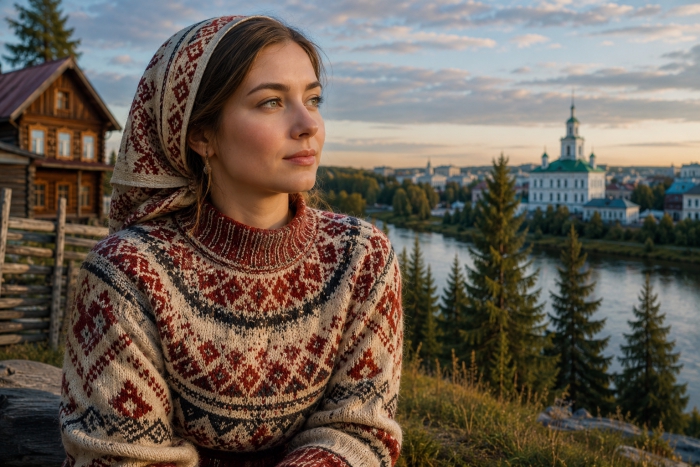
The question of Komi women's physical appearance is more nuanced than a two-word answer allows. The Komi are anthropologically classified in the Europoid (Caucasoid) group, with morphological features close to other Finno-Ugric peoples of north-east Europe. Unlike Turco-Mongol populations of Siberia or Central Asia, they do not present the epicanthal folds or prominent cheekbones of East Asian populations. Their complexion is typically fair, eyes range from grey to blue-green, hair from chestnut to blonde — a Finno-Ugric genetic inheritance shared with Finns and Estonians. That said, centuries of intermarriage with neighbouring Russian populations (and more occasionally with Nenets groups in the north) have introduced real diversity. What our clients most often report is an impression of naturalness — an understated beauty, a physical presence shaped by long seasons and harsh winters, a quiet solidity.
Myth #8 — "Her crafts and traditions are quaint curiosities — nothing more"
This is where I need to pause, because Komi craftsmanship genuinely deserves attention. The Komi developed one of the most sophisticated traditions of geometric knitting in all of Europe — predating Baltic and Scandinavian traditions, according to textile historians. The diagonal patterns of diamonds and chevrons, knitted in two-colour wool on two needles, are documented from the Middle Ages. Some textile specialists argue that this technique travelled from the Komi to the Estonians, Finns and perhaps even neighbouring Russian communities through medieval trade networks. Add to this birch-bark work — woven shoes (lapti), baskets, decorated boxes — weaving, embroidery with symbolic motifs linked to household protection and fertility, and wood carving. This craft heritage is not a dead museum: it is experiencing a genuine commercial revival, particularly in Nordic markets (Finland, Sweden, Norway), which recognize a Finno-Ugric cultural kinship. When a Komi woman sends you a pair of hand-knitted socks, she is offering you six centuries of living history in a single gesture.
Myth #9 — "A Komi woman is ultimately just a regular Russian woman"
Neither fully Russian, nor foreign to Russian culture. She is both at once — and that is precisely what makes her singular. A Komi woman is a Russian citizen, fully fluent in Russian, educated in the post-Soviet system — and simultaneously the heir to a people who have spent a thousand years of history preserving their language, their patterns, their tales and their memory. The purges of the 1930s tried to erase the Komi intelligentsia; the Vorkuta Gulags turned her land into a deportation territory; Russification reduced the daily use of her language. And yet: Syktyvkar still hosts the Federal Finno-Ugric Cultural Centre, Komi cultural associations organize festivals in Tallinn and Helsinki, and the Permian falcon motif — symbol of the Republic — appears on local mineral water bottles as naturally as on official buildings. This woman is not trying to be "just Russian." She knows exactly who she is.
Komi women, Tatar women, Russian women: the real differences
| Criterion | Komi woman (Komi Republic) | Tatar woman (Tatarstan) | Russian woman (European Russia) |
|---|---|---|---|
| Heritage | Finno-Ugric (related to Finns / Estonians) | Kipchak Turkic + Soviet Russian culture | East Slavic, Eurasian culture |
| Religion | Orthodox (since 14th c.) + animist traces in folklore | Moderate Hanafi Islam | Orthodox (variable practice) |
| Temperament | Reserved, resilient, rooted in nature, craft-oriented | Discreet, loyal, elegant, inner stability | Warm, direct, reserved on first contact |
| Language | Russian-speaking + Komi (co-official language) | Bilingual Russian-Tatar | Russian-speaking |
| Attitude toward marriage | Central, strong demographic pressure | Central, strong family pressure | Strong, varies by individual |
| Distinctive craft | Komi geometric knitting, birch-bark work, symbolic embroidery | Embroidery, leatherwork | Varies by region |
| Logistics / access | Syktyvkar: flight via Moscow (daily connections) | Kazan: fast train or direct flight | Varies by city |
The 5 mistakes men make with Komi women
1. Mistaking her for a Slavic or Siberian woman. She is Finno-Ugric, Russian-speaking, and her original culture has nothing to do with either Slavic identity or Asia. Telling a Komi woman she is "a bit like a Finnish woman" will likely please her more — and be more accurate — than filing her under "standard Russian woman."
2. Dismissing her craft heritage. This is one of the most frequent — and most regrettable — mistakes. Komi craftsmanship (knitting, birch-bark work, embroidery) is a direct window into her deepest identity. Taking a genuine interest, asking about the patterns, asking what they mean: this is a gesture of respect that opens conversations you cannot imagine.
3. Reading her reserve as coldness. A Komi woman is not expansive on first contact. This is a Finno-Ugric cultural trait: words are weighed before they are spoken; the interior life is not handed over in the first conversation. Interpreting that silence as disinterest would be a fatal mistake. Patience and consistency are the virtues that pay.
4. Assuming Syktyvkar is unreachable. A single flight via Moscow gets you there. Our team handles all logistics for this type of trip so you never have to improvise alone.
5. Using unverified platforms. The international dating sector remains saturated with PPL scams and fake profiles. Any platform that charges you per message or per letter is suspect. Caution before spending a single dollar.
Two stories from the field
The Norwegian sweater and the history lesson
Robert, our client from Edinburgh, 54 years old, had sent a photo of his favourite hiking sweater to his contact from Syktyvkar — a Norwegian-style pullover with geometric diamond patterns. Her response: a long message explaining that the diamond pattern was originally Komi, not Norwegian, and had migrated northward through medieval trade routes. "She rewrote the entire history of my sweater in twenty minutes," Robert told me, laughing. "And she finished by suggesting I send it to her so she could check whether the proportions were authentic." They laughed together for an hour. This is not mysticism — it is a woman who knows exactly who she is.
The deported grandfather and the French recipe
James, our client from Toronto, 51 years old, told me that on their third video call, his contact mentioned her grandfather — a Komi intellectual deported to Vorkuta in the 1940s, who had survived the Gulag and returned home carrying a pâté recipe he had learned from a French prisoner also held in the camp. "She told me the recipe had been in her family for three generations and she makes it every winter," James said. "I understood that day that this woman was carrying a history I could never fully measure — and that was precisely why she deserved to be loved."
Frequently asked questions about Komi women
Are Komi women Orthodox or animist?
The great majority practice Russian Orthodoxy, inherited from the 14th-century Christianization by Saint Stephen of Perm. Animist traces survive in folklore (forest spirits, seasonal rites) as cultural tradition, not daily religious practice. A contemporary Komi woman celebrates Christmas on January 7th, often marries in church, and mentions forest spirits the way someone quotes a childhood fairy tale.
How do I get to Syktyvkar from Canada, the UK or Australia?
There are no direct flights from North America, the UK or Australia. The route goes through Moscow (regular flights from Toronto, London, Sydney), then a domestic flight to Syktyvkar (daily connections). Our agency handles complete logistical support for this type of trip.
Do I need to learn Komi to meet a Komi woman?
Absolutely not — Russian is the common language and entirely sufficient. That said, knowing a word or two in Komi (such as "bur vu" — "good water," a traditional greeting) is a gesture of genuine curiosity that will always be noticed and appreciated.
What age gap is reasonable with a Komi woman?
The same general benchmarks apply as with other women from Russia: a gap of 2 to 10 years represents the optimal success zone, with a reasonable maximum of 15 years depending on your own age. Antoine Monnier discusses this concept in detail in his Sunday YouTube live sessions.
Do Komi women speak English or French?
Rarely French, sometimes English for the younger and more urban generations. Communication generally runs through Russian, via our bilingual interpreters — which is never an obstacle to a serious and sincere relationship.
What you really need to understand about Komi women
A Komi woman from the Komi Republic is not one more Slavic woman among millions. She is the heir to a millennia-old Finno-Ugric people who created their own written script in the 14th century, survived the Vorkuta Gulags, resisted Soviet linguistic erasure, and built in silence one of the most sophisticated craft traditions in northern Europe. A minority on her own land — around 23% of her republic's population — she has developed a quiet but profound identity resilience, typical of Finno-Ugric peoples who learned that survival is won through patient transmission, not grand declarations.
What the experience of international matchmaking agency CQMI, after more than 350 successful marriages since 2014, confirms at every meeting:
- Her reserve is not coldness — it is the restraint of a woman who, when she speaks, says something that matters.
- Her connection to craft and nature is not yesterday's folklore — it is a living intelligence of the world, passed down through generations.
- Her dual belonging — Finno-Ugric and Russian — is not a contradiction. It is a richness that most women in the Western world will never be able to offer you.
If you are a serious man looking for a genuine, shared life project, Russian women in all their diversity — and Komi women in particular — deserve your full attention.
Ready to meet a serious woman from Russia or its republics?
CQMI Agency has been operating since 2014. Our subscription — $350 CAD/month — gives you access to 10 verified contacts of women genuinely motivated to build a lasting relationship. Over 40% of female applications are rejected during our selection process.
350+ successful marriages | Divorce rate < 7% | No chatbots, no ghost translators
Discover our process →Questions? Write directly to Antoine: This email address is being protected from spambots. You need JavaScript enabled to view it.
Scoop.it summary — copy and paste
Who are Komi women from the Komi Republic — and why do so few Western men know anything about them? Antoine Monnier, founder of international matchmaking agency CQMI, debunks nine of the most persistent myths about this exceptional group of women.
First revelation: the Komi are not Slavic. They are Finno-Ugric — the same broad ethnic family as Finns, Estonians and Hungarians. Their language, Komi-Zyrian, belongs to the Uralic family and is entirely distinct from Russian. The Komi Republic, with its capital Syktyvkar (245,000 inhabitants), is not in Siberia but in European Russia — and it has a State Opera, a university and the Federal Finno-Ugric Cultural Centre, unique in all of Russia.
Second revelation: Komi craftsmanship is among the most sophisticated in northern Europe. The geometric diagonal patterns of Komi knitting — documented since the Middle Ages — predate Baltic and Scandinavian traditions according to textile historians. This is not a frozen folk museum; it is a living heritage now finding commercial outlets in Nordic markets.
Third revelation: the contemporary Komi woman is fully Russian-speaking, educated, and professionally active — in oil and gas (70% of regional revenue), education, healthcare or culture. Her urbanisation rate is higher than the Russian national average. She is neither a shaman in any primitive sense, nor cut off from the modern world.
Her reserve — a Finno-Ugric cultural trait — can surprise on first contact. But it is not coldness. It is the restraint of a woman whose identity was forged by centuries of quiet resistance to assimilation. Stalin's purges devastated her intelligentsia in the 1930s. The Vorkuta Gulags turned her land into a deportation zone. And yet, in 2026, Syktyvkar still hosts the Federal Finno-Ugric Cultural Centre, and Komi cultural associations organize festivals in Tallinn and Helsinki.
If you are a serious man looking for a life project with a woman of rare depth — who knows the medieval origin of your Norwegian sweater better than you do, and who makes every winter a pâté recipe learned from a French prisoner in the Vorkuta Gulag — a Komi woman deserves your attention.
CQMI Agency has been guiding serious men since 2014: 350+ successful marriages, divorce rate under 7%, $350 CAD/month subscription for 10 verified contacts.
#KomiWomen #KomiRepublic #MatchmakingAgency #CQMI #RussianWomen #InternationalMarriage #FinnoUgric #Syktyvkar #InternationalDating #AntoineMonnier
Latest from Antoine Monnier
- Ukrainian Woman Asks You for Money: Scam or Sincere?
- Ukrainian Refugee Women: Why Their Host Country Changes Everything
- Ukrainian or Russian Woman: 7 Signs She Is Truly Single and Serious About Marriage
- Ukrainian Woman and Marriage: Why It Is Her Only Real Safety Net
- Language Barrier With a Ukrainian or Russian Woman: The Complete Guide

 +1 514 794-5053