


Ukrainian and Russian Bride dating advices - CQMI blog

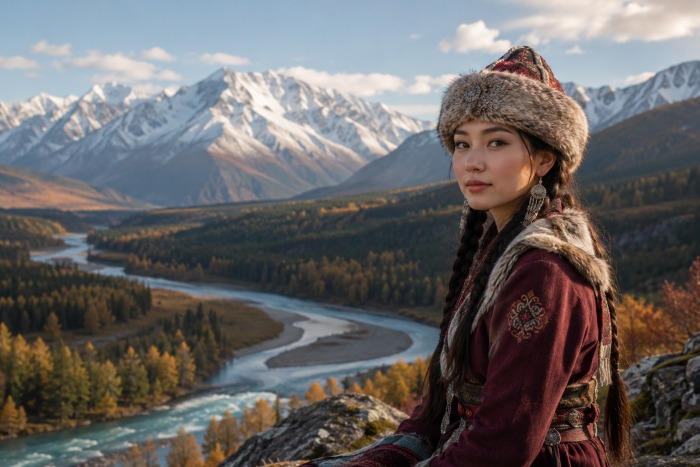 Altaian Women of the Altai Republic: 9 Myths Debunked — What You Never Knew
Agence CQMI
Altaian Women of the Altai Republic: 9 Myths Debunked — What You Never Knew
Agence CQMI
Altaian Women of the Altai Republic: 9 Myths Debunked — What You Never Knew
Quick answer: A woman from the Altai Republic is neither Mongolian, nor Buryat, nor a postcard cliché. She is the heir of a Turkic mountain people — the Altai-kiji — settled for millennia at the crossroads of Russia, Mongolia, China and Kazakhstan, whose spirituality blends ancestral shamanism with Tibetan Buddhism. A minority in their own republic (barely a third of the population), discreet, shaped by mountain life and decades of cohabitation with Russians, these women combine a deep connection to nature with a genuinely modern life. Before reducing her to a shamanic stereotype, read what follows.
Article by Antoine Monnier, director and founder of CQMI International Matchmaking Agency, specialist in serious relationships between Western men and women from Russia, Eastern Europe, the Caucasus and Central Asia since 2014.
Let me be direct with you.
In our experience at CQMI, whenever the Altai Republic comes up with our clients — men from Canada, the UK, the US or Australia looking for a serious relationship — I almost always get the same blank stare. Some confuse it with Altai Krai, the neighbouring Russian region that is overwhelmingly populated by ethnic Russians. Others imagine an isolated tribe cut off from the world, still living in yurts and communicating with spirits. Almost nobody knows it is actually a federal republic of Russia, listed by UNESCO for its "Golden Mountains of Altai," and that its capital, Gorno-Altaysk, is a modern town with universities, hospitals and stable internet.
The Altai Republic covers 92,900 km² in southern Western Siberia, bordering Mongolia, China and Kazakhstan — a genuinely unique Eurasian crossroads. Its population, barely 211,000 people, makes it the least populous republic in Russia. Ethnic Altaians themselves account for only about 34% of that population, against 56% ethnic Russians. That is an essential fact to grasp before saying anything else about the Altaian woman: she is a minority in her own homeland, and that minority status has forged a remarkably strong sense of identity in her.
I remember a call with Robert, one of our clients from Edinburgh, 52, right after his first video exchange with a member from Gorno-Altaysk. "Antoine, I half expected someone disconnected from civilisation, almost mystical. Instead I get an accountant telling me about her temperamental internet connection up in the mountains, her Persian cat, and explaining with a smile why she never confuses the spirits of the river with a weather app." What Robert glimpsed there is exactly what I am about to explain — backed by verified data, more than ten years of experience at CQMI, and nine myths debunked one by one.
If you are not serious, please look elsewhere. These women are not looking for a one-night stand, but for marriage and a lifelong union.
For a broader overview of Russian women in all their diversity — and the Altai Republic is fully part of that diversity — our overview page of Russian women registered with CQMI remains the best starting point.
Myth #1 — "An Altaian woman is basically Mongolian or Buryat"
This is the most common confusion, and a geographically understandable one, but ethnically incorrect. The Altaians — Altai-kiji in their own language — are a Turkic people, not a Mongolic one. Their language belongs to the Northern Turkic family, distinct from the Mongolic languages spoken by Buryats or Khalkha Mongols. Historically, their roots trace back to Turkic tribes settled in the region as early as the 1st millennium BCE, with major archaeological heritage such as the Pazyryk burials, dated to the 5th century BCE — including the famous "Ice Maiden of Altai," the mummy of a young Scythian woman discovered in 1993 on the Ukok Plateau. Genetically, recent studies even distinguish two populations: Southern Altaians, dominated by the Q-M242 and R1a Y-chromosome haplogroups, and Northern Altaians, where R1a dominates with no trace of Q-M242 at all. In other words, the Altaian woman is neither Mongolian, nor Buryat, nor interchangeable with a Kazakh woman: she belongs to a singular Turkic group at the crossroads of Central Asia and Siberia.
Verdict: FALSE. The Altaian woman descends from a Turkic people distinct from Mongols and Buryats, with her own archaeological history going back more than 2,500 years.
Myth #2 — "Altai is completely cut off from the world"
Partly true geographically — and exactly what makes it a sought-after tourist destination — but largely false in terms of actual isolation. Gorno-Altaysk, the capital, has its own airport with regular flights to Moscow, Novosibirsk and several major Russian cities. There is admittedly no railway station in the town itself — the nearest one is in Biysk, about a hundred kilometres away — but road connections are frequent and well maintained, including the legendary Chuysky Trakt highway that crosses the republic all the way to the Mongolian border. Internet and mobile coverage work normally in urban areas; only the deep mountain gorges occasionally lose signal. Today's Altaian woman is not cut off from the world: she lives, studies and works with the same digital tools as any European woman, simply set against an exceptional mountain backdrop.
Verdict: EXAGGERATED. Altai is a remote region geographically, but reasonably connected by air, road and digital networks. The isolation is scenic, not social.
Myth #3 — "She still practices old-school shamanism, she's basically a mountain witch"
This is the most persistent — and most misunderstood — stereotype. Traditional Altaian shamanism does exist, and it runs deep through regional culture, with figures such as Erlik, god of the underworld, and rituals still visible today: white ribbons tied to trees along rivers, offerings left for local spirits, pilgrimages to Mount Belukha, regarded in local folklore as a gateway to the mythical kingdom of Shambhala. But contemporary religious reality is far more nuanced. According to a 2012 survey, around 28% of the republic's population follows Russian Orthodoxy, while ethnic and nature religions — including shamanism, Tengrism and Burkhanism — together account for about 13% of the population. A significant share simply describes itself as "spiritual but not religious" or atheist. Burkhanism, a religious movement born in 1904 that blends reformed shamanism with Buddhist elements, remains a strong identity marker, but has nearly vanished as a daily ritual practice; people today speak instead of "neo-shamanism" or "neo-Burkhanism," more cultural than devotional. A modern Altaian woman may well honour these traditions out of identity pride — taking a genuine interest in throat singing, folklore, seasonal festivals — without living by a strict ritual calendar.
Verdict: LARGELY EXAGGERATED. Shamanism and Burkhanism are identity and cultural pillars of Altai, but strict daily religious practice concerns only a minority, spread across Orthodoxy, Buddhism and various spiritualities.
Myth #4 — "She still lives in a yurt, with no real education"
The image of the illiterate nomad belongs to the distant past. Under the Soviet era, universal schooling was applied in Altai with the same rigour as everywhere else in the USSR. Today the republic has higher-education institutions in Gorno-Altaysk, and its fertility rate — around 2.03 children per woman, well above the Russian national average of roughly 1.4 — coexists with standard female schooling and growing access to university education. The republic does remain one of the least urbanised in Russia, with only about 30% of its population living in cities, and a significant share of young Altaian women leave rural areas to pursue studies or find work in Gorno-Altaysk or beyond — a trend that also contributes to the gender imbalance in some rural areas. The woman you will meet today has, in most cases, attended school normally, speaks fluent Russian — the language of instruction — and holds a genuine job, whether in administration, tourism, healthcare or education.
Verdict: FALSE. Universal education has existed in Altai since the Soviet era. The modern Altaian woman is schooled, Russian-speaking and often professionally active, even though part of the population remains rural.
Myth #5 — "She's just trying to escape poverty in her region"
The Altai Republic is indeed one of the economically less developed regions of Russia — it would be dishonest to deny it — with livestock farming (horses, sheep, goats, cattle) and tourism as the two main local sources of income. But reducing an Altaian woman's motivation to economic escape would be a misreading. In our experience at CQMI, the dominant motivation, as with most Russian women, remains the well-documented structural gender imbalance among adults, locally worsened by male rural exodus toward the mining sector and certain men's greater exposure to military mobilisation. On top of that comes a strong traditional cultural pressure favouring marriage and starting a family. An Altaian woman who enters a serious international matchmaking process arrives with a carefully considered life plan, not the hope of a financial rescue.
Verdict: FALSE as a primary motivation. The driving force is demographic and family-related before it is economic. She arrives with a built life plan, not a flight from hardship.
To understand the deeper drivers behind this approach, and to avoid the traps of platforms that exploit these women, our complete guide to Pay Per Letter (PPL) scams is essential reading before you start.
Myth #6 — "Communicating with her is impossible, she only speaks some tribal language"
The Altaian woman, like almost every female citizen of Russia's ethnic republics, is Russian-speaking. Russian is the language of instruction at every level of schooling, the language of administration and of regional media. Out of roughly 78,000 people who identified as ethnically Altaian in the 2020 census, about 62,500 still speak the Altaian language — a figure that shows real linguistic vitality, passed down within families and taught in schools, but it never replaces Russian as the language of everyday and international communication. You will therefore communicate exactly as you would with any woman from Russia: in Russian via translation, or directly in English for the youngest and most urban generations. Our bilingual Russian-English translation assistants accompany all your early exchanges without ever interfering in the relationship itself.
Verdict: FALSE. The Altaian woman is fluently Russian-speaking. The Altaian language remains alive and valued, but it never stands in the way of international communication.
Myth #7 — "All Altaian women look the same"
The exact opposite is what tends to surprise men meeting them for the first time. Russian geneticists have documented remarkable internal diversity between Northern groups (Tubalars, Kumandins, Chelkans) and Southern groups (Altai-kiji, Telengits, Teleuts), with notably different genetic profiles — the Northern Chelkans even standing out clearly from other groups in mitochondrial DNA studies. This diversity translates physically into a wide range of features: some women display high cheekbones and slightly almond-shaped eyes inherited from ancient Turco-Mongolic ancestry, others present features much closer to neighbouring Slavic populations, intermarriage with the Russian population being common for several generations now. What our clients often report is a physical presence shaped by mountain life — natural endurance, a direct gaze — combined with a quiet elegance, free of artifice or excessive polish.
Verdict: OVERSIMPLIFIED. Genetic and physical diversity between Northern and Southern Altaian groups is scientifically documented. No single physical "type" represents "the" Altaian woman.
Myth #8 — "She will refuse to raise her children away from her own traditions"
This is a fair question, and it deserves an honest answer rather than evasion. Contemporary Altaian identity was built precisely on multi-religious, multi-ethnic cohabitation: Russian Orthodoxy, Tibetan Buddhism (clearly growing since the 1980s, with stupas and Buddhist organisations now established in the region), a small Evangelical Christian minority, and shamanic or neo-Burkhanist spiritualities coexist within the same extended family without major identity conflict. In our experience at CQMI, an Altaian woman who commits to an international relationship generally already has a pragmatic approach to cultural transmission: she wants to pass down her roots — the seasonal festival, the cuisine, respect for nature — without imposing them as a rigid framework. This is not religious relativism; it is a habit of cohabitation forged by more than a century of cultural mixing in a small republic at the crossroads of four civilisations.
Verdict: EXAGGERATED. Religious and cultural cohabitation is an everyday reality in Altai. The modern Altaian woman is generally pragmatic about this, provided the topic is discussed honestly from the start.
Myth #9 — "An Altaian woman is basically just another Russian woman"
Neither fully Russian, nor entirely separate from Russian culture. That is precisely what makes her distinctive. The Altaian woman carries a dual identity without apparent contradiction: a Russian citizen, fluently Russian-speaking, shaped by the post-Soviet education system — and at the same time the heir of a thousand-year-old Turkic mountain people, a minority in her own homeland, whose history blends Mongol conquests, gradual integration into the Russian Empire from the 17th century onward, religious repression under Stalin, and an identity revival since the fall of the USSR. This numerical minority status within her own republic — under 35% of the population — has paradoxically reinforced a tenacious sense of pride, where larger peoples might have assimilated more easily. She does not seek to be "just Russian": she claims her mountain, her songs, her history. To better understand the nuances among different women of the former Soviet space, see our article on the subtle difference between a Russian woman and a Ukrainian woman — the framework there is genuinely useful.
Verdict: FALSE. The Altaian woman is not an "ordinary" Russian woman. Her dual Turkic-shamanic and Russian-Soviet identity, carried by a resilient minority, gives her a distinctive cultural depth.
Altaian woman, Tatar woman, Russian woman: the real differences
| Criterion | Altaian woman (Altai) | Tatar woman (Tatarstan) | Russian woman (European Russia) |
|---|---|---|---|
| Heritage | Turkic mountain people + Soviet-Russian culture | Kipchak Turkic + Soviet-Russian culture | East Slavic, Eurasian culture |
| Religion | Shamanism, Burkhanism, Orthodoxy, Buddhism (mosaic) | Moderate Hanafi Islam | Orthodox (variable practice) |
| Temperament | Resilient, discreet, grounded in nature, proud | Discreet, loyal, elegant, inner stability | Warm, direct, reserved at first contact |
| Education | Schooled, Russian-speaking, partly bilingual in Altaian | Highly schooled, bilingual Russian-Tatar | Highly schooled, Russian-speaking |
| Attitude to marriage | Central, strong family and demographic pressure | Central, strong family pressure | Strong, varies by individual |
| Religious question in a mixed couple | Mosaic already part of daily life — generally pragmatic | To address openly — generally pragmatic | Rarely a daily issue |
| Access / logistics | Gorno-Altaysk: flight via Moscow/Novosibirsk, no railway in town | Kazan reachable by fast train or direct flight | Visa required (restrictions since 2022) |
The 5 mistakes men make with Altaian women
1. Confusing her with a Mongolian or Buryat woman. She is Turkic, from the Altai Mountains, not Mongolic. A recurring geographical mix-up — but one that reveals a lack of preparation.
2. Reducing her entire personality to shamanic folklore. The opposite mistake: turning every conversation into an esoteric interrogation about mountain spirits quickly becomes tiresome for a woman whose day-to-day life mostly revolves around her job and routine. Genuine interest in her culture is an asset; turning her into a permanent exotic fantasy is a seduction mistake.
3. Underestimating her resilience and independence. Life in a mountainous, rural region forges a solid character used to fending for itself. Come as a respectful partner, not a condescending rescuer.
4. Not researching the real travel logistics. Gorno-Altaysk has no railway station and the airport offers limited connections. Improvising a trip without preparation is a frequent source of disappointment — proper guidance avoids these rookie mistakes.
5. Going through unverified platforms. The international dating industry involving Russian women remains saturated with PPL scams and fake profiles. Any platform charging by the letter or message is suspect. Vigilance is required before you spend a single dollar.
Two stories from the field
Cedar honey and the white ribbon
James, our client from Toronto, 52, received a small package from his member in Gorno-Altaysk a few weeks into their correspondence. Inside: a jar of cedar honey, a signature product of the region, along with a strip of white fabric and a handwritten note explaining, with a touch of humour, that she was not asking him to tie the ribbon to a tree — "that gesture belongs to my grandmother, not to me," she wrote — but simply to taste a bit of her mountains. James called me, amused: "Antoine, I expected mysticism. I got a lesson in self-deprecating humour and some genuinely delicious honey." They met three months later in Moscow.
Patchy wifi and cool composure
Robert, 54, our client from Edinburgh, told me about his first video call, which dropped three times because of an unstable connection. Rather than apologising nervously, his match — a 39-year-old schoolteacher — burst out laughing and sent him a voice message: "Welcome to the mountains, even the spirits struggle with 4G here." Robert told me: "That was the moment I realised this woman had a sense of humour and a composure I hadn't found anywhere back home. She turned a technical glitch into a genuine moment of connection."
Frequently asked questions about Altaian women
Is an Altaian woman Muslim, like women from the Caucasus?
No. Traditional Altaian spirituality is rooted in shamanism and Burkhanism, a religious movement specific to the region born in 1904. Islam is almost entirely absent from Altaian culture; instead you find Russian Orthodoxy, growing Tibetan Buddhism, and shamanic or neo-traditional spiritualities depending on the family.
Do I need to be interested in shamanism to win over an Altaian woman?
A genuine, respectful interest in her culture is always appreciated, but it is in no way a requirement. Most Altaian women pursuing a serious matchmaking process lead modern, professional lives and do not expect a spiritual conversion from you.
How do you get to the Altai Republic from Canada, the UK, the US or Australia?
There is no direct flight from North America, the UK or Australia. The journey typically goes through Moscow, then a domestic flight to Gorno-Altaysk, or through Novosibirsk followed by a several-hour road transfer. Our agency assists clients with the logistics of this type of trip.
What age gap is acceptable with an Altaian woman?
The same general guidelines apply as for other Russian women: a gap of 2 to 10 years sits in the optimal success zone, with a reasonable maximum of 15 years depending on your own age. Antoine Monnier covers this concept in detail in his coaching sessions and YouTube videos.
Do Altaian women speak English?
Sometimes, mostly among younger, urban generations. Communication generally goes through Russian, via our translation assistants, which never gets in the way of building a serious relationship.
What you really need to understand about Altaian women
A woman from the Altai Republic is neither a postcard-Mongolian image nor a mountain witch cut off from the modern world. She is the heir of a Turkic people that is a minority in its own homeland, shaped by 2,500-year-old burial sites, by the harshness of a mountainous territory at the crossroads of four countries, and by a rare religious mosaic where shamanism, Burkhanism, Orthodoxy and Buddhism coexist without major rupture. This history has forged a remarkably resilient woman: discreet yet proud, pragmatic yet deeply attached to her roots, rural in her history yet fully integrated into the modern world in her daily life.
What the experience of CQMI International Matchmaking Agency, after more than 350 successful marriages since 2014, confirms with every meeting:
- Her resilience is not toughness — it is a quiet strength inherited from generations accustomed to mountain life.
- Her discretion is not coldness — it is a habit of weighing her words before speaking them.
- Her attachment to nature and tradition is not frozen folklore — it is a living cultural richness, not a limitation.
If you are a serious man looking for a genuine shared life project, Russian women in all their diversity — and Altaian women in particular — deserve your full attention.
Ready to meet a serious Russian or Altaian woman?
CQMI Agency has been operating since 2014. Our membership — $350 CAD/month — gives you access to 10 verified contacts of women genuinely motivated to build a lasting relationship. More than 40% of female applications are rejected during our screening process.
350+ successful marriages | Divorce rate < 7% | No chatbots, no ghost translators
Questions? Write directly to Antoine: This email address is being protected from spambots. You need JavaScript enabled to view it.
Latest from Antoine Monnier
- Ukrainian Woman Asks You for Money: Scam or Sincere?
- Ukrainian Refugee Women: Why Their Host Country Changes Everything
- Ukrainian or Russian Woman: 7 Signs She Is Truly Single and Serious About Marriage
- Ukrainian Woman and Marriage: Why It Is Her Only Real Safety Net
- Language Barrier With a Ukrainian or Russian Woman: The Complete Guide

 +1 514 794-5053