


Ukrainian and Russian Bride dating advices - CQMI blog

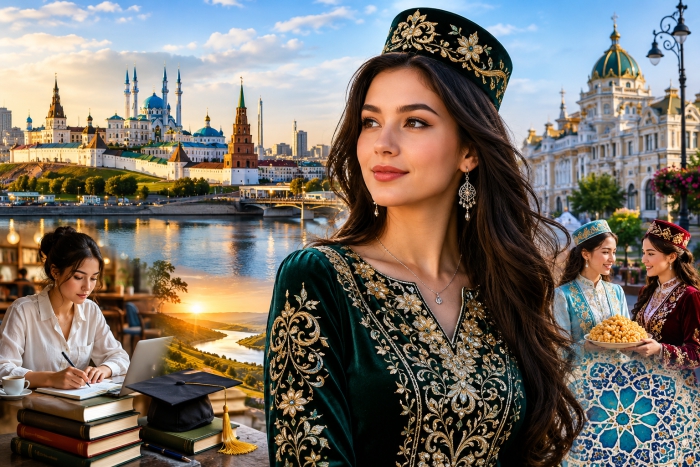 Tatar Women from Tatarstan
Agence CQMI
Tatar Women from Tatarstan
Agence CQMI
Tatar Women from Tatarstan: 9 Myths Debunked — What You Really Don't Know
Quick answer: A Tatar woman from Tatarstan is neither Arab nor Turkish, nor a steppe nomad frozen in medieval times. She is the heir to the Volga Tatar people — Turkic-speaking Muslims since the 10th century, Russian citizens since Ivan the Terrible, whose capital Kazan has housed one of Russia's oldest universities since 1804. Bilingual in Russian and Tatar, highly educated, deeply family-oriented, she combines moderate Islamic tradition with unambiguous modernity. Before you put her in a box, read what follows.
Article by Antoine Monnier, director and founder of CQMI International Matchmaking Agency, specialist in serious relationships between Western men and women from Russia, Eastern Europe, the Caucasus, and Central Asia since 2014.
Let me be straight with you.
When I mention Tatarstan to my clients — men from Canada, the UK, the US, and Australia who are genuinely looking for a serious relationship — the reaction is almost always the same. Either they confuse "Tatar" with "Tartar" and picture Genghis Khan sweeping across the steppe, or they imagine a strictly veiled woman in a deeply conservative society. Almost nobody knows that Tatarstan is, in fact, one of Russia's most dynamic, industrially advanced, and culturally vibrant republics — and that its capital, Kazan, is the country's fourth-largest city and arguably its most cosmopolitan.
Tatarstan is roughly the size of Ireland, landlocked between the Volga and Kama rivers, 800 kilometres east of Moscow. Its population of four million — around 53% Tatar and 40% Russian — has built a model of interethnic coexistence that many Western nations would do well to study. On the same hilltop fortress in Kazan, two Orthodox cathedrals and two major mosques stand side by side. That is perhaps the best image for understanding what a Tatar woman carries within her: two civilizations that have learned to coexist without erasing each other.
I remember a call with James, one of my Toronto-based clients, 51, the morning after his first video chat with a woman from Kazan. "Antoine, I was expecting someone very closed off because of the religion. Instead I get a corporate lawyer who quotes Tolstoy and tells me her cousin married a Russian Orthodox man like it's the most normal thing in the world. Direct, poised, no chip on her shoulder. I did not see that coming." What James glimpsed, I'm going to explain — with verified data, more than a decade of experience at CQMI, and nine myths to dismantle one by one.
If you are not serious, move on. These women are not looking for a fling or a holiday romance. They are looking for a marriage and a lifelong partnership.
For a broader first look at the full spectrum of Russian women — Tatarstan being very much part of that world — our dedicated profile page is the best starting point.
Myth #1 — "A Tatar woman is basically Arab or Turkish"
This is the most common and most fundamental error. The Volga Tatars are neither Arab, nor Ottoman Turk, nor direct descendants of Genghis Khan's Mongols. They are a Turkic-speaking people of Eastern Europe, Islamized as early as the 10th century through merchants from Baghdad — well before the Ottoman Empire existed. Their language, Tatar, belongs to the Kipchak branch of the Turkic family, close to Kazakh and Bashkir, but distinct from Istanbul Turkish. Genetically, recent population studies (Rootsi 2004; Yunusbayev 2015) show a majority of R1a and R1b haplogroups — the same as Slavic populations of Eastern Europe — with a minority Central Asian contribution. A Tatar woman has more in common genetically and culturally with a Polish or Ukrainian woman than with a Saudi or Iranian one.
Myth #2 — "Tatarstan is a poor, backward corner of Russia"
The opposite is true. Tatarstan is one of the most prosperous and industrialized republics in the Russian Federation. Its GDP per capita ranks among the top ten of Russia's 89 federal entities. The region produces oil (Tatneft, one of Russia's largest oil companies), heavy trucks (KAMAZ, the global leader in heavy commercial vehicles, rolls out of Naberezhnye Chelny), and military and civilian helicopters from the Kazan plant. Kazan University, founded in 1804, is one of Russia's oldest — it is where Lenin studied law and where mathematician Lobachevsky invented non-Euclidean geometry. A woman who grows up in this environment is not someone to be rescued from hardship: she has access to first-rate education and a functioning economy.
Myth #3 — "She is veiled and lives under strict Islamic rules"
The Volga Tatars practice Hanafi Islam — historically one of the most moderate schools in the Muslim world — shaped by centuries of cohabitation with Russian Orthodoxy and by the 19th-century Jadidist reform movement, which promoted female education long before it was the norm in Europe. Today, according to Levada Center data (2023), fewer than 20% of Tatar women pray regularly, and the hijab remains a minority choice in urban settings. The modern Tatar woman in Kazan drinks tea with her family, celebrates Sabantuy (the traditional Tatar plowing festival), observes Ramadan to varying degrees depending on her family, but walks in a skirt, works in law or medicine, and needs no male guardian's permission to speak with you. A word of honesty, though: if you are genuinely not comfortable with any form of cultural Islamic identity — even a mild one — that is a conversation to have early and openly. It matters.
Myth #4 — "She hasn't had a real education"
Kazan University opened its doors in 1804. The Tatar people have produced major poets (Gabdulla Tukay, 19th–20th centuries), composers, and intellectuals who drove the Islamic modernization of a vast swathe of Eurasia. Under the Soviet era, universal schooling was applied in Tatarstan with the same rigour as everywhere in the USSR: near-100% literacy, access to higher education for women from the 1920s onward. Today, Rosstat data (2022) places Tatarstan among Russia's highest-ranking republics for the proportion of university graduates. The woman you are likely to meet is often a teacher, lawyer, doctor, engineer, or economist — bilingual in Russian and Tatar, sometimes trilingual with English.
Myth #5 — "She just wants to escape Russia for economic reasons"
A Tatar woman from Kazan who pursues a serious international relationship is not doing so out of financial desperation. Tatarstan's median wage exceeds the Russian national average, the labour market is active, and the region has seen sustained infrastructure investment (it hosted the 2013 Summer Universiade and three matches of the 2018 FIFA World Cup). Her motivation is of a different nature: the well-documented demographic imbalance in Russia — roughly 86 men per 100 women in the 30–50 age group, according to the 2021 Russian census — combined with strong cultural expectations around marriage, pushes her to widen her horizons. She comes to you with a life plan, not an empty suitcase.
Before venturing onto any platform advertising women from Russia, take the time to read our breakdown of Pay Per Letter (PPL) dating scams — an essential read that could save you both money and heartbreak.
Myth #6 — "Communication is impossible — the language barrier is total"
A Tatar woman from Kazan speaks Russian as a mother tongue — or at minimum as a language she has fully mastered from childhood, alongside Tatar. Russian is the language of instruction at all universities, the language of business and media. You will communicate exactly as you would with any Russian woman: in Russian via professional translation, or directly in English for women under 40. Tatar is a living language — spoken at home, taught in schools, broadcast on regional television — but it is never an obstacle to international communication. Our bilingual French-Russian and English-Russian assistants support all your initial exchanges without ever inserting themselves between the two of you as a relationship develops.
Myth #7 — "Tatar beauty is just another 'Asian type'"
This is exactly what confuses — and captivates — men who meet her for the first time. A Tatar woman does not fit into any predictable category. Genetically positioned at the crossroads of Eastern Europe and Central Asia, she displays a remarkable variety of features: some have pronounced cheekbones and faintly almond-shaped eyes; others have wholly Slavic features; others still carry a subtle blend that defies classification. What my clients describe most consistently is a natural elegance — women from Kazan have a reputation across Russia for being exceptionally well-dressed and well-presented — combined with a quiet pride that does not seek to impose itself but does so anyway. This beauty is not constructed for the camera. It lives in a posture, in the way she looks at you directly.
Myth #8 — "She will refuse to raise children outside Islam"
This is a legitimate question and it deserves an honest answer, not a reassuring dodge. In modern and mixed Tatar families — which account for 21 to 23% of all marriages in Tatarstan, according to official Republic statistics cited by civil registry director Elmira Zaripova — interfaith cohabitation is the norm, not the exception. Tatarstan's statistics also show that Tatar men who marry Russian Orthodox women divorce at half the rate of same-ethnicity Tatar or Russian couples. That figure, counter-intuitive as it seems, is well-documented. The Tatar woman who pursues an international relationship has generally already worked through this question and settled on a pragmatic approach: respect the other's roots, pass on her own, and let children grow up in both cultures. This is not relativism — it is a wisdom forged across centuries of cohabitation.
Myth #9 — "She's just an ordinary Russian woman, really"
Neither quite Russian, nor quite anything else. That is precisely what makes her singular. A Tatar woman carries two identities without contradiction: she is a Russian citizen, a fluent Russian speaker, embedded in the post-Soviet cultural landscape — and simultaneously the heir to a Turkic Islamic civilization stretching back a thousand years, proud of Sabantuy and the epic of Idegey, conscious of the singular history of a people that survived Ivan the Terrible's conquest, the forced Russification of the 18th century, partial Stalinist deportations, and the Soviet collapse. That double heritage gives her a depth and an inner steadiness that is rare. She does not try to be "just Russian" — she is Tatar, and she owns it. For a clearer sense of how the women of Russia's many cultures compare, our article on the subtle difference between a Russian woman and a Ukrainian woman offers practical reference points.
Tatar Woman, Russian Woman, Ukrainian Woman: Real Differences at a Glance
| Criterion | Tatar Woman (Tatarstan) | Russian Woman (European Russia) | Ukrainian Woman |
|---|---|---|---|
| Heritage | Kipchak Turkic + Soviet Russian culture | Eastern Slavic, Eurasian culture | Eastern Slavic, European culture |
| Religion | Hanafi Islam, moderate (practice varies) | Orthodox Christianity (practice varies) | Orthodox Christianity (practice varies) |
| Temperament | Reserved, loyal, elegant, deep inner stability | Warm once trust is built, direct | Expressive, direct, very warm |
| Education | Highly educated, bilingual Russian-Tatar | Highly educated, Russian-speaking | Highly educated, Ukrainian/Russian |
| Attitude toward marriage | Central, strong family expectation, genuine autonomy | Strong, variable by individual | Central, clearly expressed |
| Religion in a mixed couple | Must be raised early — generally pragmatic | Rarely a daily-life issue | Rarely a daily-life issue |
| Logistics / access | Kazan: fast train (11 hrs from Moscow) or direct flight | Visa required (restrictions since 2022) | Schengen visa-free (short stays) |
5 Mistakes Men Make With Tatar Women
1. Comparing her to a Middle Eastern woman. She is a Turkic European, not Arab. Approaching her as if she carried the weight of a theocratic regime is a geography mistake as much as a respect failure.
2. Dismissing her Islamic cultural identity entirely. The opposite mistake: even where it is moderate, her Muslim identity exists. Showing zero curiosity about her culture — the Sabantuy festival, Tatar cuisine, the language — reads as indifference and is genuinely off-putting. Authentic interest goes a long way.
3. Underestimating her intellectually. A woman from Kazan may well be a lawyer, physician, or engineer, trained at one of Russia's oldest universities. Come as a partner, not as a rescuer.
4. Avoiding the religion conversation. If you are not prepared to accommodate any form of cultural Islamic identity in your household — even a light one — say so. She is pragmatic, but she deserves complete honesty on this point before committing. Our article on age difference and what it really costs offers the same level of frank realism on a related topic.
5. Using unverified platforms. The international dating space targeting women from Russia is saturated with PPL scams and fake profiles. Any platform that charges per letter or per message is suspect. Caution before the first dollar spent.
Two Stories From the Field
The Chak-chak from Kazan
Robert, our client from Edinburgh, 56, received a parcel a few weeks into his exchanges with a member from Kazan. Inside: a box of chak-chak — the traditional Tatar confection of fried dough bound with honey — and a handwritten note in Russian: "So you know where I'm from." A food enthusiast himself, he understood the gesture better than most. He called me, genuinely moved: "Antoine, I thought I was building a relationship at arm's length. Someone just handed me a piece of their world and said: come in." They met in Moscow two months later.
Sabantuy and Composure
James, 51, from Toronto — the same client I mentioned at the start — told me about his first video call. He made a clumsy joke, confusing Tatar with Mongol. His contact — an economist, 38 — did not take offence. She smiled, pulled out her phone, sent him a real-time map of Turkic migrations in three seconds, and explained in two clear sentences why the confusion is understandable but inaccurate. "I realized right then," he told me, "that this woman wasn't going to let me get away with being lazy about her. And I already loved that."
Frequently Asked Questions About Tatar Women from Tatarstan
Is a Tatar woman Russian or a foreign national?
Do you have to be Muslim to marry a Tatar woman?
What age difference works with a Tatar woman?
Do Tatar women speak English?
Where can men from Canada, the UK, or Australia meet a serious Tatar woman?
What You Really Need to Understand About Tatar Women
A Tatar woman from Tatarstan is not a veiled Arab, not a Turkish stereotype, and not a cliché from the Mongol steppe. She is the heir to a Turkic-speaking people of Eastern Europe that survived Ivan the Terrible's conquest, the forced Russification of the 18th century, partial Stalinist deportations, and the Soviet collapse — and that today runs oil companies, argues cases before courts, and teaches mathematics at one of Russia's oldest universities. That history has produced a woman of remarkable coherence: reserved but firm, loyal and clear-eyed, rooted in her tradition and perfectly at ease in the modern world.
What CQMI International Matchmaking Agency, after more than 350 successful marriages since 2014, confirms in every relationship:
- Her elegance is not superficiality — it is a culture of self-care rooted in deep identity pride.
- Her reserve is not passivity — it is the habit of weighing her words before she speaks them.
- Her attachment to family and cultural transmission runs through two civilizations at once — that is her richness, not her limitation.
If you are a serious man looking for a genuine shared life project, Russian women in all their diversity — Tatar women among them — deserve your full attention.
Ready to meet a serious Russian or Tatar woman?
CQMI has been operating since 2014. Our subscription — $350 CAD/month — gives you access to 10 verified contacts from women genuinely motivated to build a lasting relationship. Over 40% of female applications are rejected during our selection process.
350+ successful marriages | Divorce rate < 7% | No chatbots, no ghost translators
Discover our process →Questions? Write directly to Antoine: This email address is being protected from spambots. You need JavaScript enabled to view it.
Latest from Antoine Monnier
- Ukrainian Woman Asks You for Money: Scam or Sincere?
- Ukrainian Refugee Women: Why Their Host Country Changes Everything
- Ukrainian or Russian Woman: 7 Signs She Is Truly Single and Serious About Marriage
- Ukrainian Woman and Marriage: Why It Is Her Only Real Safety Net
- Language Barrier With a Ukrainian or Russian Woman: The Complete Guide

 +1 514 794-5053