



Ukrainian and Russian Bride dating advices - CQMI blog

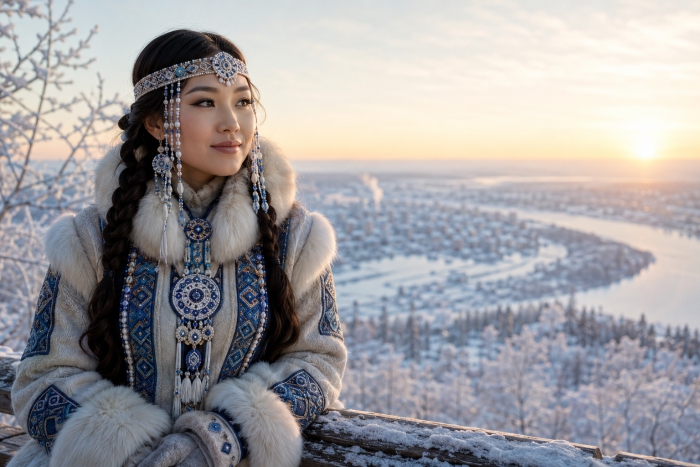 Yakutia Women
Agence CQMI
Yakutia Women
Agence CQMI
Yakutia Women: 9 Myths Debunked — What You Never Knew
In short: A woman from Yakutia is not a Mongol, not an Eskimo, and not an illiterate reindeer herder lost in the taiga. She is the heir of the Sakha people, Turkic-speakers who came from Lake Baikal seven centuries ago, distant cousins of the Turks, Kazakhs and Kyrgyz, who became the masters of the coldest inhabited place on Earth. Her republic — the size of India, five times the size of France — produces a fifth of the world's diamonds, has its own thousand-year-old epic, its own cinema, its own university, and a living language still spoken by nine Sakha out of ten. Before you put her in a box, read on.
Article by Antoine Monnier, director and founder of the international matchmaking agency CQMI, specialist in serious relationships between Western men and women from Russia, Eastern Europe, the Caucasus and Central Asia since 2014.
Let me be direct with you.
When I mention Yakutia to my clients — men from Canada, the UK, Australia or the United States looking for a serious relationship — the reaction is almost always the same. Either they confuse Yakutia with "Siberia in general," or they picture some Mongol people lost in the snow. Almost no one knows that this is, in fact, one of the most surprising peoples in all of Russia: Russian women from the Far North-East, Turkic-speaking, deeply attached to their land, and forged by a climate the rest of humanity would simply call unlivable.
Yakutia — officially the Republic of Sakha — is a world apart: the largest administrative territory on the planet, where Yakutsk, the capital, holds the title of coldest city on Earth, built on permanently frozen permafrost, with buildings raised on stilts so the ground beneath them does not melt. A few hundred kilometres away sits Oymyakon, the coldest inhabited village on the globe: minus sixty-seven degrees at its record low. It was in this white inferno that a people from the steppe not only survived, but built a civilisation of the horse, the diamond and the epic.
Robert, one of my Edinburgh clients, 54, called me after his first video call with a member from Yakutsk. "Antoine, I was expecting a shy woman from the end of the world. Instead I meet an accountant who manages the budget of a mining company, who tells me about summers drinking fermented mare's milk at her grandmother's during the summer festival, and who laughs out loud when I mix up Yakut with Mongolian. Gentle and solid at the same time. I had never felt anything like it."
What Robert glimpsed, I am going to explain to you — with verified data, more than ten years of experience at CQMI, and nine myths to take apart one by one. If you are not serious, move along: these women are not looking for a one-night stand, but for a marriage and a union for life.
Short answer
Women from Yakutia are Russian citizens of the Siberian Far North-East, descended from the Sakha (Yakut) people, of Turkic language and origin — a people who came from Lake Baikal and colonised one of the most extreme climates in the world. They speak Russian fluently, are highly educated, often hold degrees, and carry a culture in which resilience, generosity and loyalty are central. Far from the Mongol or Eskimo clichés, they are straightforward, calm and deeply loyal women.
Myth #1 — "A woman from Yakutia is a Mongol"
The confusion runs deep: Central Asian faces, horses, vast cold spaces — the Westerner spontaneously files the Yakuts under "Mongol." That is wrong. The Sakha are a Turkic-speaking people, not a Mongol one. Their language, Sakha, belongs to the northern branch of the Turkic languages: they are the distant linguistic cousins of the Anatolian Turks, the Kazakhs, the Kyrgyz and the Azerbaijanis. Their ancestors lived around Lake Baikal, then migrated north between the 13th and 15th centuries, fleeing Mongol pressure, taking their horses and cattle all the way to the Lena River. Mongolian did leave its mark — roughly one Yakut word in three is of Mongolian origin — but the backbone of the language, the identity, and the very name "Sakha" remain Turkic.
Verdict: FALSE. The woman from Yakutia belongs to the Turkic-speaking Sakha people, cousin of the Turks and Central Asian peoples, not the Mongols.
Myth #2 — "Yakutia, Chukotka, Siberia… it's all the same"
In the Western mind, anything cold and Russian forms one indistinct block. That is a crude error. Chukotka, at the far north-eastern tip, is home to the Chukchi, a Palaeo-Siberian people distantly related to Native Americans. The Sakha, by contrast, are Turkic-speakers from the south: two origins, two languages, two civilisations with nothing in common. Where the Chukchi herded reindeer and hunted sea mammals, the Sakha did the unthinkable: they acclimatised the horse and the cow to minus fifty degrees, creating breeds unique in the world, stocky and indestructible. Confusing a Yakut woman with her neighbours is like confusing a Portuguese woman with a Finn because both happen to be European.
Verdict: FALSE. Yakutia has its own people, its own Turkic language and its own civilisation of the horse. Nothing to do with the other peoples of the Russian Far North.
Myth #3 — "A woman from Yakutia just wants to escape the cold and poverty"
The region is harsh, so she must want to leave: the reasoning sounds logical. It is false. First, because Yakutia is not poor: its subsoil supplies nearly 20% of the world's diamond production (the company ALROSA reigns there), not counting gold and rare earths. Second, because you do not leave Yakutia on a whim: there is no stable bridge or road crossing the Lena River from Yakutsk, access depends on ferries in summer and the ice road in winter, and everything goes through thousands of kilometres of taiga. A woman who engages in a serious international process therefore does so out of conviction, never out of convenience — and she almost always keeps a visceral attachment to her land, her summers in the village, her river.
Verdict: FALSE as a dominant motivation. In a region rich in resources and hard to leave, the woman who commits does so by real choice, not to flee.
Myth #4 — "Yakut women are submissive and self-effacing"
I will not sell you a fairy tale: traditional nomadic society was patriarchal, as everywhere. But the Sakha woman already enjoyed real autonomy there — she could own livestock and divorce. Above all, the 20th century changed everything: schooling, university, legal equality. Today, the woman from Yakutia is an administrator, a teacher, a doctor, an accountant, a lawyer. Yakutsk is a lively university city, with theatres, museums and a regional cinema renowned throughout Russia. The woman you will meet is gentle but lucid, welcoming but firm — and taking her for a trophy would be the fastest mistake to backfire on you.
Verdict: FALSE today. The modern woman of the Sakha Far North is educated, independent and deeply dignified.
Myth #5 — "They are illiterate herders in the taiga"
Brace yourself for a surprise. Yakutia has its own university, its theatres, a renowned music scene — and a local film industry so active it is nicknamed "Sakhawood," capable of producing award-winning films shot in the Yakut language. Sakha culture rests on the Olonkho, a thousand-year-old oral epic listed by UNESCO, passed down by bards and now performed on stage. So you have in front of you a cultured woman, proud of her heritage, who shares with you the common language of the entire former Soviet space: Russian. A few words of Russian on your part will remain, as always, a much-appreciated seduction asset.
Verdict: FALSE, and quite the opposite. University, theatre, cinema, a UNESCO-listed epic: the woman from Yakutia is educated and sharp.
Myth #6 — "Communication is impossible, their language is incomprehensible"
Yakut intrigues linguists, but it does not concern you. Unlike other Far North languages on the brink of extinction, Sakha is very much alive: nearly nine Yakuts out of ten speak it, and it is one of the official languages of the republic. But above all, around 90% of the Sakha speak Russian fluently. You will therefore communicate exactly as you would with any Russian woman: in Russian, sometimes in English depending on the generation, and with the support of translator-assistants who remove the obstacle from the very first exchanges without ever stepping into the relationship. One point of caution before searching alone on dubious platforms: first read our analysis of the Pay Per Letter (PPL) scams that infest online dating with Eastern European women.
Verdict: OVERSTATED. Yakut intrigues, but communication happens through Russian and professional translation, exactly as everywhere in Russia.
Myth #7 — "Yakut beauty is just another Asian face"
Neither the Slavic type nor the classic East-Asian type: the woman from Yakutia escapes the usual grids. Hers is a beauty of the great cold, shaped by centuries of life under the Siberian sky — high cheekbones, warm complexion, a frank and present gaze, a vitality rather than a fragility. But what strikes my clients most goes beyond the physical: it is the quality of her presence. In a culture where survival depends on solidarity, welcoming a guest, feeding him, never letting him leave with an empty stomach is a deeply rooted duty. That kind of generosity, few cultures still know with such obviousness.
Verdict: FALSE. An assertive Siberian beauty, natural vitality, and a sense of hospitality inherited from a culture of survival.
Myth #8 — "They have remained primitive shamans"
You hear about Sakha shamanism and immediately picture a people frozen in superstition. The reality is more subtle. Yakut spirituality blends Orthodoxy with an ancestral foundation, Tengrism, a cult of nature and sky that is still alive. Every summer, the Ysyakh festival gathers nearly two hundred thousand people to greet the solstice, dance, share kumys (fermented mare's milk) and honour the spirits of nature. But this woman who respects the traditions of her grandparents is, the rest of the year, a modern professional managing a household, a career and a budget. The sacred and the everyday coexist in her without contradiction — and that is precisely what gives her relationship with family so much depth.
Verdict: FALSE. Living, inherited spirituality, yes; primitiveness, no. The Sakha woman is a modern who has not denied her roots.
Myth #9 — "A woman from Yakutia will never leave her land"
The attachment is real, but it does not mean immobility — quite the contrary. Here is a people who travelled thousands of kilometres from Baikal, tamed the coldest inhabited place on Earth, survived collectivisation, the camps set up along the grim "Road of Bones," then the collapse of the 1990s. Adaptation to the most hostile environment on the planet is written into this culture as a matter of survival. From that school, the woman from Yakutia emerges with a resourcefulness and a composure that work wonders abroad. When she chooses to leave, she has thought about it long and hard — and she brings with her a treasure: a sense of family, a tested loyalty, a memory that gives weight to every commitment. To place the Russian woman in relation to her neighbours, our article on the age difference that comes with a price tag will also give you honest benchmarks on real expectations.
Verdict: FALSE. When a woman from Yakutia commits, she does so in full awareness. She leaves with conviction and integrates with the quiet tenacity of a people who learned to overcome anything.
Yakutia, Russian, Ukrainian woman: the real differences
| Criterion | Woman from Yakutia | Russian (European Russia) | Ukrainian |
|---|---|---|---|
| Heritage | Turkic-speaking Sakha + Russian culture | East Slavic, Eurasian culture | East Slavic, European culture |
| Religion | Orthodoxy + Tengrism/shamanism | Orthodox | Orthodox |
| Temperament | Calm, loyal, Siberian resilience | Warm once trust is established | Expressive, direct, warm |
| Education | Highly educated, Russian-speaking | Highly educated | Highly educated |
| Language bridge | Russian (universal), Yakut, English variable | Russian, English variable | Ukrainian/Russian, English variable |
| Access / logistics | Very remote, access via Yakutsk + Moscow | Visa required (restrictions since 2022) | Schengen visa-free (short stay) |
| View of marriage | Central, rooted in family and land | Strong, varies by individual | Central, clearly expressed |
To go deeper into the nuances between the two Slavic peoples, see our article on the subtle difference between a Russian woman and a Ukrainian woman.
The 5 mistakes men make with women from Yakutia
- Taking her for a Mongol or an indistinct "Siberian native." She is Sakha, Turkic-speaking, proud of a civilisation of her own. Throwing a vague cliché about "the peoples of the cold" at her starts things very badly.
- Mistaking hospitality for submission. She welcomes you like a king because receiving is sacred in her culture. That does not mean she will stay silent. Answer her generosity with respect, never with condescension.
- Underestimating her intellect. A woman from the Russian Far North is often a degree-holder and lucid. Come as a partner, not as a saviour out to "rescue" a girl from the end of the world.
- Not being serious from the start. A woman who commits from a place this isolated knows exactly what she is looking for: a marriage, a union for life. If that is not your plan, do not waste her time.
- Going through unverified platforms. The sector is saturated with Pay Per Letter scams and fake profiles. Always verify before spending a single dollar.
Two stories from the field
The grandfather's knife
James, our Toronto client, 57, receives a parcel a few weeks after his first exchanges with his member from Yakutsk: a small Sakha knife with a bone handle, forged according to the region's tradition. A weekend hunter himself, he understands the message better than anyone. He calls me, his voice tight: "Antoine, I thought I was getting a piece of folklore. In fact, it's her family telling me I'm worthy of trust." They met in Moscow this winter.
The ferry and the composure
Robert, 54, from Edinburgh, told me about his first meeting trip. The ferry across the Lena was blocked by ice, the meeting was about to fall apart, and he started to fret. His counterpart, a 41-year-old lawyer, calmly pulled out a thermos, offered tea, reorganised the schedule with two phone calls and carried on the conversation as if nothing had happened. "That's the day I understood," he told me, "that I wasn't looking for a woman to reassure, but for a woman with whom I'd never panic. She was exactly that."
Frequently asked questions about women from Yakutia
Is a woman from Yakutia Russian or Mongol?
She is a Russian citizen and belongs to the Sakha (Yakut) people, of Turkic language and origin — a distant cousin of the Turks, Kazakhs and Kyrgyz. Mongolian influenced her vocabulary, but this is not a Mongol people.
Do I need to speak Yakut to meet a woman from Yakutia?
No. Around 90% of the Sakha speak Russian fluently. Communication goes through Russian and through CQMI's translator-assistants. A few words of Russian on your part remain an appreciated seduction asset.
What religion do women from Yakutia practise?
Mostly Orthodoxy, blended with an ancestral foundation of Tengrism and shamanism, alive notably during the summer Ysyakh festival. The vast majority live this spirituality in a peaceful and modern way.
What age difference is acceptable with a woman from Yakutia?
Between 2 and 10 years is the optimal success zone, with a maximum of about 15 years depending on your age and profile. Beyond that, expectations change, as we explain in our dedicated article.
Where can I seriously meet a Russian woman from Canada, the UK, Australia or the US?
Through a serious matchmaking agency with an anti-scam charter, such as CQMI: verified profiles, support and coaching before, during and after the meetings. Take our free compatibility test to see where you stand.
What you really need to understand about women from Yakutia
A woman from Yakutia is neither a Mongol, nor an illiterate herder of the taiga, nor a shaman frozen in the past. She is the heir of the Sakha people: Turkic-speakers from Baikal who tamed the greatest cold in the world, built a civilisation of the horse and the diamond, and carried a thousand-year-old epic all the way to today's cinema. This history has forged a psychology of remarkable consistency: solid calm and quiet pride, generosity elevated to a duty and unshakeable composure, a sense of family and assumed autonomy.
What the experience of the CQMI international matchmaking agency confirms everywhere in Russia, after more than 350 successful marriages since 2014:
- Her generosity is not naivety — it is a hospitality that expects respect in return.
- Her resilience does not make her cold — it makes her reliable, on good days and bad.
- Her attachment to her land and family is deep — lived, never proclaimed.
If you are a serious man in search of a real shared life project, a Russian woman — from the Sakha Far North or elsewhere — deserves your full attention.
Ready to meet a serious Russian woman?
CQMI has been operating since 2014. Our package — $350 CAD/month — gives you access to 10 verified contacts of women genuinely motivated to build a lasting relationship. More than 40% of female applications are rejected during our selection.
This is not a dating site. It is a matchmaking agency with a strict ethical charter.
350+ successful marriages | Divorce rate < 7% | No chatbots, no ghost translators
Questions? Write directly to Antoine: This email address is being protected from spambots. You need JavaScript enabled to view it.
Latest from Antoine Monnier
- Ukrainian Woman Asks You for Money: Scam or Sincere?
- Ukrainian Refugee Women: Why Their Host Country Changes Everything
- Ukrainian or Russian Woman: 7 Signs She Is Truly Single and Serious About Marriage
- Ukrainian Woman and Marriage: Why It Is Her Only Real Safety Net
- Language Barrier With a Ukrainian or Russian Woman: The Complete Guide

 +1 514 794-5053