


Ukrainian and Russian Bride dating advices - CQMI blog

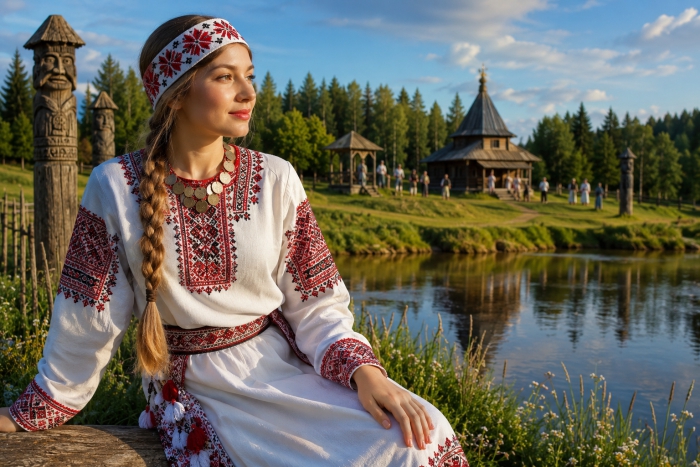 A Mari woman from the Republic of Mari
Agence CQMI
A Mari woman from the Republic of Mari
Agence CQMI
Mari Women of Mari El: The Last Living Pagans of Europe
In short: A Mari woman from the Republic of Mari El is not a folkloric curiosity to tick off a list of exotic Russian nationalities. She is the heir of a Finno-Ugric people of about 550,000 people who made a choice unique in Europe: never fully giving up their pre-Christian faith. The traditional Mari religion, the Marla, is today one of the very few living animist religions in Europe still officially recognised and actively practised, with close to 500 sacred groves still in use across the Republic of Mari El. If you are not serious — if you are looking for a one-night stand — please move along. These women are looking for exactly one thing: marriage and a union for life.
Article by Antoine Monnier, director and founder of the international matchmaking agency CQMI, specialist in serious relationships between Western men and women from Russia, Eastern Europe, the Caucasus and Central Asia since 2014.
The Volga people that the West has completely forgotten
Let me be direct with you. In more than ten years running CQMI, I have noticed a pattern that repeats itself with striking consistency: the less known a Russian nationality is on mainstream dating radars, the more sincere, available, and untouched by industrialised scams the women from that nationality tend to be. A few months ago, James, our client from Toronto, 51, an engineer, asked me why I had never mentioned the women of the middle Volga. I asked him a simple question: "Do you know what a prayer in a sacred grove looks like today, in 2026, in Russia?" He did not. Neither do almost all the Western men who contact us.
And yet, about 600 kilometres east of Moscow, in the heart of the Volga basin, lives a people of roughly 550,000 people who survived Ivan the Terrible's conquest in 1552, forced Christianisation, and repression under both the Tsars and the Soviets — without ever fully abandoning their original religion. This people is the Mari, sometimes still called Cheremis in older Russian texts. To place this culture within the broader Slavic and Finno-Ugric world we usually present to our members, our reference page on Russian women remains the best starting point before exploring a republic as singular as Mari El.
What ten years of matchmaking work have taught me is that the men who succeed with a woman from such an unfamiliar nationality are the ones who accept to learn before trying to seduce. That is the purpose of this article.
Short answer: a Mari woman is a Russian citizen of Finno-Ugric origin (Volgaic branch), whose family culture remains marked, to varying degrees depending on the family, by the Marla — the traditional Mari religion, animist and polytheistic, officially recognised since the 1990s alongside Orthodoxy and Old Believer Orthodoxy. Many Mari women today are Orthodox, others practise a form of syncretism between Christianity and ancestral rites, and a minority remain faithful to the Marla alone. She lives in a rural country, 57% forested, where embroidery passed down from mother to daughter occupies a central cultural place. She is not looking for a passing adventurer, but for a stable man who respects her roots and is capable of patience.
Myth #1 — "Mari paganism is dead folklore trotted out for tourists"
This is the most common mistake among Westerners discovering this nationality, and it is entirely unfounded. The traditional Mari religion, called Marla or Chimari Yula ("the true Mari way"), has never stopped being practised. In the 1990s, after the fall of the USSR, it was officially recognised by the Russian state as one of the constitutive religions of the Republic of Mari El, alongside Russian Orthodoxy and Old Believer Orthodoxy. Mari people still gather today around roughly 500 sacred groves (the kusoto), where about twenty ritual festivals are held each year, with offerings of animals and vegetables. In 1995, a large Marla prayer gathering was held near the village of Kupriyanovo — an event rare enough that the previous ones dated back to 1953 and, before that, 1882.
Myth #2 — "It's just like the reconstructed neo-paganism spreading across Western Europe"
No, and the distinction matters. In Western Europe, most neo-pagan movements (Wicca, Scandinavian Ásatrú, reconstructed Druidry) are modern creations, born in the 20th century from fragmentary sources, after several centuries of complete rupture with any living practice. The Marla, on the other hand, never went through a total break in transmission: despite forced Christianisation — the Tsars went as far as blowing up a sacred mountain to break Mari religious resistance — and despite Soviet-era persecution of the Mari intelligentsia, the oral chain of transmission of the traditional priests (the kart) was never entirely severed. This is precisely what distinguishes the Mari from their Udmurt neighbours, also Finno-Ugric and animist by tradition: where the Udmurt have preserved a diffuse, family-based traditional religious practice with no centralised structure, the Mari made the opposite choice in the 1990s, creating a structured religious organisation, the Oshmari-Chimari, recognised by the state on a par with a Church.
Myth #3 — "All Mari women are Muslim or Orthodox like the rest of Russia"
This is inaccurate, and it deserves careful clarification, because three religions genuinely coexist in the Republic of Mari El: Russian Orthodoxy, the majority faith, Old Believer Orthodoxy, and the Marla, which remains the main religion for many Mari families, particularly among the Meadow and Forest Mari (in the east), while the Hill Mari (in the west, on the steep right bank of the Volga) converted to Christianity as early as the 18th century and today speak Russian more broadly in daily life. The Muslim presence recorded in some regional statistics essentially concerns the Tatar minority settled in Mari El, not the Mari themselves. In practice, most Mari families today practise an openly assumed syncretism: they celebrate Orthodox Easter while still holding, in summer, a prayer at the family's sacred grove.
Myth #4 — "A Mari woman is a mystical witch or an exotic shaman"
This is the shortcut I hear most often, fuelled by Western reports fond of images of ritual sacrifice. The reality is simpler, and to my mind, far more beautiful. The religious officiants of the Marla, the kart, are traditionally elder men, respected for their knowledge of ancestral prayers, not figures of sorcery. The Mari woman's central spiritual role lies elsewhere: in embroidery. Every Mari woman traditionally learned, from childhood, the art of embroidering without a preliminary drawing, counting the threads of hemp cloth by hand. A woman unable to embroider was considered to have a serious social shortcoming. Before her wedding, a young woman had to prepare her embroidered dowry — shirts for herself, a shirt for her future husband, gifts for her in-laws. This embroidery had, in ancient belief, a protective function: it "guarded" the openings of a garment (collar, cuffs, hem) against the evil eye and illness.
Myth #5 — "The embroidered traditional costume is just a folklore show costume"
False, and actually the opposite is true: the traditional Mari costume, with its embroidered dress (tuvyr), dark caftan (shovyr), belt, and full set of silver jewellery (shiydarman), is not merely a museum piece. It is still worn today, in its complete form, for prayers held in the sacred groves: silver jewellery worn in the forest is considered "lit up," invested with a particular power by the ritual itself. Contemporary embroiderers, in villages such as Chodrayal or Shorunzha, still teach this craft to anyone who wishes to learn it, and still make complete costumes today for ceremonies that are entirely real, not museum showcases.
Myth #6 — "She lives isolated in the forest, cut off from modern life"
I understand where this image comes from — the Republic of Mari El is 57% forested — but it is misleading. The capital, Yoshkar-Ola, is a modern city of about 280,000 people, home to universities where many young Mari women pursue higher education. The country has more than 900 primary and secondary schools. The sacred groves themselves are generally not lost in the middle of nowhere: they sit close to the villages, woven into daily life rather than cut off from it. A contemporary Mari woman splits her time between urban life, university or salaried work, and a genuine emotional connection to her extended family's rural traditions — a balance, not an isolation.
Myth #7 — "The story of repression against the Mari is exaggerated anti-Russian propaganda"
I am not going to dodge this question for comfort's sake, because it deserves an honest answer, as I always try to give my clients. The history is documented and sourced: Tsarist authorities pursued an active forced-Christianisation policy from the 18th century onward, going as far as destroying a sacred Mari mountain to break religious resistance. During the Soviet period, a large part of the Mari intelligentsia concerned with preserving their people's identity was eliminated in the 1930s. More recently, human rights organisations have documented cases of pressure on Mari cultural and religious figures in the 2000s, which prompted reactions at the level of the European Parliament. These are historical and contemporary facts, not partisan exaggeration — and I would rather tell you clearly than sell you an idealised picture.
Myth #8 — "All Finno-Ugric women of the Volga are the same: Mari, Udmurt, Chuvash, it's all one thing"
This is a very common confusion among Westerners, and it deserves precise correction. The Mari and the Udmurt are indeed both Finno-Ugric peoples — but from different branches: the Mari belong to the Volgaic branch, the Udmurt to the Permic branch, closer to the Komi. The Chuvash, meanwhile, are not Finno-Ugric at all: they are a Turkic-speaking people, descended from the Volga Bulgars. Religiously, the difference is just as clear: the Mari institutionalised their traditional religion into a structured organisation recognised by the state; the Udmurt, by contrast, maintain a much more diffuse, family-based animist practice, with no church or centralised hierarchy. Confusing these peoples is a bit like confusing a Portuguese woman and a Hungarian woman just because they both live in Europe.
Myth #9 — "She will never adapt to life in Canada, the US, the UK or Australia"
I will answer you honestly, without downplaying the real cultural differences. They exist, and it would be dishonest to pretend otherwise. The bond to the extended family and to rural traditions remains strong, even among young urban Mari women; traditional cuisine — koman-melna, those three-layer flatbreads, symbols of hospitality — holds a central place in family and festive life. What ten years of work at CQMI have shown me: couples who fail almost never stumble over cultural difference as such. They stumble over the man's lack of curiosity, his inability to take a genuine interest in what matters to her. A man who takes the time to learn, even briefly, about the Marla, about family embroidery, or about the history of Mari El, sends a signal of seriousness that immediately changes the nature of the relationship.
Mari woman, Udmurt woman, Russian woman: the real differences
| Criterion | Mari woman (Mari El) | Udmurt woman (Udmurtia) | Russian woman (European Russia) |
|---|---|---|---|
| Heritage | Finno-Ugric, Volgaic branch | Finno-Ugric, Permic branch | East Slavic |
| Religion | Orthodoxy, Old Believers, and institutionalised Marla | Mostly Orthodox, diffuse non-centralised animism | Orthodox (practice varies widely) |
| Central value | Family transmission, ritual embroidery, bond with nature | Discretion, humility, bond with nature | Family warmth, practical sense |
| Women's craft | Embroidery (tur) with protective function, learned from childhood | Embroidery, weaving, woodwork | Varies by region |
| Temperament | Reserved, discreet, warm once trust is built | Reserved, humble, modest | Warm, direct over time |
| View of marriage | Strong commitment, elaborate rituals, weight of the extended family | Strong commitment, rural roots | Strong, varies by region and generation |
| Languages | Mari (two literary standards) + Russian | Udmurt + Russian | Russian |
| Meeting logistics | Yoshkar-Ola: flights via Moscow | Izhevsk: flights via Moscow | Varies by city |
The 5 mistakes men make with Mari women
Read carefully before your first contact.
- Confusing the Marla with witchcraft or Satanism. Animal sacrifice rites, poorly understood and poorly filmed, often shock Westerners. Asking the question with respect, rather than judging outright, completely changes the nature of the exchange.
- Confusing her with an Udmurt or a Chuvash. A Mari woman knows exactly who she is. Showing that you know the difference is a signal of respect she will notice immediately.
- Underestimating the value of family embroidery. This is not a simple decorative hobby: it is knowledge passed down from mother to daughter for generations. Taking a sincere interest in it is always appreciated.
- Going through unverified platforms. This nationality, still little known to serious agencies, is prime target for fake profiles. Our article on Pay Per Letter (PPL) dating scams will give you the keys to tell the genuine from the fabricated.
- Approaching the religious subject clumsily. It is not about sharing her faith, but about respecting it concretely, without mockery or unhealthy curiosity, whether in messages or on video calls.
Two stories from the field
James's embroidered shirt. James, our Toronto client, received a gift after a few months of exchanges with a member from Yoshkar-Ola: a shirt embroidered by the young woman's mother. Not knowing how to react, he called me, worried about "not knowing what to do with such a gift." I explained the place of embroidery in Mari family transmission. He wore the shirt on their next video call. "Antoine, I saw her mother's whole face change," he told me afterwards. They are now planning their first trip to Yoshkar-Ola.
Robert's sacred grove. Robert, our client from Edinburgh, was invited by video call to watch, from a distance, a family prayer held at a sacred grove near his member's village. Not knowing what to say, he simply asked: "May I wish you a good prayer?" The whole family smiled, touched by the sincere clumsiness of the question. "No one had ever asked us that with so much respect," his correspondent told him afterwards. They have now been together for six months.
Frequently asked questions about Mari women
Do I need to share the Marla faith to consider a serious relationship with a Mari woman?
No. The majority of Mari women today are Orthodox or practise a family form of syncretism. What matters is sincere respect for her roots, not personal adherence to a belief.
How can I meet a Mari woman from Canada, the US, the UK or Australia?
Through a serious, verified matchmaking agency like CQMI, which has members across the whole of the Russian Federation, including from the Republic of Mari El, with personalised support at every step.
Will the weight of the extended family be an obstacle to the relationship?
No, if you accept it with respect. A serious relationship with a Mari woman often engages, symbolically, her whole family — that is something to factor in, not to work around.
Will a Mari woman agree to settle in Canada, the US, the UK or Australia?
Many Mari women consider relocating abroad as part of a sincere couple project, while keeping a strong bond with their family and heritage.
What age difference is acceptable with a Mari woman?
As with Slavic and Finno-Ugric women across Russia more broadly, a gap of 2 to 10 years remains the optimal success zone, with a maximum of about 15 years depending on your own age. See our article on the age gap that comes with a price tag to go further.
What you really need to understand about Mari women
A Mari woman is not an ethnographic curiosity to add to a list of exotic Russian Federation nationalities. She is the heir of a people of about 550,000 people who made the rare choice, unique in Europe, to preserve a living animist religion through centuries of Tsarist and then Soviet pressure. What the experience of the international matchmaking agency CQMI confirms, after more than 350 successful marriages since 2014:
- Her initial reserve is not coldness — it is a modesty that has to be earned, and which then gives way to unwavering loyalty.
- Her bond to her family and traditions is not an obstacle to work around — it is a reality to respect, which, once accepted, opens the door to a rare warmth of welcome.
- Her uniqueness — Finno-Ugric, shaped by a still-living animist religion — is not an added difficulty. It is what makes the relationship profoundly different from anything you have known before.
If you are a serious man — in Canada, the US, the UK or Australia — who wants to build a real life project with a woman from Russia, our page dedicated to Russian women presents our full range of verified members, including some from the middle Volga.
Ready to meet a serious woman from Russia?
CQMI has been operating since 2014. Our package — $350 CAD/month — gives you access to 10 verified contacts of women genuinely motivated to build a lasting relationship. More than 40% of female applications are rejected during our selection process.
350+ successful marriages · Divorce rate < 7% · 1,750 verified members · No chatbots, no ghost translators
Questions? Write directly to Antoine: This email address is being protected from spambots. You need JavaScript enabled to view it.
Further reading
Latest from Antoine Monnier
- Marriage in the West and the East: Why One Institution Is Fading While the Other Holds
- Raising Kids: Canada, the US, Russia, and Ukraine Do It Differently
- Divorce in Russia, Ukraine, Canada and the US: What the Sociology Shows
- Ukrainian Woman Asks You for Money: Scam or Sincere?
- Ukrainian Refugee Women: Why Their Host Country Changes Everything

 +1 514 794-5053