


Ukrainian and Russian Bride dating advices - CQMI blog

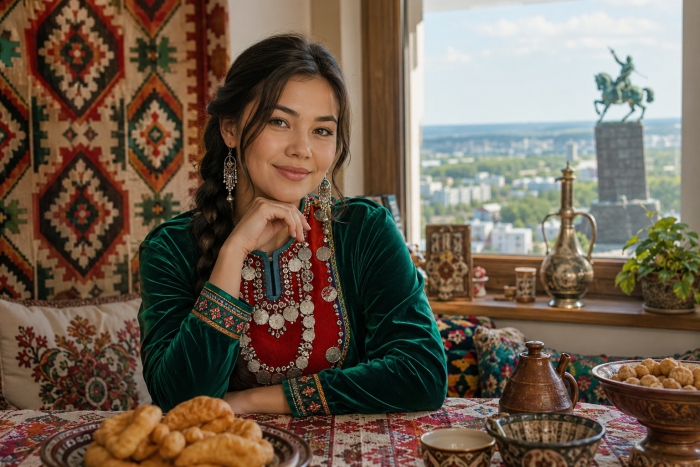 Bashkir Women
Agence CQMI
Bashkir Women
Agence CQMI
Bashkir Women of the Republic of Bashkortostan: 9 Myths Debunked — What You Really Don't Know
A Bashkir woman from the Republic of Bashkortostan is neither a Tatar with a different accent, nor a Russian woman with Turkic roots, nor a steppe nomad frozen in a Soviet ethnography textbook. She is the heiress of a Turkic-speaking people settled for millennia at the southern foothills of the Ural Mountains — at the precise crossroads of Europe and Asia — whose language is related to Kazakh and Tatar, whose epic oral tradition of kubair songs dates back to the origins of the steppe, and whose beauty, often striking in its Eurasian blend, is only the surface of a personality of remarkable depth. A Russian citizen, fluent in Russian, often trilingual (Bashkir, Russian, English), educated, professionally active — and yet so little known to men from Canada, the UK, Australia, or the United States who have never looked beyond Moscow. Read what follows before walking past something rare.
Article by Antoine Monnier, director and co-founder of CQMI international matchmaking agency, specialist in serious relationships between Western men and women from Russia, Eastern Europe, the Caucasus and Central Asia since 2014.
The country you never thought to look for in a matchmaking agency
Let me ask you something directly. If I say "Bashkortostan," what comes to mind? The vast majority of men from Canada, the UK, and Australia who contact me for the first time either draw a complete blank or admit — honestly and without embarrassment — that they've never heard the name. That's a perfectly fair reaction, and I'm not here to judge it. What I will tell you, however, is that this unfamiliarity may have cost you something genuinely extraordinary.
After more than a decade at CQMI, I've learned that the most surprising women — the ones who most profoundly transform our clients' lives — don't always come from the cities everyone mentions. Sometimes they come from places nobody talks about, and that is precisely why they remain available, authentic, and deeply themselves. Bashkir women are exactly that.
I remember James, a 51-year-old civil engineer from Toronto, who had been searching without success for two years. After a string of disappointing contacts from profiles in Kyiv or Moscow that felt, as he put it, "too curated to be real," he told me: "Antoine, I'm done with profiles that look like they were written by a PR agency. I want someone genuine." I introduced him to a member from Ufa, the Bashkir capital. Six weeks later he called from his office to tell me it was the first time in years he'd had the impression of talking to someone who wasn't trying to impress him — just being there. They met in person four months later.
If you're not serious — if you're looking for a short-term adventure or an exotic fantasy — stop reading now. The Bashkir women we work with at CQMI are not interested in one-night stands. They are looking for marriage. A union for life. That is their nature, their culture, their deliberate choice.
To understand who Russian women are in their full cultural and regional diversity — Bashkir women being Russian citizens — our dedicated page on Russian women is the best starting point.
A Bashkir woman is a Russian citizen of Turkic-Uralic heritage, fully fluent in Russian, often trilingual, educated and deeply rooted in her family values. She practices a moderate Sunni Islam — the legacy of a conversion through Volga trade routes, not conquest — with no veil, no rigidity. Her Eurasian beauty is real, the result of millennia of mixing between the peoples of the steppe, the Ural forests, and the ancient trade roads. She is not looking for a visa or an exit ticket: she is looking for a man of character who will see her as a full and equal partner.
Myth #1 — "Bashkortostan? That's some oil province lost in Siberia"
Let's start by correcting a fundamental geographical error, because it shapes everything that follows. Bashkortostan is not in Siberia. It is a federal Republic of Russia situated at the southern foothills of the Ural Mountains — the mountain range that has for centuries marked the conventional boundary between Europe and Asia. Its capital, Ufa, sits roughly 1,400 kilometres east of Moscow. It is therefore technically in European Russia — or, if you prefer, at the exact edge where Europe meets Asia.
Ufa is a city of 1.15 million people. It is a major university centre — home to Bashkir State University, Bashkir State Medical University, the Ufa State Aviation Technical University (UGATU), and several research institutes. It is also a significant industrial city (petrochemicals, machinery, converted Soviet aerospace industry) that has produced generations of women trained in technical and scientific fields. The oil industry is real — Bashneft was one of the jewels of Soviet industry — but reducing an entire civilization to an economic label would be as absurd as reducing Canada to its mining sector.
What I observe at CQMI: women from Ufa carry the quiet sophistication of inhabitants of a large provincial city that has no need to show off. They have neither the Parisian arrogance nor the Moscow restlessness. They have a natural self-assurance that comes from a thousand-year culture.
Myth #2 — "She's Turkish, or maybe Mongolian — I'm not really sure"
The identity confusion around Bashkirs is understandable — their ethnic history is fascinatingly complex — but it needs to be untangled in order to understand who a Bashkir woman really is.
The Bashkirs are a Turkic-speaking Kipchak people, linguistically related to Kazakhs, Kyrgyz, and Volga Tatars. Their territory has been inhabited for at least 3,000 years BC (the Sintashta and Andronovo cultures, forerunners of the Indo-Iranian steppe peoples). Islamisation began in the 10th century through Volga trade networks, well before the Mongol invasion. The Mongols came and went — without erasing the Bashkirs, who negotiated a relative autonomy with the Golden Horde. The Russians arrived in the 16th century under Ivan the Terrible, and the Bashkirs resisted them in several major uprisings (including the revolt of Salavat Yulaev in 1773–1774, alongside Pugachev — Salavat is today the national hero of Bashkortostan, whose equestrian monument dominates Ufa).
The result of this history: a Bashkir woman carries in her features and in her psychology the result of millennia of mixing between steppe peoples, Ural forest peoples, and Eurasian trade routes. She is neither Turkish, nor Mongolian, nor Russian — she is Bashkir, which is an entirely distinct category.
Myth #3 — "She wears the veil and her husband will make all the decisions"
This is the most damaging misconception — and the furthest from the reality I've observed over ten years on the ground.
Bashkir Islam is Sunni Hanafi, of moderate Sufi tradition. It was transmitted not through conquest or indoctrination, but through steppe trade networks beginning in the 10th century. Seventy years of Soviet secularism then deeply secularised Bashkir society. The result in 2026: a cultural and identity-based religiosity, but extremely discreet in its outward manifestations. A full veil or even a systematic hijab is a marginal exception in urban Ufa — and even more so among women who orient themselves toward an international relationship.
By our experience at CQMI: the Bashkir women we work with generally have a relationship to religion comparable to that of a moderately Catholic Canadian or British woman — faith as an inner anchor, not as an imposed dress code or behavioural constraint. What they value deeply is honesty, loyalty, and respect — values perfectly compatible with a serious relationship with a non-Muslim Western man.
The question of religion deserves an honest conversation, of course — as in any serious cross-cultural relationship. But it is not a wall. It is a nuance worth respecting.
Myth #4 — "She hasn't really studied — it's a backward region"
This idea simply reveals a lack of information about the educational reality of Bashkortostan, which is easy to correct with data.
The Republic of Bashkortostan has approximately 12 higher education institutions in Ufa alone, including Bashkir State University (founded 1957, 15,000 students), Bashkir State Medical University (one of Russia's most important for regional medical training), the Bashkir State Petroleum Technical University (USPTU), and the Ufa State Aviation Technical University. Women are heavily over-represented in medical, educational, economic, and legal programmes. The literacy rate exceeds 99.5% (Rosstat 2021). Many Bashkir women have pursued studies in Moscow, Saint Petersburg, or abroad.
What I observe in the files of our members from Ufa and other Bashkir cities: a level of education that is often impressive, a serious relationship with knowledge, an intellectual curiosity I don't find everywhere. These women read. They ask precise questions. They distinguish information from cliché.
Myth #5 — "She just wants to leave — a foreign husband is her exit ticket"
This objection comes up regularly. It conflates a legitimate question (how do you distinguish a sincere approach from a migration strategy?) with a prejudice that doesn't hold up under field analysis.
A Bashkir woman who engages in an international dating process almost always has a stable situation in Ufa: a job, housing, a strong family network. Ufa is not a poor city — Bashkortostan's GDP per capita is among the highest in regional Russia, driven by petrochemical and chemical industry. She doesn't need a Canadian or British passport to survive. What she is looking for is a couple project she cannot find in her immediate environment — for demographic reasons (the structural male-female imbalance in Russia, accentuated in the 30–45 age bracket) and reasons of values (Bashkir men are described by our members as often immature on the question of commitment — an observation I find in all post-Soviet cultures without exception).
What distinguishes a sincere approach from an exit strategy: the quality of the questions she asks. A woman looking for an exit ticket asks about immigration procedures by the second message. A serious Bashkir woman asks what you read, how you think about family, and whether you know how to cook. It's not the same conversation.
Myth #6 — "She's basically the same as a Tatar woman"
The Bashkir/Tatar confusion is extremely common, even among Russians themselves. It's understandable — the two peoples are Turkic-speaking, Muslim, geographically neighbouring, with a largely intertwined history. But it is inaccurate, and a Bashkir woman will tell you so with a quiet but firm precision.
The real differences are multiple. Linguistically: Bashkir and Tatar are two distinct languages from the Kipchak branch, mutually intelligible but not identical — like Spanish and Portuguese. Historically: the Bashkirs maintained a clan autonomy in the Ural steppes, while the Volga Tatars developed a merchant and urban culture centred on Kazan. In terms of identity: a Bashkir woman defines herself in relation to her territory — the southern Ural mountains, the Yaik river, the mixed forests — in a way that the Tatar woman, more urban and commercial, does not necessarily share. In terms of character: Bashkir women are often described by our staff and clients as more direct, less diplomatic, with a natural frankness that can surprise at first contact but quickly becomes a major relational asset.
Myth #7 — "She'll be cold and distant — Ural women aren't warm"
This is the exact opposite of what our clients report — and probably the most counter-intuitive misconception for men who arrive with images of windswept steppes and Siberian coldness.
At the heart of Bashkir culture is the value of hospitality — kunakchylyk in Bashkir — which is structurally important in a way few Westerners can imagine. A guest in a Bashkir household is treated as a blessing, not a burden. You are given the best. The meal that takes the longest to prepare is made for you. You are never allowed to leave without eating. This hospitality is not social calculation — it is a deep moral value, inherited from steppe traditions where welcoming a stranger could literally save his life in winter.
What this means concretely in a relationship: a Bashkir woman who is interested in you will put real, sincere, and often surprising energy into taking care of you — whether in the quality of her messages, in the way she checks whether you've eaten today, or in the meticulous preparation of your first real meeting. This warmth is not servility. It is an expression of respect and commitment.
Myth #8 — "The cultural gap will be an insurmountable obstacle"
This is the paralyzing complexity argument — the one that pushes serious men to give up before they've even tried. It deserves an honest answer, not a reassuring speech.
There are real cultural differences between a Bashkir woman and a Canadian, British, or Australian man. They concern mainly: the relationship to the extended family (inter-generational ties are strong — a Bashkir woman will not cut contact with her parents to please her Western husband), the relationship to food (Bashkir cuisine is generous, meat-centred, focused on collective sharing — the beshbarmak, the national dish of boiled meat with flat pasta noodles, is a ritual, not a meal), and the relationship to emotional discretion in public (ostentatious displays of affection are not part of the culture).
But here is what ten years of accompanying couples has taught me: couples who fail do not stumble on cultural differences. They stumble on the lack of curiosity and respect of one or both partners. A man who is genuinely interested in Bashkir history, who learns three words of Bashkir, who takes an interest in kubair music — that man will be welcomed into a Bashkir family as a potential member, not a threatening outsider.
Myth #9 — "A Bashkir woman is basically just another Russian woman"
This is perhaps the most widespread error among men who already have some experience with women from the post-Soviet space. She speaks Russian perfectly — often with a slightly different accent that Russians themselves recognise immediately. She grew up with the same TV shows, the same national holidays, the same school system. So in practice...
No. A Bashkir woman is not just another Russian woman. Her identity rests on a language that does not belong to the Slavic family, an oral tradition of kubair epics transmitted by sesens (poet-musicians), a relationship to the Ural territory that shapes her way of seeing the world, and a Bashkir national feeling that has asserted itself since the dissolution of the USSR. When a Bashkir woman says she is Bashkir — not Russian, not Tatar, Bashkir — she is expressing something that has survived decades of Sovietism without disappearing. It is an identity that resists.
To grasp the nuances between the different women of the Russian-speaking world, and to understand how the Bashkir woman stands apart through her unique heritage, our page dedicated to Russian women in all their diversity will give you a useful frame of reference — the Bashkir woman belongs to an entirely different register from the Slavic Russian woman.
Bashkir woman, Tatar woman, Russian woman: the real differences
| Criterion | Bashkir woman (Bashkortostan) | Tatar woman (Tatarstan) | Russian woman (European Russia) |
|---|---|---|---|
| Heritage | Turkic Kipchak, Ural steppe and mountain tradition | Turkic Kipchak, Volga merchant culture | East Slavic, Orthodox Eurasian culture |
| Religion | Sunni Hanafi Islam, secularised, very discreet | Sunni Islam, more culturally visible in Kazan | Orthodox (practice highly variable) |
| Core value | Kunakchylyk — hospitality, generosity, direct frankness | Education, urban prestige, commercial sense | Family warmth, directness, practicality |
| Temperament | Direct, warm, proud, attached to land and family | Educated, ambitious, cosmopolitan, more strategic | Warm, reserved at first contact, direct |
| Relationship to marriage | Central, sacred, strong family pressure but genuine commitment | Important, often associated with social status project | Strong, varies by region and generation |
| Languages | Bashkir (native) + Russian (fluent) + English (frequent) | Tatar + Russian + English in university settings | Russian |
| Meeting logistics | Ufa: regular connections via Moscow or Yekaterinburg | Kazan: direct flights from several European cities | Varies by city |
The 5 mistakes men make with Bashkir women
1. Confusing Bashkir with Tatar — or Bashkir with Russian. This is the equivalent of confusing a Scotsman with an Englishman in front of someone who cares deeply about their regional identity. A Bashkir woman knows exactly who she is and where she comes from. Showing her that you took the trouble to understand this distinction — even at an elementary level — is a strong signal of seriousness and respect.
2. Treating religion as an obstacle to overcome. Don't open with "you're Muslim, so that's complicated, right?" It's clumsy and reveals a deep misunderstanding. Let her describe her own relationship to faith if and when she chooses — on her terms and timeline.
3. Underestimating the importance of family. A Bashkir woman talks about her family regularly. She will ask questions about yours. This is not superficial curiosity — it's an assessment of your capacity to integrate the family dimension into a couple project. A man who responds in monosyllables on the subject sends an immediate negative signal.
4. Using unverified platforms. Bashkortostan is sufficiently off the radar of serious agencies for dishonest platforms to use invented profiles or stolen photos. A "too perfect" profile of a "woman from Ufa" on a Pay Per Letter site is a red flag. Our guide on PPL scams will give you the tools to distinguish the authentic from the fabricated.
5. Underestimating her standards. An educated Bashkir woman seeking a Western partner has precise standards. She is not looking for the richest or the most handsome — she is looking for someone consistent, stable, and real. A man who performs, exaggerates his income, or makes promises he won't keep will be identified quickly — and set aside with a politeness but a firmness that is quite remarkable.
Two field stories
Robert, our Edinburgh-based client, 54 years old and an accountant, contacted me somewhat perplexed after a third exchange with his member from Ufa. "Antoine, she sent me a photo of an equestrian statue and said it was the symbol of her city. I replied that it was very beautiful. She took ten minutes to respond — and when she did, she sent two full pages explaining who Salavat Yulaev was, why he fought against Catherine II, and what this represented for Bashkirs today." Robert told me he didn't know how to respond. I suggested one simple thing: "Ask her how she felt as a child standing in front of that statue." Her reply was three times longer than her previous message. They talked for two hours that evening. "She taught me more history in two hours than twenty years of school," he told me. He flew to Ufa four months later.
James, our Toronto client, had a problem. He had been vegetarian for seven years for health reasons, and his Bashkir member had warned him that her family was preparing a beshbarmak — the national dish of boiled meat with flat pasta noodles, a Bashkir honour meal — for his first meeting with them. "Antoine, it's their national dish. I can't refuse. But I don't eat meat." I told him to do exactly what he'd done with his doctor: the truth, clearly and without drama. His correspondent passed the information to her mother. The mother — 68 years old, speaking only Bashkir and Russian — spent two hours preparing an entirely meat-free feast. When James found out what she had cooked just for him, he nearly broke down on the first video call with the whole family. "I have never in my life experienced hospitality like that."
Frequently asked questions about Bashkir women
Can a non-Muslim man seriously pursue a relationship with a Bashkir woman?
Yes, in the vast majority of cases. Bashkir Islam is secularised, personal, and discreet. What matters to a Bashkir woman is not your religion — it's your honesty, your respect, and your seriousness about marriage. Some more traditional families may raise the subject, but it is not a systematic barrier. The conversation is possible, provided it is approached with respect and without posturing.
How do you meet a Bashkir woman from Canada, the UK, or Australia?
The most serious and safe route remains a specialised matchmaking agency that verifies the identity and motivations of each member. CQMI has been accompanying this type of process since 2014. Our subscription at $350 CAD/month gives you access to 10 verified contacts of serious women — including some originally from Bashkortostan. Ufa is accessible by air via Moscow, with regular connections from Toronto, London, or Sydney.
Do you need to learn Bashkir for a serious relationship?
No — Russian is the language of everyday exchange, and our translator-assistants accompany the first contacts. That said, learning three or four words in Bashkir — salam (hello), räxmät (thank you), sin niseqsen? (how are you?) — is perceived as an extraordinarily touching gesture. A Bashkir woman who sees a man make that small effort will tell you it was one of the things that moved her most.
What age gap is reasonable with a Bashkir woman?
In Bashkir culture, as in the broader post-Soviet world, a mature and stable man is perceived positively — not as an obstacle. A difference of 5 to 15 years remains the most well-documented comfort zone in our experience. Beyond 15 years, a relationship is possible but requires total honesty about mutual expectations on both sides. Our article on age difference will give you concrete benchmarks.
Will a Bashkir woman consider relocating to Canada, the UK, or Australia?
Yes, provided the couple project is clear and respectful. A Bashkir woman will not leave her city and her family for a stranger whose intentions are vague. But one who commits to a serious man is capable of building a life elsewhere — with her own skills, her own adaptability, and her own ambitions. Bashkir women who have emigrated in professional contexts (doctors, engineers, researchers) show a remarkable capacity for integration.
What you really need to understand about Bashkir women
A Bashkir woman is not an ethnographic museum exhibit or an exotic profile to tick off a list. She is the heiress of a people of 1.6 million who negotiated with the Mongols, resisted the Russians, survived the USSR, and rebuilt their cultural identity after 1991 — language, epics, music, territory — without making a noise about it, without needing the world to know. That discretion is not weakness. It is the mark of a culture that is sure of itself.
What the experience of the international matchmaking agency CQMI confirms, after more than 350 successful marriages since 2014:
- Her direct frankness is not rudeness — it is an economy of falseness that makes the relationship clear and solid.
- Her hospitality is not calculation — it is a natural expression of who she is, and it profoundly transforms the men who receive it.
- Her attachment to family and territory is not a constraint — it is the guarantee that when she commits, she commits with everything she is.
If you are a serious man looking for a real life project, Russian women in all their remarkable diversity — and Bashkir women in particular — deserve your full attention. Not for what they represent in your imagination. For what they are.
Before you take the first step, find out whether your profile matches what these women are genuinely looking for: take the CQMI compatibility quiz.
Ready to meet a serious woman from Russia or Bashkortostan?
CQMI has been operating since 2014. Our subscription — $350 CAD/month — gives you access to 10 verified contacts of women genuinely motivated to build a lasting relationship. Over 40% of female applications are rejected during our vetting process.
Questions? Write directly to Antoine: This email address is being protected from spambots. You need JavaScript enabled to view it.
Further reading
- Komi Women of the Komi Republic: 9 Myths Debunked
- Pay Per Letter (PPL) Dating Scams
- The Age Difference Comes With a Price Tag
- Real Stories of Men Who Married a Ukrainian or Russian Woman
Scoop.it Summary — Bashkir Women: 9 Myths Debunked
Who are Bashkir women from the Republic of Bashkortostan, really? Antoine Monnier, director of the international matchmaking agency CQMI, dismantles nine myths that prevent Western men from discovering one of the most singular feminine personalities in the post-Soviet world.
A Bashkir woman is a Russian citizen, fully fluent in Russian, and often trilingual — but her identity rests on a Turco-Kipchak language of its own, a millennia-old oral tradition of kubair epic poetry, and a culture of hospitality (kunakchylyk) that invariably surprises the men who encounter it. She comes from a university metropolis of 1.15 million people — Ufa — and not from a steppe lost in Siberia (another frequent geographical error: Bashkortostan is at the Europe-Asia boundary, not in Siberia).
Her Sunni Hanafi Islam is secularised, personal, and discreet — the legacy of an Islamisation via Volga trade routes in the 10th century, compounded by seventy years of Soviet secularism that deeply reshaped society. She does not wear the veil systematically. She is not looking for a Muslim man. She is looking for a man of character.
Contrary to the stereotypes, she is not there to "escape" — she comes from a region economically stabilised by the petrochemical and university industries, and her international dating approach is a couple project, not a migration strategy. Her direct frankness — one of the characteristic traits of Bashkir women compared to Tatars or Slavic Russians — is often perceived as disconcerting on first contact, before becoming a major relational asset.
The article also includes two field anecdotes (the Salavat Yulaev statue and the unexpected history lesson; the beshbarmak and the meatless hospitality), a comparison table of Bashkir / Tatar / Russian women, the 5 mistakes to avoid, a complete FAQ, and internal links to CQMI resources on Russian women in all their diversity. Essential reading for Canadian, British, and Australian men seeking a serious, lasting relationship with a woman from the post-Soviet world.
CQMI Agency — 350+ successful marriages since 2014 — $350 CAD/month for 10 verified contacts.
Latest from Antoine Monnier
- Ukrainian Woman Asks You for Money: Scam or Sincere?
- Ukrainian Refugee Women: Why Their Host Country Changes Everything
- Ukrainian or Russian Woman: 7 Signs She Is Truly Single and Serious About Marriage
- Ukrainian Woman and Marriage: Why It Is Her Only Real Safety Net
- Language Barrier With a Ukrainian or Russian Woman: The Complete Guide

 +1 514 794-5053