


Ukrainian and Russian Bride dating advices - CQMI blog

 Udmurt Women:
Agence CQMI
Udmurt Women:
Agence CQMI
Udmurt Women from the Republic of Udmurtia: 9 Myths Debunked — What You Never Knew
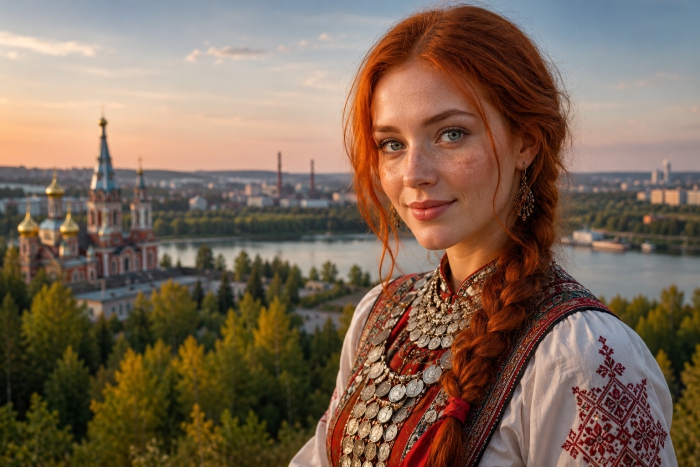
An Udmurt woman from the Republic of Udmurtia is not a generic Russian, not an ethnographic curiosity, and not someone lost in a Soviet-era industrial wasteland. She is the heir of a Finno-Ugric people who have lived between the Kama and Vyatka rivers — at the western edge of the middle Urals — for millennia. Her language is a cousin of Finnish, Estonian and Hungarian. Her most striking physical trait has been documented since the 18th century: ethnographers of the time called the Udmurts "the most red-headed people in the world." That claim is scientifically grounded — over 10% of the Udmurt population carries the MC1R gene variant responsible for natural red hair, a frequency unmatched anywhere outside Western Europe. But she is far more than a hair colour. She is shaped by centuries of forest animism, by an Orthodox Christianity she wears lightly, by seventy years of Soviet precision manufacturing in a closed city, and by a quiet national pride that outlasted everything the 20th century threw at it. If you are not serious — if you are looking for a short-term adventure — stop reading now. These women are looking for marriage. A life commitment. Nothing less.
Article by Antoine Monnier, director and co-founder of the international matchmaking agency CQMI, specialist in serious relationships between Western men and women from Russia, Eastern Europe, the Caucasus and Central Asia since 2014.
The woman you never thought to look for — and why that is your advantage
Let me be direct with you. In over ten years running CQMI, I have learned that the most remarkable women — the ones who genuinely change the lives of the men who find them — are rarely where everyone is looking. They are in places most men have never heard of. And that is precisely why they are still there: authentic, available, and completely themselves.
Robert, one of my Edinburgh clients, 54, called me after his first video call with a member from Izhevsk. "Antoine, I was expecting some shy woman from the back of nowhere. Instead I met an engineer who manages quality control at a precision factory, who tells me about summers picking wild berries in the Udmurt forest, who laughed out loud when I confused Udmurt with Uzbek — and then patiently explained the entire history of her people for forty minutes. Gentle and solid at the same time. I had never felt anything like it." What Robert discovered that evening, I am going to explain to you — with verified facts, more than a decade of direct observation from our international matchmaking agency CQMI, and nine persistent myths to dismantle one by one.
Before we go further: if this is your first encounter with Russian women from minority peoples, our Russian women profile page provides a solid starting framework. Udmurt women are Russian citizens — but their identity runs much deeper than that label suggests.
Short answer
An Udmurt woman is a Russian citizen of Finno-Ugric origin — fluent in Russian, often university-educated, and statistically the most likely woman in all of Russia to have natural red hair. Her religion is a gentle mix of nominal Orthodoxy and ancient animism. Her character is marked by initial reserve that gives way, once trust is established, to warmth and loyalty that consistently surprise Western men. She is not looking for an exit visa — she comes from a stable industrial city of 643,000 people. She is looking for a man of character who will see her for who she actually is.
Myth #1 — "Udmurtia is somewhere in Siberia, isn't it?"
No. This is the most common geographical error, and it matters because it shapes everything else. The Republic of Udmurtia is a federal subject of Russia located in the western Ural region, between the Kama and Vyatka rivers. Its capital, Izhevsk, sits 970 km east of Moscow — technically still European Russia, not Siberia.
Izhevsk has a population of approximately 643,000, making it the twentieth largest city in Russia — a regional metropolis with universities, an opera house, a state philharmonic, and a zoo. It became world-famous for one reason: this is where Mikhail Kalashnikov developed and began mass-producing the AK-47 in 1948. The city was entirely closed to foreigners throughout the Soviet period because of its defence industry — which is precisely why the Udmurts remain so unknown outside Russia. Not because they are isolated or backward, but because the world was kept out.
One detail that always catches my clients off guard: Pyotr Ilyich Tchaikovsky was born in 1840 in Votkinsk — 60 km from Izhevsk, in what is now Udmurtia. Kalashnikov rifles and Tchaikovsky symphonies, both from the same land. That tells you something about the range of this culture.
Myth #2 — "The red hair thing is just a marketing gimmick"
This is one of the best-documented facts about this people — and one of the least known outside specialist ethnology circles.
Since the 18th century, European and Russian ethnographers consistently noted the exceptional frequency of red hair and light eyes among the Udmurts. "The most red-headed people in the world" was the phrase in common use among scholars of the era. Modern genetics has confirmed and refined this observation: research has identified an unusually high frequency of the R allele of the MC1R gene in the Udmurt Republic — the gene variant responsible for pheomelanin production, which gives hair its red and auburn tones. The Udmurts are, alongside the Irish and Scots, the only non-Western European population to show natural redhead frequency above 10%. The global average outside these groups is below 2%.
Since 2004, an annual Redhead Festival has been held in Izhevsk — one of just a handful of such events worldwide, alongside those in Breda (Netherlands) and Crosshaven (Ireland). Women parade through the city centre in embroidered traditional costumes, copper hair in the sun, celebrating what makes them singular. This is not tourism. It is cultural identity in action.
James, a Toronto client, described his first video call with a member from Izhevsk: "Antoine, I was not prepared for the combination — auburn hair, light grey eyes, and this completely unself-conscious intelligence. She was explaining Udmurt history and I just kept thinking: how does someone like this exist and not have every man in the world lining up?" The answer, James, is that most men are not looking in Izhevsk.
Myth #3 — "She's animist — isn't that, well, strange?"
This deserves a precise answer rather than a reassuring one, because the religious reality of Udmurt women is genuinely interesting.
The Udmurts were forcibly Christianised from the 16th century onward, after the Muscovite conquest of Kazan. The Orthodox Church gained ground — but never fully replaced the pre-Christian animist beliefs centred on the forest, rivers, ancestors, and a pantheon of nature deities including Inmar (sky god), Kyldysin (earth god) and Vumurt (water spirit). That animism never disappeared. Since 1994, the national animist organisation Vos has led a formal neo-pagan revival. In southern Udmurtia, spring rituals in sacred forest clearings continue alongside Orthodox Easter services.
What does this mean in practice for an urban Udmurt woman from Izhevsk? A spirituality that is personal, quiet and entirely non-prescriptive. She may cross herself at Easter and keep a small talisman her grandmother gave her in a drawer. She imposes neither. This is not inconsistency — it is what happens when a people learns to hold two worlds without needing to resolve them into one. For a man from Canada, the UK or Australia, this creates exactly zero problems in practice. What it creates instead is a woman with a rich inner world and no interest whatsoever in religious conflict.
Myth #4 — "A closed Soviet weapons city — she can't be well-educated"
This is precisely backwards. Soviet defence industries required engineers, physicians, precision technicians and scientists at every level. The massive investment in education that this demanded did not vanish when the USSR collapsed.
Izhevsk today hosts several major universities: Udmurt State University (founded 1931), Kalashnikov Izhevsk State Technical University (Kalashnikov Tech, founded 1952 — over 12,000 students, 275 international), an agricultural academy, a pedagogical institute in Glazov. Women are heavily represented in medical, educational, legal and economic faculties. Literacy exceeds 99.5%. Many Udmurt women hold postgraduate degrees.
What our field experience at CQMI consistently shows: Udmurt women from Izhevsk have a rigorous, curious relationship with knowledge. They ask precise questions. They read. They distinguish information from cliché with a speed that consistently surprises our clients. The Soviet legacy of technical precision in this city produced generations of women who approach problems — including the problem of finding a serious partner — with methodical intelligence.
Myth #5 — "She just wants a Western passport — it's all about leaving"
I hear this objection regularly. Let me address it with facts rather than reassurance.
Udmurtia is not an economically depressed region. The republic's economy is anchored by machine building, metallurgy, electronics, chemical manufacturing and oil extraction. The Concern Kalashnikov still employs thousands of skilled workers. An Udmurt woman with a university degree and a stable professional position in Izhevsk does not need a Canadian or British passport to survive. She has options.
What she does not have, in sufficient numbers, are men who take commitment seriously. Russia's structural demographic imbalance — women living an average of ten years longer than men, the 35–55 male cohort severely depleted by alcohol, accidents and disease — is real. The pattern we observe across all Russian cities, consistently, is that men of the right age who are emotionally mature and willing to commit are genuinely scarce. That is what drives serious Udmurt women toward international matchmaking — not economic desperation.
The tell is always in the questions she asks early on. A woman looking for an exit route asks about immigration procedures by the third message. A serious Udmurt woman asks what you value in life, whether you want children, and whether you know how to cook anything. Not the same conversation.
Myth #6 — "She's basically the same as a Komi woman, or Finnish"
The confusion between Finno-Ugric peoples is completely understandable — the languages are related, the territories overlap, the histories are entangled. But it is inaccurate, and an Udmurt woman will tell you so quietly and clearly.
Udmurt belongs to the Permic branch of Finno-Ugric — most closely related to Komi, not to Finnish or Estonian. But even compared to Komi women, the differences are significant. Komi women were Christianised more thoroughly from the 14th century onward and developed urban merchant culture with Russian contact earlier. Udmurt women maintained stronger animist traditions and a more introverted, forest-rooted identity well into the Soviet period. The character types differ accordingly: Komi women tend toward a certain northern resilience and independence; Udmurt women have a deeper reserve and a more layered inner life, with a warmth that emerges more slowly but runs more deeply.
With Finnish or Estonian women, the distinction is wider still. These are European Union citizens shaped by Scandinavian and Baltic cultural frameworks — entirely different registers. An Udmurt woman shares with them only the grammatical bones of a distant common ancestor language, and virtually nothing else in terms of daily psychology or relational culture.
Myth #7 — "Women from a closed industrial city must be cold and guarded"
This is the exact opposite of what our clients consistently report — and the myth that surprises me most because it sounds so plausible before you encounter the reality.
Izhevsk has a quality that its residents themselves describe: it is a city where everyone knows everyone. Social networks are dense, locally rooted, built on trust. It is not Moscow — no anonymity, no perpetual social performance, no metropolitan arrogance. People make eye contact on the street.
The Udmurt character, as documented by anthropologists and confirmed by everything I have observed over a decade at CQMI, is essentially non-aggressive. This is not just a cultural stereotype — it is historically grounded: the Udmurts never sought to conquer other peoples. They paid their tributary taxes, maintained autonomy in their forests, and outlasted everyone who tried to assimilate them. That temperament translates in women as genuine gentleness — combined with a quiet resolve that never collapses into passivity.
The pattern we see consistently: an Udmurt woman is reserved in first contact. She observes more than she speaks. But once she decides you are worth trusting — and that trust is built by consistency, not charm — she is warm in a way that Western men describe, almost universally, as unlike anything they have previously experienced. Robert from Edinburgh put it simply: "She doesn't perform warmth. She just has it."
Myth #8 — "The cultural gap will be too wide to work in daily life"
I will give you an honest answer here — not a comfortable one.
Real cultural differences exist between an Udmurt woman and a man from Canada, the UK or Australia. The cuisine first: Udmurt food is generous, forest-centred, meat-based — wild game, pork, chicken, mushrooms, and traditional baked pastries called perepech (open-top meat and egg tartlets cooked over open flame). Meals are communal events. Declining food offered with care is culturally negative and should be handled with grace, not refusal.
Family ties next: intergenerational links are strong and non-negotiable. An Udmurt woman will not cut contact with her parents to accommodate a Western husband's preferences. This is not dependency — it is a structural value. Men who respect it, rather than resist it, find it becomes one of the warmest parts of their relationship.
Public emotional expression: demonstrative affection in public is not the norm. A man who understands this and does not interpret its absence as emotional distance immediately signals a maturity that is noticed and appreciated.
What a decade of accompaniment at CQMI confirms: couples do not fail because of cultural differences. They fail because one or both parties were incurious. A man who knows that Tchaikovsky was born in Udmurtia, who asks what perepech is, who learns to say "thank you" in Udmurt (tau) — that man is welcomed into an Udmurt family with a warmth most Western men have never encountered.
Myth #9 — "An Udmurt woman is just a Russian woman with an unusual background"
This is the mistake most common among men who already have some experience of the post-Soviet world — and think they therefore know what to expect.
She speaks Russian fluently. She grew up with the same national holidays, the same television series, the same school system as any Russian. So, practically speaking — right?
Wrong. An Udmurt woman is not a Russian woman with a twist. Her mother tongue — Udmurt, a Finno-Ugric language — belongs to an entirely different language family from Slavic. Her mythological world includes Inmar, Kyldysin, Vumurt — beings that exist nowhere in Russian folk tradition. Her poetic heritage includes the Dorvyzhy, the Udmurt national epic, and ritual choral songs called krozy, a tradition with no Slavic parallel. And her national identity — long suppressed during the Soviet period when the old exonym Votyak carried a pejorative charge — has been reasserting itself since 1991 with a quiet, grounded confidence.
The poet and ophthalmologist Ashaltchi Oki (Akilina Vekchina, 1898–1973) stands as a symbol of this identity: she survived the Stalinist purges that decimated the Udmurt intelligentsia in the 1930s, continued writing poetry in the Udmurt language, and remained a reference point for every generation since. When an Udmurt woman says she is Udmurt — not Russian, not Tatar, Udmurt — she is expressing something that survived decades of pressure to disappear.
For a broader understanding of the diversity within Russia's women — which makes the Udmurt profile all the more remarkable — our analysis of the difference between Russian and Ukrainian women gives useful context. Udmurt women occupy an entirely different register from either.
Udmurt, Komi, Russian: the real differences
| Criterion | Udmurt woman (Udmurtia) | Komi woman (Komi Republic) | Russian woman (European Russia) |
|---|---|---|---|
| Heritage | Permic Finno-Ugric, forest animism of the Urals | Permic Finno-Ugric, deeper Christianisation, boreal tradition | East Slavic, Eurasian Orthodox culture |
| Phenotype | Natural redheads >10%, light eyes frequent, fair complexion | Nordic traits, more often light brown/blonde hair | Highly variable by region |
| Religion | Nominal Orthodoxy + active animism (Vos org. since 1994) | Orthodoxy more integrated, less residual animism | Orthodox (practice varies widely) |
| Core value | Loyalty, non-conflict, connection to nature and community | Resilience, independence, northern solidity | Family warmth, practical strength, directness |
| Temperament | Reserved at first contact; deeply warm once trust is established | Reserved, proud, strong interiority | Warm, initially reserved, direct |
| Approach to marriage | Deep commitment, family-centred, total loyalty when engaged | Serious commitment, personal independence maintained | Strong, varies by region and generation |
| Languages | Udmurt + Russian (fluent) + English (university circles) | Komi + Russian (fluent) | Russian |
| How to reach her | Izhevsk: flights via Moscow or Kazan (~2h domestic) | Syktyvkar: flights via Moscow | Varies by city |
The 5 mistakes men make with Udmurt women
Read carefully before your first message.
1. Calling her Russian — or confusing her with a Komi or Finnish woman. She knows exactly who she is and where she comes from. You do not need to be an expert in Finno-Ugric linguistics. You do need to show that you have taken the trouble to understand the basic distinction. Knowing that Izhevsk is the Kalashnikov city, that Tchaikovsky was born in Udmurtia, or that there is an annual Redhead Festival — any one of those details signals respect that she will notice.
2. Interpreting her initial reserve as disinterest. She does not open up quickly to strangers. If her first few messages are factual and brief, that is her baseline, not a rejection signal. Stay consistent, stay genuine. The warmth will come — and when it does, it is real.
3. Being dismissive about her family. She will mention her parents and her family early and often. Ask questions. Show genuine interest in the people who matter to her. A man who responds in monosyllables to anything family-related sends a clear negative signal in her relational framework.
4. Using unverified platforms. Udmurt women are sufficiently under the radar of serious agencies that dishonest platforms use fabricated profiles and stolen photos from the region. A profile that seems too polished, on a Pay Per Letter site, is a red flag. First read our guide to PPL dating scams before searching alone.
5. Underestimating her standards. She is not impressed by income or status. She is looking for consistency, reliability, and honesty. A man who exaggerates his circumstances, makes promises he will not keep, or puts on a performance will be identified quickly — and graciously but firmly removed from consideration. Do not perform. Be accurate about who you are.
Two stories from the field
The Redhead Festival photograph and the question that changed everything
Robert, my Edinburgh client, mentioned in passing during a video call with a member from Izhevsk that he had read about the Redhead Festival. He had not prepared for her reaction. She lit up — genuinely, not politely — and said: "My younger sister has taken part twice. You actually know about this in Scotland?" That detail — that a man from Edinburgh had taken the trouble to know something so specific about her city — shifted her assessment of him completely. She told him weeks later that it was the moment she decided he was worth trusting. "He was interested in me. Not in an image of a Russian woman." They met in Warsaw three months later. She is now applying for a UK visa.
The perepech, the vegetarianism, and the two-hour feast
James, our Toronto client, had a problem: seven years of vegetarianism for health reasons, and a member from Izhevsk whose mother was preparing perepech — the traditional Udmurt meat and egg open pastries, the family's highest honour for a first visit. "Antoine, I cannot refuse this. But I don't eat meat." I told him to do what he had done with his doctor: the truth, clearly, without drama. His match passed the information to her mother. The mother — 66 years old, speaking only Udmurt and Russian — spent two hours creating an entirely meat-free feast from scratch. When James heard what she had done, he told me he nearly broke down on the video call with the whole family. "I have never in my life been shown hospitality like that. She cooked for two hours for a stranger's dietary restrictions." He booked his flight to Izhevsk the following week.
Frequently asked questions about Udmurt women
Do Udmurt women really have red hair more often than other Russian women?
Yes, significantly. The MC1R gene variant responsible for natural red and auburn hair is found in over 10% of the Udmurt population — the highest frequency outside Western Europe, and far above the Russian national average. The annual Redhead Festival in Izhevsk (since 2004) has turned this into a cultural celebration. It is not a marketing claim — it is a documented genetic phenomenon.
How do I meet an Udmurt woman from Canada, the UK or Australia?
The most reliable path is through a verified international matchmaking agency. CQMI has been facilitating these connections since 2014. Our $350 CAD/month subscription gives you access to 10 verified, marriage-minded contacts. Izhevsk is accessible by domestic flight via Moscow or Kazan (approximately 2 hours). First meetings are typically arranged in a neutral city — Warsaw or Moscow depending on circumstances.
Does the age gap matter more with an Udmurt woman?
Not more than elsewhere in Russia — and possibly less, since Udmurt culture values stability and maturity positively. A 5–15 year difference sits within the documented comfort zone. Beyond 15 years, the relationship is entirely possible but requires complete honesty about mutual expectations from the outset. For a detailed framework, see our analysis of the age difference question in international couples.
Do I need to speak Russian or Udmurt?
No. Russian is the language of all exchanges. Our translator-assistants support the first contacts until direct communication develops. Learning a few words of Udmurt — "hello" is zech, "thank you" is tau — is genuinely appreciated and costs you ten minutes. The effect is disproportionate to the effort.
Will an Udmurt woman relocate to Canada, the UK or Australia?
Yes, when the relationship project is clear and respectful. Udmurt women who have relocated for professional reasons show excellent integration capacity. What they need: ongoing regular contact with their family, and genuine recognition of their cultural identity — not erasure of it. Men who provide this find that the transition is smoother and more solid than they expected.
Is the animist background a problem for a non-religious Western man?
Not in practice. Urban Udmurt women from Izhevsk who are looking for an international relationship carry their spiritual heritage lightly and never impose it. What they value is honesty and respect — not religious alignment. This is confirmed by our field experience at CQMI across many years of accompaniment.
What you actually need to understand about Udmurt women
An Udmurt woman is not an exotic entry in a matchmaking catalogue. She is the heir of a people of 386,000 who survived the Golden Horde, the Kazan Khanate, the Russian Empire, seventy years of Soviet defence industry in a city closed to the outside world — and who rebuilt their cultural identity after 1991 without needing anyone's approval. The Udmurt language. The Dorvyzhy epic. The animist spring rituals. The Redhead Festival. All of it maintained, on their own terms, in their own time.
What the international matchmaking agency CQMI confirms, after more than 350 successful marriages since 2014:
- Her initial reserve is not distance — it is depth. It rewards patience, not performance.
- Her loyalty, once committed, is total. Men who have experienced it describe it as genuinely stabilising — a quality they did not know they were missing.
- Her singularity — the red hair, the forest mythology, Kalashnikov and Tchaikovsky from the same city — is not an obstacle. It is the texture that makes the relationship unlike anything you have known.
Take the CQMI compatibility quiz to find out whether your profile matches what these women are genuinely looking for.
Ready to meet a serious woman from Russia or Udmurtia?
CQMI has been operating since 2014. Our subscription — $350 CAD/month — gives you access to 10 verified contacts of women genuinely committed to building a lasting relationship. Over 40% of female applicants are screened out during our selection process.
Questions? Write directly to Antoine: This email address is being protected from spambots. You need JavaScript enabled to view it.
Further reading
- The subtle difference between a Russian woman and a Ukrainian woman
- The age difference comes with a price tag: a truth nobody wants to hear
- Pay Per Letter (PPL) dating scams: how to spot them
- Browse verified profiles of Eastern European women
Latest from Antoine Monnier
- Ukrainian Woman Asks You for Money: Scam or Sincere?
- Ukrainian Refugee Women: Why Their Host Country Changes Everything
- Ukrainian or Russian Woman: 7 Signs She Is Truly Single and Serious About Marriage
- Ukrainian Woman and Marriage: Why It Is Her Only Real Safety Net
- Language Barrier With a Ukrainian or Russian Woman: The Complete Guide

 +1 514 794-5053