


Ukrainian and Russian Bride dating advices - CQMI blog

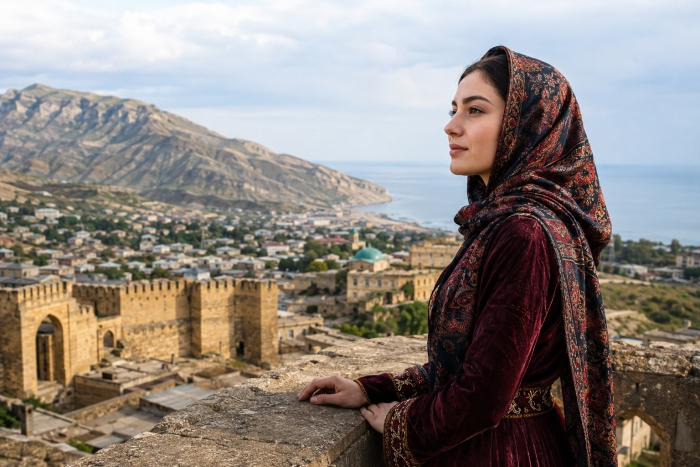 Dagestani Women
Agence CQMI
Dagestani Women
Agence CQMI
Dagestani Women of the Republic of Dagestan: 9 Myths Debunked
21 min read
Short answer: a Dagestani woman does not belong to a single people, but potentially to one of some thirty distinct peoples of the Republic of Dagestan — Avars, Dargins, Laks, Lezgins, Kumyks, Tabasarans, and many others — each with its own language, sometimes limited to a handful of mountain villages. Predominantly Sunni Muslim, she lives in the largest and most populous republic of Russia's North Caucasus, a land once crossed by the Silk Road, where the city of Derbent claims the title of Russia's oldest city. If you are not serious — if you are looking for a one-night stand — please do not apply. These women want one thing only: marriage, a lifelong union.
Article by Antoine Monnier, director and co-founder of CQMI International Matchmaking Agency, specialized in serious relationships between Western men and women from Russia, Eastern Europe, the Caucasus, and Central Asia since 2014.
Dagestan: thirty peoples under one flag
Over more than ten years running CQMI, I get asked some version of the same question again and again. Robert, one of our clients from Edinburgh, put it to me this way after watching a documentary about combat sports originating from this region: "Antoine, where exactly is Dagestan? Is that still Russia?" Yes, Robert, it is Russia — but a Russia unlike any other region of the country. Dagestan is the largest and most populous republic of the North Caucasus, covering roughly 50,000 km² with more than three million residents. What makes it unique is not just its size, but its diversity. It is home to around thirty peoples and some sixty languages, thirteen of which are recognized as official local languages alongside Russian. Some mountain villages, too isolated to ever have merged with their neighbours, still speak their own dialect, understood only a few kilometres away. For context on the broader Slavic and Caucasian world we introduce to our members, our page on Russian women and their mindset remains the best starting point before tackling a republic as composite as Dagestan. What ten years of matchmaking has taught me: the men who succeed with a woman from such a little-known nationality are the ones willing to learn before trying to charm. That is the point of this article.
Short answer: a Dagestani woman is a Russian citizen originally from the Republic of Dagestan, most often belonging to one of the region's major ethnic groups — Avars, Dargins, Laks, Lezgins, or Kumyks foremost among them. Predominantly Sunni Muslim, she speaks fluent Russian as a common language, alongside her own ethnic mother tongue. She places strong value on the extended family and clan, inherits a culture of hospitality and loyalty, and is not looking for a passing adventure but for a stable, respectful man capable of patience toward an identity she has to explain constantly, even to fellow Russians.
Myth #1 — "Dagestanis are all one and the same people"
This is the most common mistake, and it deserves to be corrected first. Unlike neighbouring Chechnya, where over 90% of the population is ethnically Chechen, Dagestan has no truly dominant ethnic group. Avars, the largest group, make up around 29% of the population; next come the Dargins (roughly 17%), followed by Kumyks, Lezgins, Laks, Tabasarans, Nogais, Rutuls, Aghuls, Tsakhurs, and others. The word "Dagestani" is therefore, much like "Mordvin" for the neighbouring republic I covered in a previous article, a collective label rather than an ethnicity in itself. A Dagestani woman will almost always introduce herself first by her specific people — Avar, Lezgin, Dargin — before calling herself "Dagestani."
Verdict: FALSE. Dagestan is home to roughly thirty distinct peoples with no dominant ethnic majority, making it one of the most linguistically fragmented republics in the entire Russian Federation.
Myth #2 — "She only speaks her regional language, communication is impossible"
This is false — if anything, the opposite trend is the real concern: some local languages, spoken by only a few thousand people, are genuinely declining. Since Soviet times, Russian has been the language of interethnic communication — the only common ground for an Avar, a Lezgin, and a Dargin, who often share no other language at all. A Dagestani woman, especially one born after 1991, was schooled in Russian and speaks it fluently day to day, including within mixed or urban households. Basic English is also fairly common among the younger generation, particularly in Makhachkala, the capital.
Verdict: FALSE. Russian is the shared language across all of Dagestan, and a Dagestani woman speaks it as naturally as a woman from Moscow or Saint Petersburg.
Myth #3 — "As a Muslim, she will never consider marrying a non-Muslim Westerner"
I would rather address this directly than dodge it, because it is the first question our English-speaking clients ask me. It is true that roughly 85 to 90% of Dagestanis are Muslim, overwhelmingly Sunni of Sufi tradition — a form of practice historically defined more by personal spirituality than by rigid rule-following. This reality has an honest consequence I will not hide from you: the share of Dagestani women genuinely open to marrying a non-Muslim Western man is, in practice, smaller than among an Orthodox Russian woman from Moscow or a Catholic Ukrainian woman from Lviv. This is precisely why Dagestan remains a nationality rarely covered by Western matchmaking agencies: the pool of sincerely motivated candidates is smaller, but not nonexistent. The Dagestani women who register with a serious agency like ours generally come from urban, long-Russian-speaking families, are sometimes already once married outside the Dagestani community, or grew up outside the Republic itself. Their decision is a deliberate personal choice, rarely taken lightly, and all the more sincere for not having been an obvious one within their own circle.
Verdict: NUANCED. Dagestan's Muslim majority genuinely narrows the pool of candidates open to marrying a Westerner, but those who take that step do so with a personal determination that is rarely superficial.
Myth #4 — "She chooses her husband as freely as a Russian woman does"
This is an oversimplification that deserves an honest nuance. Dagestan remains, far more than European Russia, structured around clan and extended family — what ethnographers call the tukhum among the Avars, a patrilineal system that still weighs on major life decisions, marriage included. In rural mountain areas, family opinion remains decisive. But this fades noticeably in the cities: in Makhachkala, home to a growing share of the Dagestani population, young urban, educated, professionally active women enjoy a level of decision-making autonomy much closer to that of an ordinary Russian woman. A Dagestani woman registered with an international matchmaking agency has, by definition, already made the personal choice to step outside the traditional pattern — a choice that deserves respect and understanding, not minimizing.
Verdict: NUANCED. Clan influence remains real, particularly in rural areas, but the autonomy of urban Dagestani women has grown considerably, and those who reach out to a Western agency have already distanced themselves from that pattern.
Myth #5 — "Dagestan is a permanent war zone, avoid the idea entirely"
I will not sugarcoat this out of commercial caution: Dagestan went through a difficult period, roughly between 2010 and 2018, marked by counterterrorism operations tied to the wider fallout of the wars in neighbouring Chechnya. That period is now largely behind it: the security situation has stabilized considerably since, and unlike Chechnya, Dagestan has never pushed for secession — its mosaic of peoples has instead closed ranks against outside attempts at destabilization. This does not change our standard advice: any meeting with a Dagestani member is prepared through the agency's guidance, never improvised, exactly as we recommend for any destination in the Volga region or the Caucasus.
Verdict: NUANCED. Dagestan went through a difficult period that has since largely stabilized, but caution and serious guidance remain essential, as with any well-prepared international meeting.
Myth #6 — "Makhachkala is just an unremarkable provincial town"
That is a reductive image. Makhachkala, the capital of Dagestan, is home to more than 600,000 people and functions as a true Caucasian melting pot: its residents come from dozens of different ethnic groups, making the city something of a microcosm of the entire Republic. Founded in 1844 as a simple fortress under the name Petrovskoye, in tribute to Peter the Great's passage through the region in 1722, it became the capital of the Soviet Autonomous Republic of Dagestan in 1921. Located on the western shore of the Caspian Sea, it is today the region's main port and an economic crossroads between Russia, Azerbaijan, and Iran.
Verdict: FALSE. Makhachkala is a regional capital of over 600,000 people, cosmopolitan and strategically located on the Caspian Sea — a far cry from the image of a mere provincial town.
Myth #7 — "Dagestan has no history of its own, it's just another Russian region"
This is false, and in fact the exact opposite is true. The city of Derbent, in southern Dagestan, claims the title of Russia's oldest city, with origins tracing back to the Sassanid Persian era in the 5th century, when its rulers built the famous "Caspian Gates" citadel. Dagestan was once crossed by the legendary Silk Road, withstood the armies of Tamerlane in the 14th century — repelled, according to local legend, under the command of a mountain resistance leader nicknamed the "Joan of Arc of the Caucasus," Partu Patimat — and even, for a time, managed to found the independent Emirate of Derbent. In the 19th century, Dagestan was home to Imam Shamil, leader of the Caucasian resistance against Russian imperial expansion, a figure still celebrated across the region today.
Verdict: FALSE. Dagestan has a history of its own stretching back to late antiquity, with Derbent a serious contender for Russia's oldest city — a historical depth rarely known to Westerners.
Myth #8 — "A Dagestani woman has nothing to offer compared to a typical Russian woman"
That is a reductive view worth unpacking. A Dagestani woman is, administratively and culturally, fully Russian: she holds a Russian passport, speaks Russian daily, and shares with women from Moscow or Saint Petersburg a deep commitment to family values that I describe regularly in my articles on Russian women. But her regional background — belonging to a specific Caucasian people, a culture of mountain hospitality, a strong sense of family honour inherited from the tukhum — gives her a particular rootedness and strength of character, forged by centuries of delicate balance among thirty neighbouring peoples forced to coexist.
Verdict: NUANCED. A Dagestani woman shares the common Russian cultural foundation, but with a Caucasian rootedness, a sense of hospitality, and a strength of character that clearly set her apart from a woman from Russia's large metropolises.
Myth #9 — "She will never adapt to life in Canada, the US, the UK, or Australia"
I will answer this honestly, without minimizing the real cultural differences. They exist, and it would be dishonest to pretend otherwise — even more so than with a typical Russian or Ukrainian woman, given the weight of Caucasian culture and, in some cases, religious practice. What ten years at CQMI have shown me: couples who fail almost never stumble over cultural difference itself. They stumble over the man's lack of curiosity, his inability to genuinely care about what matters to her. A man who makes the effort to learn, even briefly, the difference between an Avar and a Lezgin, or the history of Derbent, sends a signal of seriousness that immediately changes the nature of the relationship.
Verdict: NUANCED. Cultural differences are real and deserve respect, but they are only a serious obstacle for a man who refuses to take an interest.
What we often see with our members. By experience, after more than ten years at CQMI International Matchmaking Agency, we find that a man who approaches a Caucasian nationality with the exact same reflexes as a standard Slavic one — same questions, same expectations, same pace — nearly always struggles in the first exchanges. The main factor for success is not the nationality itself, but the man's ability to slow down, observe, and ask sincere questions rather than making assumptions.
The CQMI method for starting a conversation with a Dagestani woman
- Ask about her specific people first. Never assume she is "just Dagestani": respectfully ask whether she is Avar, Dargin, Lezgin, or from another group. This simple question, asked sincerely, is seen as a rare sign of genuine consideration.
- Learn a bit about Makhachkala and Derbent. Mentioning the region's historical depth, especially Derbent's status as one of Russia's oldest cities, shows you made the effort to place her homeland on the map.
- Approach the religious question tactfully, don't avoid it. If she is a practicing Muslim, treat it not as an obstacle to work around but as a reality to understand and respect together.
- Avoid quick comparisons with neighbouring Chechnya. Each North Caucasus republic has its own history; conflating them erases what makes Dagestan distinct.
- Only go through a serious agency. This nationality, still barely covered by Western agencies, is a prime target for fake profiles.
4 mistakes to avoid with a Dagestani woman
- Treating her as just a "Russian woman from the Caucasus." Her precise ethnic identity is not an administrative detail — it is a full identity, often more important to her than her Russian nationality itself.
- Underestimating the weight of the extended family. Even with an urban, independent woman, the clan's opinion often still lingers in the background; keeping that in mind avoids plenty of missteps.
- Completely avoiding the topic of religion. Pretending religion will play no role in the relationship, when it often does, starts things off on a dishonest footing for both people.
- Going through unverified platforms. Our article on Pay Per Letter (PPL) dating scams will help you tell the real thing from the fabricated, an even more important issue with a still little-known nationality.
Two stories from the field
James' geography lesson. James, one of our clients from Toronto, opened his first video call by complimenting his match on "beautiful Chechnya," convinced that all women from Russia's Caucasus came from there. She corrected him with a smile: "I'm Avar, from Dagestan, not Chechen!" Far from being offended by the mix-up, she spent the rest of the call patiently — and with a good dose of quiet pride — explaining the difference between the two republics. James now admits that this honest stumble was the real starting point of their relationship.
Robert's tea. Robert, our client from Edinburgh, expected a fairly formal first exchange with a member from Makhachkala. He was struck by the sheer warmth of the greeting, almost theatrical to his more reserved Western ear. "Antoine, she spent twenty minutes talking about Dagestani hospitality before even asking my name twice!" he told me, still amused. What he didn't know at the time is that hospitality is a cornerstone value across all Caucasian culture, long before being an individual personality trait.
Dagestani woman, Chechen woman, Russian woman: the real differences
| Criteria | Dagestani woman | Chechen woman | Russian woman (European Russia) |
|---|---|---|---|
| Heritage | North Caucasian, around thirty peoples | North Caucasian, one dominant people | East Slavic |
| Ethnic makeup | No majority ethnicity (Avars ~29%) | Chechens > 90% of the population | No equivalent |
| Religion | Majority Sunni Muslim (Sufi) | Majority Sunni Muslim (Sufi) | Orthodox Christianity |
| Mother tongue | Russian + ethnic language (Avar, Lezgin...) | Russian + Chechen | Russian |
| Family structure | Extended clan (tukhum), looser in cities | Extended clan, very structuring | Nuclear family |
| Core value | Hospitality, honour, embraced diversity | Honour, clan loyalty | Family warmth, practicality |
| Cultural symbol | Derbent, ancient citadel | Rebuilding of Grozny | Varies by region |
| Meeting logistics | Makhachkala: flights via Moscow | Grozny: flights via Moscow | Varies by city |
Frequently asked questions about Dagestani women
Can a Muslim Dagestani woman consider marrying a non-Muslim Western man?
Yes, but this remains a smaller share than among Orthodox Russian or Catholic Ukrainian women. Dagestani women registered with a serious matchmaking agency have already made, personally, the choice to be open to this possibility, which usually reflects a sincere and considered motivation.
Do I need to speak Avar, Dargin, or another Dagestani language to have a serious relationship?
No, that is not necessary at all. Russian is the common language across the entire Republic, and a Dagestani woman speaks it fluently, including in writing and during video calls.
How can I meet a Dagestani woman from Canada, the US, the UK, or Australia?
The safest path remains a serious, verified matchmaking agency able to confirm each candidate's identity, marital status, and genuine motivation, while organizing guidance tailored to this specific part of the Caucasus.
Is Dagestan a safe destination to meet a member?
The security situation has stabilized significantly since the 2010-2018 period. As with any destination in the Caucasus or the Volga region, we recommend serious agency guidance rather than an improvised trip.
What is an acceptable age gap with a Dagestani woman?
The same general guidelines apply as for other Russian nationalities: a gap of 2 to 10 years marks the optimal success zone. Our article on the ideal age difference covers this topic in depth.
What you really need to understand about Dagestani women
A Dagestani woman is not just another exotic nationality to add to a list of curiosities from the Russian Federation. She is heir to a unique mosaic of thirty peoples who, century after century, learned to coexist on the same territory without any one of them truly dominating the others — a lesson in embraced diversity rarely matched anywhere else in the world. What CQMI International Matchmaking Agency's experience confirms, after more than 350 successful marriages since 2014:
- Her precise ethnic identity is not an administrative detail — it is a source of pride that deserves respect and understanding, often mattering more to her than her Russian nationality itself.
- Her religious dimension, where it exists, is not a topic to hide — it is a subject to address honestly, from the start, to build a relationship on sincere foundations.
- Her region, far from being only associated with past unrest, carries a thousand-year-old history, embodied by Derbent, one of the oldest cities in all of Russia.
If you are a serious man — in Canada, the US, the UK, or Australia — looking to build a real life project with a woman from Russia, our page featuring verified member profiles presents the full range of our candidates, including some from the Caucasus.
Ready to meet a serious woman from Russia?
CQMI has been operating since 2014. Our formula — $350 CAD/month — gives you access to 10 verified contacts with women genuinely motivated to build a lasting relationship. Over 40% of female applicants are rejected during our screening process.
350+ successful marriages · Divorce rate under 7% · 1,750 verified members · No chatbots, no ghost translators
Questions? Write directly to Antoine: This email address is being protected from spambots. You need JavaScript enabled to view it.
Further reading
Latest from Antoine Monnier
- Caring for Aging Parents: Why Ukrainian Women Never Really Leave Their Mother Behind
- Marriage in the West and the East: Why One Institution Is Fading While the Other Holds
- Raising Kids: Canada, the US, Russia, and Ukraine Do It Differently
- Divorce in Russia, Ukraine, Canada and the US: What the Sociology Shows
- Ukrainian Woman Asks You for Money: Scam or Sincere?