



Ukrainian and Russian Bride dating advices - CQMI blog

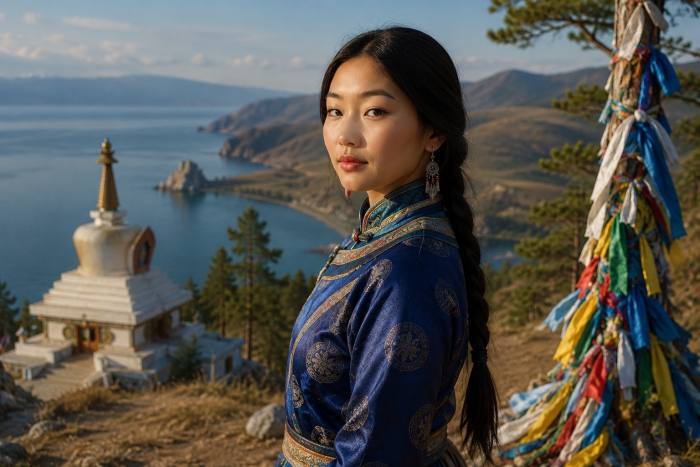 Buryat woman
Agence CQMI
Buryat woman
Agence CQMI
Buryat Women: 9 Myths Debunked — What You Really Need to Know
A Buryat woman is not a Chinese woman living in Siberia, nor a Russian woman with almond eyes — and certainly not the steppe warrior some Western men imagine. She is the heiress of a thousand-year-old shamanic civilization shaped by Tibetan Buddhism, Russian imperial rule, Soviet collectivisation, and a post-1991 cultural renaissance. The result? A woman of absolute loyalty, anchored in some of the strongest family values in the entire Russian Federation, carrying a rare Eurasian beauty that resembles nothing you have encountered before.
Article by Antoine Monnier, founder and director of CQMI International Matchmaking Agency, specialist in serious relationships between Western men and women from Russia and Eastern Europe since 2014.
Let me start with a confession.
When my first clients began asking about Buryat women — after years spent guiding Canadian, British, and Australian men toward serious relationships with Russian women and Ukrainians — I realised I was facing something that even my deep experience of the Slavic world had not fully prepared me for. Buryatia, in the Western imagination, is a vague dot on a Siberian map somewhere between Lake Baikal and Mongolia. Rarely does it conjure a woman.
And yet. The first time I encountered Buryat women during a trip to Ulan-Ude — that remarkable city where Buddhist temples and Soviet-era apartment blocks coexist with disarming tranquillity, and where the world's largest Lenin head stands in the central square with an irony that no one seems to notice — I understood I was dealing with something fundamentally different. Not a Slavic woman in the classical sense. Not Asian in the way the West understands that word. A human synthesis produced by centuries of history in this precise spot where Asia and Europe look at each other in the mirror of Lake Baikal.
James, a Toronto-based client of mine, 49, a civil engineer, had contacted me after meeting a Buryat woman at a scientific conference in Irkutsk. "Antoine," he told me, "I don't know how to describe it. She has almond eyes that smile before her mouth does. She talks about her grandmother who was a shaman with the same seriousness as she discusses her biology PhD. She's somehow entirely in this world and in something else I can't name." James had touched, without realising it, on the very essence of what makes Buryat women unique.
In this article, I will debunk nine persistent myths that my clients — and many men in their situation — carry about Buryat women. With verified data, real field anecdotes, and the direct honesty you have every right to expect from me.
Myth #1 — "A Buryat woman is essentially an Asian woman"
The ethnic reductionism trap
This is the most widespread misconception — and the most limiting. The moment the word "Buryat" comes up, many Western men project a purely Asian image onto the woman. This either shuts them down before the conversation begins, or, worse, launches them into an exoticising fantasy that has nothing to do with who she actually is.
What history and genetics actually reveal
The Buryats are the largest indigenous people of Siberia — approximately 500,000 people according to the 2021 Russian census, with the majority living in the Republic of Buryatia (capital: Ulan-Ude) and the neighbouring Irkutsk and Zabaykalsky regions. Genetically, they belong to the East Mongoloid group, with significant contributions from Turkic and Tungusic peoples, and since the 17th century, from Slavic Russian populations. Centuries of cohabitation, intermarriage, and deep cultural exchange have produced a wide phenotypic spectrum: some Buryat women have features very close to Mongolian women; others have a distinctly Eurasian appearance; others still could pass for mixed Siberian heritage without you being able to place them precisely.
Culturally, they are fully Russian — citizens of the Russian Federation, native Russian speakers, educated in the Russian school system — while simultaneously carrying a distinct Buryat heritage: the Buryat language (a Mongolic language still spoken by roughly 40% of the community), pre-Buddhist shamanic traditions, and the Gelug school of Tibetan Buddhism introduced in the 17th century by Mongolian lamas. They are therefore simultaneously completely Russian and deeply something else. That paradox is not a contradiction — it is their richness.
Myth #2 — "Buryat women are isolated and poorly educated"
The "deep Siberia" prejudice
Siberia evokes images of vast emptiness, rural populations with limited access to modern education, cut off from the world by distances and cold. Applied to Buryat women, this prejudice is particularly unjust.
What the numbers actually show
Buryatia is one of the Russian republics with the highest school enrolment rates — a direct legacy of the Soviet policy of universal literacy and an ancestral Buryat tradition of respect for knowledge. Ulan-Ude is home to the Buryat State University (founded 1932), several specialised institutes in medicine, agriculture, culture and arts, and branches of major Russian universities. According to Rosstat (2020 data), the adult literacy rate in Buryatia is 99.4% — among the highest in the world.
In direct experience at CQMI, the Buryat women's profiles we work with are very frequently those of highly educated women: doctors, teachers, biologists, economists, translators. Buryat-Russian bilingualism is common, and a notable number also speak a third language — English or Mongolian, depending on their academic background. Their supposed geographical isolation is largely offset by fully functional digital connectivity and frequent internal mobility within Russia — Ulan-Ude is 5.5 hours by air from Moscow.
Myth #3 — "A Buryat woman mainly wants to leave Russia"
The Siberian escape theory
Buryatia is one of Russia's poorest regions — its GDP per capita is significantly below the national average. Internal migration toward Moscow, St. Petersburg, or Irkutsk is a documented reality. The supposed conclusion: any Buryat woman interested in a Western man is primarily looking for an exit ticket.
What logic and experience actually disprove
This reasoning contains a fundamental flaw. A Buryat woman who simply wants to leave does not need an international matchmaking agency — she can move to Moscow, Irkutsk, or Krasnoyarsk under her own power, as thousands of Buryats do every year. If she engages in a serious process with a Western man, it is because she is searching for something specific: a mature, stable, respectful partner capable of lasting commitment.
What I observe at CQMI is that the Buryat women who engage in a matrimonial process typically have an established professional life, strong family roots, and a cultural pride that makes them particularly selective. They are not making this choice as a last resort. They make it because they know what they want — and have decided to widen their search beyond local borders. That is an act of courage and clarity, not flight.
If you want to protect yourself from insincere approaches and understand how to detect them before a first contact, our detailed analysis of Pay Per Letter (PPL) dating scams will give you the tools you need.
Myth #4 — "Buryat women's beauty is too different from Western standards"
The Western aesthetic filter
Some men, accustomed to the canonical Slavic beauty — tall, blonde, classically European features — hesitate to consider a relationship with a Buryat woman because they anticipate an aesthetic difference they imagine as insurmountable.
What field experience actually reveals
Buryat beauty is a reality that imposes itself on anyone who takes the time to look. The high cheekbones, almond-shaped eyes often slightly lifted at the corners, luminous matte complexion, remarkably thick black hair — all of this creates a physiognomy that men who have met Buryat women describe invariably as striking and unforgettable. Not because it resembles something familiar, but precisely because it resembles nothing else.
What strikes you at first physical contact with a Buryat woman is a presence that is simultaneously soft and intense. She does not seek to impose herself through ostentation. Her femininity is discreet, natural, without excessive artifice — a quality that men over 40 who have been through exhausting relationships with high-maintenance personalities recognise instantly as precious. Elegant sobriety, carried with quiet confidence, is a Buryat cultural standard that even the youngest women have internalised.
Myth #5 — "Buddhism and shamanism will create religious incompatibilities"
The spiritual apprehension
Buryatia is the heartland of Tibetan Buddhism in Russia — the Ivolginsky Datsan, 35 km from Ulan-Ude, is the most important Buddhist centre in the Russian Federation, and pre-Buddhist shamanic traditions coexist with this religion in a unique syncretism. For a man of Catholic or secular upbringing, this double spiritual heritage can seem exotic to the point of feeling incompatible.
What the reality of practice actually shows
Buddhism as practised by contemporary Buryats is, in the overwhelming majority of cases, an identity and cultural belonging rather than a daily prescriptive practice. Attending ceremonies at the datsan for major celebrations — Sagaalgan (the Lunar New Year Buddhist festival), seasonal rituals — is a gesture of belonging to one's community and ancestors, not a constraint imposed on a partner. No tenet of Buddhist philosophy prohibits a relationship with a non-Buddhist. Buddhism, fundamentally non-proselytising, does not require that a partner share the faith — only that they respect it.
Residual shamanism — consulting a böö (shaman) for major family decisions, offerings to ongons (ancestral spirits) at important moments — is often experienced as a form of connection with nature and ancestors. For a Western man open to spiritual diversity, it is a fascinating window into a radically different worldview. Not an obstacle.
Myth #6 — "Buryat women's family values are weaker than those of Russian or Ukrainian women"
The supposed hierarchy of Eastern women
Among men who already have experience with Eastern European women, some implicitly rank nationalities by family values. Ukrainian and Russian women are often cited as the benchmark. Women from non-Slavic peoples of Russia — Tatars, Bashkirs, Buryats — are perceived as less certain on that front.
What Buryat family life actually demonstrates
This is a profound error of categorisation. In Buryat culture, the family is the absolute foundation of social organisation — and in a far more structured way than in most Slavic cultures. The clan (urug) is the basic unit of traditional Buryat society. You do not introduce yourself simply as an individual — you present yourself as a member of a clan, a lineage. This belonging structures mutual obligations, support networks, marriages, and inheritance patterns across generations.
In contemporary practice, this means a Buryat woman considers her extended family a natural part of her life — not a burden. Sagaalgan celebrations bring three or four generations together around tables that last for hours. Buryat cuisine is itself a marker of this attachment: buuza (steamed Buryat dumplings, close cousins of Tibetan momos), prepared as a family before major celebrations, are a collective ritual that can mobilise an entire household for a full day. A Buryat woman who makes buuza for you is saying something about the importance she places on you.
In the experience at CQMI, men who have built lasting relationships with Buryat women invariably describe the warmth and solidity of the family bond as a revelation — often in sharp contrast to the emotional isolation that characterised their lives before.
Myth #7 — "Communication with a Buryat woman will be very difficult"
The assumed language barrier
Some men imagine months of communication through translators, or laborious exchanges in halting English with a woman who is only partially comfortable in international languages.
What reality actually shows
Buryat women are native Russian speakers — Russian is their language of education, work, and social life from childhood. With them, the language barrier is identical to the one encountered with any Russian woman from a regional city: it either calls for a linguistic effort on your part (a few months of basic Russian transforms your exchanges dramatically) or the assistance of a translator for early meetings.
In terms of communication style, Buryat women are direct, warm, and free of social pretence. The Buryat cultural tradition does not carry the Western-style politeness facade — when she talks to you, she is genuinely talking to you. This directness — which men often discover with relief after years of coded communication and unspoken tensions — is a considerable relational asset. In our experience, the couples where communication works best are those where the man learned to appreciate this clarity rather than interpreting it as bluntness.
And if you want to make a gesture that will genuinely count: learn a few words of Buryat. Bayrla (thank you), Sain baina uu (hello, of Mongolian influence). It is not a requirement — it is a signal of respect that makes all the difference.
Myth #8 — "A Buryat woman will struggle to adapt to life in Canada, the UK, or Australia"
The Siberian roots prejudice
The image of Siberia as a territory on the margins of the modern world feeds the idea that a Buryat woman would struggle to integrate into Western society — too attached to her roots, too far removed from the European world, too anchored in a culturally alien universe.
What real life stories actually demonstrate
This projection does not survive contact with the facts. The Buryats have a long tradition of mobility — across Mongolia, China, Central Asia, and throughout Russia since the Soviet era. The Buryat diaspora is present in Moscow, St. Petersburg, Mongolia, and several Asian countries. This historical cultural mobility produces an adaptability that you will find in the relationship.
Furthermore, a Buryat woman arriving in Canada, the UK, or Australia does not arrive in a completely unknown world: she is a native Russian speaker and therefore has access to an entire cultural ecosystem already well-established in major English-speaking cities. She finds reference points, communities, footholds. She learns the local language with the same discipline she has applied to everything else in her life. And Buryat hospitality — respect for the host, generosity toward strangers, core values of the nomadic culture she inherits — translates naturally into Western societies. She does not adapt to you through pain — she enters your world with the quiet curiosity of someone whose history has always known that borders are just lines on a map.
Myth #9 — "Meeting a Buryat woman seriously is only possible through exotic tourism"
The supposed inaccessibility
Some men believe that meeting a Buryat woman is an anthropological expedition — requiring you to cross Siberia, speak Buryat and attend shamanic ceremonies. The imagined barrier is as much psychological as geographical.
What serious matchmaking actually demonstrates
Buryat women live in a connected, mobile and fully accessible country. Ulan-Ude has direct flights to Moscow, Irkutsk, Novosibirsk and several Asian cities. A 30-year-old Buryat woman in 2026 is on Instagram, streams series online, travels for work or study, and communicates digitally with the same fluency as a woman from Toronto or Edinburgh. Distance is no longer what it was — and when motivation is genuine, it transcends geography.
At CQMI, we have been accompanying this type of meeting since 2014. Our selection process — over 40% of female applications are rejected — ensures that the profiles you meet are those of women genuinely motivated to build a serious relationship. Geography is not an obstacle: it is a parameter we manage together, with personalised support at every stage.
To understand how our process works and what our subscription concretely offers, visit our procedure and pricing page.
Buryat woman vs. Russian woman vs. Ukrainian woman: the real differences
Ten years of direct observation at CQMI allow for this comparison:
| Criterion | Buryat | Russian | Ukrainian |
|---|---|---|---|
| Cultural family | Mongolo-Siberian, Buddhist-shamanic, Russian citizen | East Slavic, Orthodox, Eurasian culture | East Slavic, Orthodox, European-leaning culture |
| Communication | Direct, warm, no social pretence — rare words, well chosen | Warm once trust is built, sometimes guarded initially | Expressive, direct, sometimes reserved on first contact |
| Language bridge | Native Russian speaker, Buryat, variable English | Russian, variable English | Ukrainian/Russian, variable English |
| Femininity | Eurasian — discreet, natural, intense presence | Polished, deep, reserved on the surface | Confident, elegant, sometimes more formal |
| Family values | Foundational and structural — the clan as architecture of life | Strong, varies by individual | Central, clearly expressed |
| Religion | Tibetan Buddhism + shamanism — primarily identity-based practice | Orthodox — strong cultural foundation | Orthodox — identity strongly asserted since 2014 |
| Relationship to nature | Deep and living — nomadic and shamanic heritage very present | Present but culturally secondary | Present, rooted in rural culture |
| Visa for Canada/UK/AU | Visa required (Russian passport) | Visa required (2022 restrictions) | Visa-free Schengen since 2017 |
To go deeper into the differences between Russian and Ukrainian women — the core of our expertise — I refer you to our reference article on the subtle difference between a Russian woman and a Ukrainian woman.
The 5 mistakes men make with Buryat women
- Treating ethnic difference as an exotic fantasy. A Buryat woman is not an anthropological curiosity. She is a person looking for a partner — not an amateur ethnographer. Opening with "I'm fascinated by your culture" as a relational gambit is clumsy. Start by seeing her as a woman, not as the representative of a people.
- Underestimating the importance of the clan family. In Buryatia, your relationship with a woman involves a relationship with her family — extended, present, loving and attentive. A man who sees this as an intrusion is not ready for this type of relationship. A man who sees it as a richness will be welcomed accordingly.
- Knowing nothing about Buddhist and shamanic culture. You do not need to share these beliefs. But showing that you know and respect them — even briefly, even imperfectly — is a signal of respect that opens doors that ignorance keeps firmly shut.
- Being vague about your intentions. A Buryat woman engaged in a serious process does not waste her time with ambivalent men. Say what you are looking for. She will answer with the same clarity — and that is infinitely more comfortable for everyone.
- Using unverified platforms. The scam risk is real on uncontrolled sites. Always verify the agency, its selection processes, its references. And if you want to assess your own profile seriously before committing, our dating process page explains exactly what we do and how we protect you.
Two field anecdotes
Lake Baikal in her eyes
Robert, a client from Edinburgh, 55, a retired university professor, had contacted me after three weeks of correspondence with a Buryat member of ours — a biologist specialising in lake ecology at Ulan-Ude. During their first video call, she had spent twenty minutes talking about Lake Baikal — not as a tourist site, but as a living being, a presence. "She said the Baikal breathes, Antoine. I almost laughed. And then I saw her eyes. She genuinely believed it, with a quiet conviction that stopped me cold." Robert took time to understand that this connection to nature was not naivety — it was a way of being in the world that his academic life in Edinburgh had never offered him. He flew to Ulan-Ude six months later. He sent me a photo from the eastern shore of the lake. He was smiling in a way I had never seen in his profile pictures.
The question that had to be earned
James, my Toronto client, was on a second video call with a 34-year-old Buryat member — an English teacher — after forty minutes of fluid conversation in which her vocabulary and precision had clearly impressed him. Without preamble, she asked: "Have you ever done something difficult just because it was the right thing to do?" James told me he needed fifteen seconds before answering. "I wasn't used to being evaluated like that. Not my bank account, not my travel history, not my status. My moral backbone." He answered honestly. She smiled. And James understood he was facing someone genuinely looking for a partner — not a postcard.
Frequently asked questions about Buryat women
Can a Buryat woman marry a non-Buddhist man?
Yes, without formal religious restriction. Tibetan Buddhism does not prohibit marriage with non-Buddhists. What is expected is respect for the woman's cultural and spiritual heritage — not conversion. Mixed marriages between Western men and Buryat women exist and thrive when mutual respect is at the centre of the relationship.
Are visa procedures complicated for a Buryat woman (Russian passport) entering Canada or the UK?
A Buryat woman travels on a Russian passport. Since 2022, visa procedures have been tightened significantly for Russian nationals in Canada, the UK, and the Schengen area. Processing times are longer and documentation requirements more extensive — but it is not insurmountable with proper guidance. CQMI walks clients through the administrative steps at each stage of the process.
What age difference is reasonable with a Buryat woman?
The same guidelines apply as with any woman from the former Soviet space: an optimal success zone sits between 2 and 12 years of difference. Beyond 15 years, the gap becomes an active management parameter requiring specific preparation. Antoine Monnier addresses this topic in detail in his article on the age difference and what it actually implies.
Do I need to travel to Buryatia to meet a Buryat woman?
Not necessarily for the early stages. Initial exchanges happen online, with translator assistance where needed. A first trip to Russia — to an accessible city such as Moscow, Irkutsk, or Ulan-Ude — is recommended for in-person meetings. Inviting her to your country is also possible at a later stage. CQMI structures this process step by step.
How do I tell genuine interest from opportunistic behaviour in a Buryat woman?
Sincerity signals are universal: she asks about your values, your life, your plans — not primarily about your financial situation. Her answers are consistent over time. She does not push quickly toward money requests or gifts. She is willing to show you her real life — family, work, environment. And she passes the civil status checks that CQMI conducts on all its members.
What you really need to understand about Buryat women
A Buryat woman is not a category. She is the daughter of a people who survived five centuries of Russian imperial rule, forty years of Soviet collectivisation, a post-1991 identity renaissance and an accelerated modernisation — without ever losing the thread of what has defined them for millennia: the clan, nature, the honest word, and the bond with ancestors.
What the experience of CQMI International Matchmaking Agency — over 350 successful marriages since 2014 — confirms about Buryat women:
- Her double belonging — Russian and Buryat — is not an administrative complication; it is a rare cultural depth that few women anywhere in the world can offer.
- Her Buddhist-shamanic heritage is not a spiritual obstacle — it is a worldview that will enrich your daily life if you give it the space it deserves.
- Her natural discretion is not coldness — it is a reserve that, once trust is established, gives way to an absolute warmth and loyalty.
- Her family attachment is not a burden — it is a promise of permanence in a world that is painfully short of it.
- Her connection to Siberian nature is not irrationalism — it is a relationship with the living world that will remind you the world is larger than your dashboards.
If you are a serious man, genuinely seeking a shared life project with an extraordinary woman, a Buryat woman deserves your full attention. Discover the profiles of our Russian women available for serious meetings, which include Buryat members.
Ready to meet a serious Buryat woman?
CQMI has been operating since 2014. Our subscription — $350 CAD/month — gives you access to 10 verified contacts with women motivated to build a lasting relationship.
Over 40% of female applications are rejected during our selection process.
This is not a dating site. It is a matchmaking agency with a strict ethical charter.
350+ successful marriages Divorce rate under 7% No chatbots, no ghost translators
Discover our process →Questions? Write directly to Antoine: This email address is being protected from spambots. You need JavaScript enabled to view it.
Related articles on the CQMI blog
- The Subtle Difference Between a Russian Woman and a Ukrainian Woman
- Pay Per Letter (PPL) Dating Scams — How to Recognise Them
- The Age Difference Comes With a Price Tag: A Truth Nobody Wants to Hear
Latest from Antoine Monnier
- How to Verify a Russian or Ukrainian Woman's Photo Online
- Why There Is a Real Shortage of Men in Ukraine and Russia Since the War
- Orthodox Ukrainian Woman or Muslim Kazakh/Uzbek Woman: What's the Real Difference for Marriage?
- Dating a Russian or Ukrainian Woman: Why Your Playbook Won't Work
- Why a Russian or Ukrainian Woman Sees You as Just Another Man

 +1 514 794-5053