


Ukrainian and Russian Bride dating advices - CQMI blog

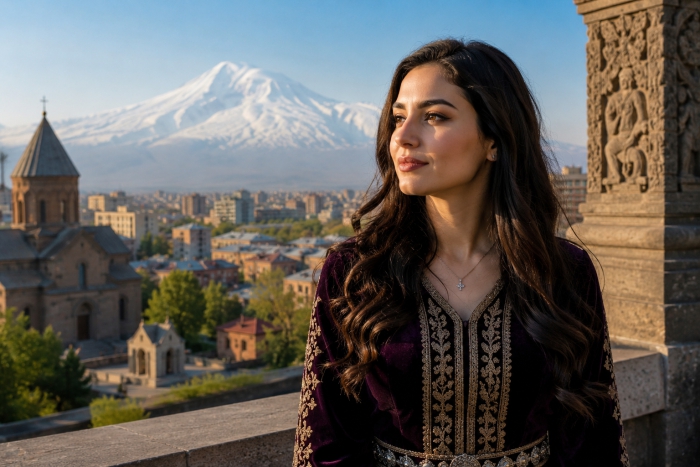 Armenian woman
Agence CQMI
Armenian woman
Agence CQMI
Armenian Women From the South Caucasus: 9 Myths Debunked
By Antoine Monnier — Director and co-founder, CQMI Agency
Two years ago, one of our clients, Robert, 57, from Edinburgh, asked me a question that made me smile: "Antoine, an Armenian woman is basically a Russian woman with a different accent, right?" I took the time to explain that no — and this confusion is something I hear almost every week since we opened our doors to members from the South Caucasus. By our experience, most Western men instinctively lump every woman from the former USSR into the same "Slavic" box. That's a mistake — one that, whether you're looking for an authentic Russian woman or an authentic Armenian woman, can make you miss essential cultural nuances needed to build a serious relationship.
An Armenian woman is neither Slavic, nor Muslim, nor "just another" face in the Caucasian mosaic. She is the heir of an isolated Indo-European people — her language resembles no other living language — and of a nation that made a unique historical choice: in the year 301, it became the very first state in the world to adopt Christianity as its official religion, decades before the Roman Empire itself. Here are the 9 myths you need to unlearn before writing to an Armenian member of CQMI Agency.
1. "Armenian women are Slavic women like any other"
This is the most widespread — and most incorrect — assumption. Armenians form their own separate branch of the Indo-European language family: Armenian belongs to neither the Slavic, Romance, nor Germanic groups. It is a language isolate, with its own 39-letter alphabet, invented around 405 AD by the monk Mesrop Mashtots to allow the Bible to be translated. No other nation on Earth shares this alphabet. An Armenian woman is therefore not "just another Russian": she carries a completely distinct linguistic and cultural identity, forged long before Russia itself was formed.
Verdict: false. Armenia is a South Caucasus country, culturally and linguistically independent from the Slavic world.
2. "Like the rest of the Caucasus, Armenia is Muslim"
This is where the most interesting misunderstanding lies. Unlike its immediate neighbors — Azerbaijan, majority Shia Muslim, and Turkey, majority Sunni Muslim — Armenia is the birthplace of Christianity as a state religion. In the year 301 (the traditional date, though some historians place it closer to 314), King Tiridates III was converted by Gregory the Illuminator and made Christianity the kingdom's official religion — a full decade before the Roman Emperor Constantine himself tolerated Christians in his empire. Over 92% of the Armenian population today belongs to the Armenian Apostolic Church, an Oriental Orthodox church distinct from Russian or Greek Orthodoxy, with its own spiritual leader, the Catholicos, based in Etchmiadzin.
Verdict: false. Armenia is officially the oldest Christian nation in the world, and faith remains a major identity pillar, including for the diaspora.
3. "An Armenian woman necessarily carries the weight of historical trauma"
Armenian history is marked by deep tragedies, notably the events of 1915, still very present in the collective memory and systematically taught and commemorated every April 24. But reducing an Armenian woman to this trauma would be a mistake — and worse, a form of disrespect. By our experience at the agency, this historical memory mostly fuels remarkable resilience and cultural pride — not a victim posture. Armenians have a saying: "surviving is already a victory" — but they apply it to building, not to dwelling on the past.
Verdict: nuanced. Historical memory shapes a strong identity and resilience, but does not define an Armenian woman's daily life or personality.
4. "She's a submissive, quiet housewife"
Armenian society, especially outside of Yerevan, remains shaped by patriarchal structures: the husband is traditionally seen as head of the household, and the wife as the guardian of the home. But this image doesn't do justice to 2026 reality. Armenian women today are massively present in higher education, medicine, law, the military, and civil society. Yerevan, the capital, has a fast-growing female student population, and Armenia's law against domestic violence, adopted in recent years, reflects a society in motion. A modern Armenian woman often combines deep respect for family tradition with genuine professional independence.
Verdict: outdated. The traditional model still exists, especially in rural areas, but it coexists with real professional emancipation, particularly in major cities.
5. "She'll only want to marry a man from the Armenian diaspora"
With close to 8 to 10 million people of Armenian descent worldwide — compared to roughly 3 million in Armenia itself — the diaspora is enormous (France, the United States, Russia, Lebanon, Argentina). Some Western men wrongly conclude that an Armenian woman is exclusively looking for a diaspora compatriot. In reality, what matters most to a serious Armenian member is stability, respect, and a genuine shared life project — far more than her future husband's passport or origins. Seriousness and sincerity matter infinitely more than belonging to any particular community.
Verdict: false. A suitor's origin matters far less than his ability to commit to a lasting, respectful relationship.
6. "The extended family will take over your marriage"
It's true that family occupies a central place: it's not unusual for several generations to live under the same roof, and major decisions are often made in consultation with parents. But "central place" doesn't mean "constant interference." By our experience, an Armenian woman who moves abroad with a serious Western husband knows very well how to strike a balance between family attachment and an independent couple's life — provided the man shows respect toward her parents, without being dispossessed of his own household.
Verdict: needs nuance. The family bond is strong, but manageable with dialogue and mutual respect — as in any serious cross-cultural relationship.
7. "Armenian women are famous only for their beauty"
The South Caucasus is indeed renowned for the beauty of its women — fine features, dark hair, striking eyes — and Yerevan has produced several internationally known figures, including celebrities of Armenian descent based in the United States. But reducing an Armenian woman to her looks misses the essential point: a culture of hospitality (the famous "khorovats," a shared family barbecue, or a table always generously set for guests), a strong sense of the arts — music, literature, chess, with Armenia having produced several world chess champions — and a cultural pride instilled from childhood.
Verdict: reductive. Beauty exists, but it's only one facet of a much richer cultural identity.
8. "We'll never be able to communicate, her language is incomprehensible"
The unique Armenian alphabet can indeed be intimidating at first glance. But in practice, the vast majority of Armenian women of marrying age speak fluent Russian, a second language inherited from the Soviet period, and a growing number also master English or French, notably through Yerevan's many French-speaking schools (Armenia is a member of the International Organization of La Francophonie). Our translation assistants also support every exchange during the early stages of correspondence.
Verdict: false. The language barrier exists, but is far from insurmountable, especially through a serious agency offering language support.
9. "She's mainly looking for a passport or financial security"
This is the myth that comes up systematically, for every nationality across Eastern Europe and the Caucasus. In reality, the overwhelming majority of our Armenian members already hold a job or are in education in Armenia, and many could very well stay in their country. What they're looking for is not a residency card, but a stable, respectful life partner capable of long-term commitment — exactly what a serious Western woman would look for too, but with a more traditional and solemn conception of marital commitment.
Verdict: false. Financial and professional independence is valued; a serious marriage takes priority over any material consideration.
Psychological analysis: what Armenian culture really reveals
By our experience at CQMI Agency, what we observe among our Armenian members is a rare combination: a very strong sense of identity pride (the country's turbulent history has forged a powerful national feeling) paired with a deep sense of hospitality and self-sacrifice toward those they consider "their own." We often observe that this combination confuses some Western men, more used to a more individualistic relational coolness: an Armenian woman who commits rarely does so halfway. The main difference from a typical Slavic candidate is that the religious dimension — even when lived discreetly and without strict observance — shapes a conception of marriage as a sacred, definitive commitment, not a simple, revisable social contract.
Practical method: how to seriously approach an Armenian member
- Do at least basic research on Armenia's history and geography — Yerevan, Mount Ararat (visible from the capital though located today in Turkey), the Nagorno-Karabakh question. An awkward remark about "neighboring Azerbaijan" can sour a conversation from the very first message.
- Never confuse Armenia with the Slavic world in your first message — this very common mistake causes instant irritation.
- Show genuine interest in her family, without overwhelming her with intrusive questions in the early exchanges.
- Value her independence if she works or studies — never assume she's waiting to be "rescued."
- Move step by step, with patience: as with any serious member of the agency, trust is built over several weeks, not three messages.
The most common mistakes Western men make
The first mistake, already mentioned: confusing Armenian culture with Slavic culture or with neighboring Muslim countries. The second: underestimating the importance of religion, even when lived discreetly — a careless remark about Christianity can be seen as disrespectful. The third: ignoring the Nagorno-Karabakh question and regional tensions, a sensitive topic best left for the woman herself to raise if she wishes. The fourth, more general but recurring across every nationality we work with: wanting to move too fast, when a serious Armenian member expects a respectful pace, worthy of a genuine marriage project.
Two stories from the field
The duduk story: One of our clients sent, as a "digital gift," a link to an electronic music track he found festive. His member replied, a bit amused, by sending back a recording of the duduk — that apricot-wood flute with a melancholic sound, a musical symbol of Armenia inscribed on the UNESCO Intangible Cultural Heritage list. Lesson learned: sometimes it's better to listen before imposing your own tastes.
The apricot story: Another client, an etymology enthusiast, thought he'd impress his correspondent by telling her that the Latin word for "apricot" — armeniaca — comes from her country's name. She replied, smiling: "I know, it's been my national fruit since antiquity — but tell me instead what YOU like, not what you know about me." A seduction lesson worth remembering for all our clients.
Comparison table: women of the Caucasus and Eastern Europe
| Criteria | Armenian woman | Georgian woman | Russian woman | Ukrainian woman |
|---|---|---|---|---|
| Language family | Isolate (Indo-European) | Kartvelian (isolate) | East Slavic | East Slavic |
| Main religion | Armenian Apostolic Church (301 AD) | Georgian Orthodoxy | Russian Orthodoxy | Orthodox / Greek Catholic |
| Diaspora | Very large (8-10 M) | Moderate | Large | Very large |
| Weight of extended family | Strong | Very strong | Moderate | Moderate to strong |
| Attitude toward female independence | Growing, especially in Yerevan | Growing, especially in Tbilisi | High | High |
An Armenian woman is not looking for a rescuer, a passport, or a man who confuses her country with its neighbors. She is looking for a serious man, respectful of her history and ready to commit for life — exactly the kind of match that CQMI Agency has been organizing since 2014.
FAQ
Is an Armenian woman Muslim?
No. Armenia was the first state in the world to adopt Christianity as its official religion, in 301 AD. Over 92% of the population belongs to the Armenian Apostolic Church.
Do I need to speak Russian to correspond with an Armenian woman?
It's not essential. Many members speak Russian, English, or French, and CQMI Agency has translation assistants to support the early exchanges.
What's the difference between an Armenian woman and a Georgian woman?
Both come from the South Caucasus, but speak completely different, unrelated languages, belong to distinct Orthodox churches, and have separate national histories, despite being geographic neighbors.
Is age difference an obstacle with an Armenian woman?
No. As with most Eastern European and Caucasus women we work with, a gap of 5 to 15 years is generally well accepted if paired with sincerity and a genuine shared project. We cover this topic in detail in our dedicated article on age difference.
How can I be sure to avoid scams?
By going through a serious matchmaking agency that verifies the identity and motivations of every member. We cover the most common scam mechanisms in our guide to PPL scams.
Conclusion: what if your next match came from the Caucasus?
If you're not a serious man, ready to invest in a lasting relationship, please refrain: an Armenian woman, like any member of CQMI Agency, is not looking for a one-night stand, but for marriage and a lifelong union. For serious single or separated men from Canada, the UK, Australia, or the US who are ready for a genuine relationship project, CQMI Agency offers a $350 CAD/month subscription, giving access to 10 verified contacts of serious women, Armenian or otherwise, looking to build a lasting relationship. Questions? Write to us at This email address is being protected from spambots. You need JavaScript enabled to view it..
Latest from Antoine Monnier
- Albanian Women: 9 Myths Debunked About the Balkans' Only Non-Slavic People
- Macedonian Women: The Overlooked Balkan Charm Between Slavic and Mediterranean
- Azerbaijani Women from the South Caucasus: 9 Myths Debunked
- Chuvash Women of Chuvashia: 9 Myths Debunked
- Circassian Women (Adyghea): 9 Myths About Their Legendary Beauty

 +1 514 794-5053