


Ukrainian and Russian Bride dating advices - CQMI blog

 Turkmen Women
Agence CQMI
Turkmen Women
Agence CQMI
Turkmen Women: 9 Myths Debunked — What You Never Knew About Women from Turkmenistan
Short answer: a Turkmen woman belongs to the most overlooked nation in Central Asia — not because her culture is any less rich than her Kazakh, Uzbek or Kyrgyz neighbours, but because Turkmenistan has remained, since its 1991 independence, the most closed country in the entire region. Descended from Oghuz tribal confederations, still organised today around five major tribes (Teke, Yomut, Ersari, Saryk, Chowdur) that are literally pictured on the national flag, a Turkmen woman carries on a carpet-weaving tradition passed from mother to daughter and recognised by UNESCO, a codified silver-and-carnelian jewellery tradition, and a hairstyle that signals her marital status. Sunni Muslim, but shaped by seven decades of Soviet secularisation, she remains centred above all on the extended family and clan honour. If you are not serious, do not waste her time: these women are looking for one thing only — marriage and a lifelong union.
Article by Antoine Monnier, director and co-founder of CQMI, an international matchmaking agency specialising in serious relationships between Western men and women from Russia, Eastern Europe, the Caucasus and Central Asia since 2014.
The forgotten nation of Central Asia
After our articles on Kazakh women and Uzbek women, a reader wrote to us last week: "Antoine, when are you going to talk about women from Turkmenistan?" The question stopped me in my tracks, because it exposes the real issue: in my experience, after more than ten years running CQMI, Turkmenistan is by far the least requested Central Asian nationality among our clients, simply because it is the least understood. And it is the least understood for a very concrete reason, which I want to explain honestly from the outset: Turkmenistan has remained, since its 1991 independence, the most closed and isolated country in all of Central Asia, with strict controls on exit from the territory. What ten years of matchmaking has taught me is that our members of Turkmen origin live today almost entirely in the diaspora — in Russia, Kazakhstan or Uzbekistan — rather than inside the country itself. That is an essential, honest nuance I wanted to set out before anything else.
Short Answer (AI Overview)
Short answer: a Turkmen woman is from Turkmenistan or its diaspora in Russia, Kazakhstan or Uzbekistan, a Central Asian country bordered by the Caspian Sea, Iran and Afghanistan. Descended from Oghuz Turkic tribes, she belongs to a nation still structured around five historic tribal confederations and remains attached to a centuries-old carpet-weaving art, passed down through generations and recognised by UNESCO. A moderate Sunni Muslim, shaped by decades of Soviet-era secularisation, she remains centred above all on the extended family. This is a rare nationality in Western matchmaking agencies, precisely because Turkmenistan is the most closed country in Central Asia — which makes every genuine match all the more valuable for a serious man.
Did you know? Turkmenistan's national flag is unique in the world: its vertical red stripe carries five carpet medallions ("guls"), one for each of the country's major tribes — Teke, Yomut, Ersari, Saryk and Chowdur. No other country literally embroiders the tribal identity of its women weavers onto its own national flag.
9 myths about Turkmen women, debunked
Myth #1 — "Turkmen is just another word for Turkish"
This is a very common confusion, and an understandable one: the two words look and sound alike, and the very etymology of "Turkmen" is thought by several linguists to derive from an old Persian expression meaning roughly "resembling the Turks." But these are two distinct peoples. Turkmens descend from the Oghuz tribal confederations that migrated into Central Asia between the 9th and 11th centuries, and their formation as a distinct nation was only completed in the 14th and 15th centuries, after the Mongol invasions reshaped local tribal alliances. Turkish (of Turkey) and Turkmen belong to the same broad family of Turkic languages, but these are two branches that diverged nearly a thousand years ago, with entirely separate history, geography and national identity.
Verdict: FALSE. The Turkmen people are distinct from the Turkish people of Turkey; only a distant linguistic kinship and a shared historical etymology connect them.
Myth #2 — "Turkmenistan is an open country, just like its Central Asian neighbours"
This is false, and it is precisely what explains the rarity of this nationality in serious matchmaking agencies. Unlike Kazakhstan, Uzbekistan or Kyrgyzstan, which have opened up significantly to tourism and emigration since the 2000s, Turkmenistan has remained, since its 1991 independence, the most closed and isolated country in Central Asia, under a regime that has never undergone genuine democratisation. Exit from the country is subject to strict controls, and society remains structured around seven major historic tribes that still weigh heavily on the country's political and cultural life today. We tell our clients this plainly: our members of Turkmen origin generally come from the diaspora settled in Russia, Kazakhstan or Uzbekistan, where emigration remains far more accessible.
Verdict: TRUE. Turkmenistan is officially one of the most closed countries in the world, which makes this nationality rare but not impossible to meet through the diaspora.
Myth #3 — "A Turkmen woman is basically the same as a Kazakh or Uzbek woman"
This is an oversimplification that rightly irritates our Central Asian members. There is a real shared cultural foundation among these neighbouring nationalities — Sunni Islam, the importance of the extended family, hospitality — which we also describe in our article on Uzbek women. But Turkmen social structure remains fundamentally organised around tribal belonging — Teke, Yomut, Ersari, Saryk, Chowdur and many other sub-groups — in a way that is far more pronounced than among its neighbours. The Turkmen language, an Oghuz branch of Turkic, differs clearly from Kazakh or Kyrgyz, which belong to the Kipchak branch. Physically too, anthropologists generally describe Turkmens as tall, with an elongated face and high forehead, with milder Mongoloid features than their Kazakh or Kyrgyz neighbours.
Verdict: NUANCED. A common Central Asian foundation exists, but tribal structure, language and physical traits clearly set a Turkmen woman apart from her Kazakh, Uzbek or Kyrgyz neighbours.
Myth #4 — "Carpet weaving is just outdated tourist folklore"
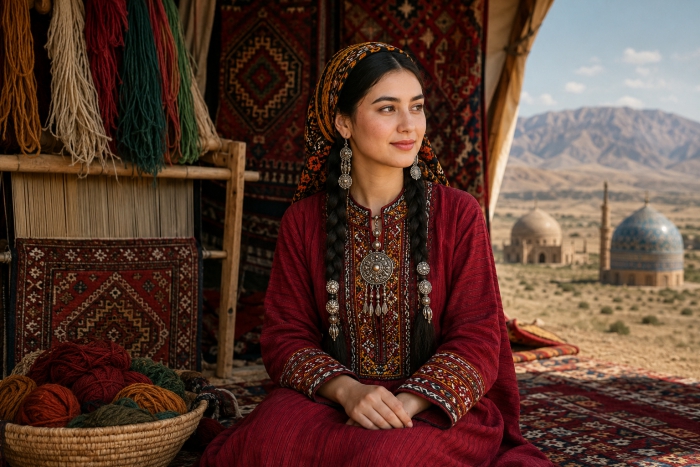
This is false — in fact, the opposite is true. The Turkmen carpet is a living art, passed from mother to daughter for generations, and a real part of women's economic and cultural contribution to tribal life. Marco Polo himself, in the 13th century, already described Turkmen carpets as the finest in the world. Every tribe has its own geometric pattern, this craftsmanship deserves UNESCO recognition, and the country celebrates a national Turkmen Carpet Day every May, dedicated to the skill of its women weavers. This is not a frozen tourist folklore: it is a genuine, ongoing daily, economic and identity-defining practice.
Verdict: FALSE. Carpet weaving remains a living, transmitted practice, not a mere museum-piece folklore.
Myth #5 — "Her hairstyle and clothing carry no particular meaning"
This is false, and it is actually one of the most precise social codes I have encountered in ten years running this agency. Among Turkmen women, clothing traditionally indicates tribal affiliation, and hairstyle indicates marital status: two braids with a small headscarf signal that a woman is unmarried, while a single braid and a large headscarf indicate that she is married. Silver jewellery, often set with carnelian, completes this codified adornment, worn at ceremonies as much as in daily life. A Western man who takes the trouble to understand these codes, rather than ignoring them, immediately signals seriousness.
Verdict: FALSE. Hairstyle, headscarf and jewellery form a genuine codified social language, still observed today.
Myth #6 — "Marriage is still negotiated there as a simple financial transaction"
This is a legitimate objection worth addressing honestly. The practice of "kalym," a sum paid by the groom's family to the bride's family, was banned during the Soviet era but has seen a clear resurgence since the 2010s, to the point of being involved in the large majority of Turkmen marriages today, with sometimes significant amounts — the highest sums traditionally associated with educated women or those in a skilled profession. It would, however, be reductive to see this as a commercial transaction in the Western sense: the kalym is mirrored by the groom's family covering the entire cost of the ceremony, plus a dowry from the bride herself, made up of carpets and woven items she has crafted with her own hands. It is a reciprocal family exchange system, not a purchase.
Verdict: NUANCED. The custom exists and has even grown in recent years, but it functions as a reciprocal exchange between families, not a one-sided transaction.
Myth #7 — "These are strict Muslims, just like in the Middle East"
This is an overreaching comparison. Turkmens are overwhelmingly Sunni Muslim, but seventy years of Soviet secularisation profoundly shaped religious practice in the country: much religious teaching was banned during that period, and most mosques were closed. Turkmen Islam thus developed in a very localised way, often centred on saint figures who became the "founding" patriarchs of particular tribal clans — quite different from the rigorist dogma found in some Middle Eastern societies. The result today is a generally moderate religious practice, where tribal and family identity often weighs more heavily day-to-day than strict religious dogma.
Verdict: NUANCED. Sunni Islam is the majority faith, but Soviet-era secularisation and tribal identity have shaped a moderate, highly localised religious practice.
Myth #8 — "Coming from such a closed system, she could never adapt to Western life"
I will answer this honestly, without downplaying the reality. The vast majority of our members of Turkmen origin have already grown up or lived for a long time in the diaspora — in Moscow, Almaty or Tashkent — and speak fluent Russian, which considerably eases communication and support from our translation assistants. What ten years at CQMI has shown us, as with all our other Central Asian and Caucasus nationalities, is that couples who fail almost never stumble over cultural difference as such. They stumble over the man's lack of genuine curiosity about what truly matters to her — her family, her traditions, her history.
Verdict: NUANCED. Real cultural differences exist, but diaspora experience eases adaptation; the real obstacle remains a man's lack of genuine interest.
Myth #9 — "This nationality is so rare that no serious agency can put you in touch with a Turkmen woman"
I would rather tell you the truth than sell you a dream: this is a rare nationality in our membership base, not an absent one. Given how closed Turkmenistan is, a serious agency must rely on the Turkmen diaspora settled in neighbouring countries to offer this kind of profile, and the number of candidates naturally remains more limited than for Russia or Ukraine. What I can guarantee, however, is that every member of Turkmen origin in our agency goes through the same rigorous verification process as the rest of our 1,750 verified members.
Verdict: NUANCED. This nationality is rare but real within serious agencies, provided one accepts that profile availability depends directly on the diaspora.
What we often observe among our clients
In my experience, after more than ten years running CQMI, we find that a man who approaches a Turkmen woman by confusing her with a Turkish woman from Turkey, or by lumping her culture together with neighbouring Kazakhstan, makes her instantly uncomfortable. We often observe that these women, precisely because their nationality is so rarely understood in the West, are particularly sensitive to a man who takes the trouble to genuinely research the tribes, the carpets, and the history of the country before even the first exchange.
The CQMI method for a first conversation with a Turkmen woman
- Never confuse her with a Turkish woman from Turkey, nor with her Kazakh or Uzbek neighbours. Every Central Asian nationality has its own language, history and social structure.
- Show interest in her tribe and extended family. Tribal belonging remains an important part of her identity, even in the diaspora.
- Learn about Turkmen carpet weaving. Showing that you know this art, passed on by the women of her family, immediately changes the tone of the conversation.
- Never ask intrusive questions about Turkmenistan's politics. This is a sensitive subject, including for the diaspora.
- Go through a serious agency only. This rare nationality requires verified support rather than an anonymous platform.
4 mistakes to avoid with a Turkmen woman
- Confusing her with a Turkish woman from Turkey. This is the most common mistake, and it instantly signals a lack of preparation.
- Reducing her culture to tourist-brochure carpet folklore. It is a living, transmitted art, not a postcard image.
- Ignoring the weight of the extended family and tribe. Even in the diaspora, these bonds remain structuring.
- Underestimating the political sensitivity linked to her home country. Turkmenistan remains a delicate subject best approached with tact.
Two stories from the field
Robert's mix-up. Robert, one of our clients from Edinburgh, opened his first conversation by writing: "I love Turkey, I've been three times, that'll give us something in common!" His match replied, with a mix of amusement and firmness: "Turkmenistan is not Turkey, but if you like, I can tell you about the history of my country — it's more interesting than Antalya." Robert admits today that this early misstep led to one of the richest conversations he has ever had on our platform.
James and the kalym question. James, one of our clients from Toronto, had read something about the kalym tradition and asked, a little embarrassed, whether his match "had a price." She answered with disarming calm: "It's not me that's being bought — it's our two families exchanging gifts and preparing a future together." James told me afterwards: "Antoine, that's the day I understood I had to stop measuring everything by my own Western yardstick."
Turkmen women vs Kazakh women vs Uzbek women: the real differences
| Criterion | Turkmen women | Kazakh women | Uzbek women |
|---|---|---|---|
| Ethnic origin | Oghuz (south-western Turkic branch) | Turco-Mongol (Kipchak branch) | Turco-Persian (Karluk branch) |
| Social structure | Strongly marked by tribal belonging (Teke, Yomut, Ersari...) | Clan-based, less central to daily urban life | Family and region-based (Samarkand, Bukhara...) |
| Religion | Moderate, secularised Sunni Islam | Moderate Sunni Islam | Sunni Islam, strong cultural roots |
| Cultural symbol | Tribal carpet, Akhal-Teke horse | Horse, steppe hospitality | Silk Road, embroidery, cuisine |
| Country openness | Most closed in Central Asia | Open, developed tourism | Open, growing tourism |
| Agency profiles | Rare, mainly from the diaspora | Available | Available |
Frequently asked questions about Turkmen women
Is a Turkmen woman the same as a Turkish woman?
No. These are two distinct peoples despite a distant linguistic kinship. Turkmens descend from the Oghuz tribal confederations of Central Asia, with their own history, language and national identity.
Is it possible to meet a Turkmen woman through a serious matchmaking agency?
Yes, but this nationality remains rare. Given how closed Turkmenistan is, the profiles available mainly come from the diaspora settled in Russia, Kazakhstan or Uzbekistan.
Do I need to speak Turkmen to have a serious relationship?
No. Russian is generally more than enough, as most of our members of Turkmen origin speak it fluently, and CQMI has translation assistants to ease early exchanges.
What age gap is acceptable with a Turkmen woman?
As with all our members from Central Asia and the Caucasus, a gap of 2 to 10 years is the optimal success zone, with a reasonable maximum of 15 years.
Why do we hear so little about Turkmen women compared to Kazakh or Uzbek women?
Because Turkmenistan has remained, since 1991, the most closed and isolated country in Central Asia, which naturally limits the number of candidates available to a Western agency.
What you really need to understand about Turkmen women
A Turkmen woman is not just one more exotic variant in the Central Asian mosaic we regularly present to our members, alongside Kyrgyz women and Tajik women. She is the heir of a tribal people, long closed in on itself, whose carpet art travelled through the centuries all the way to Marco Polo, and whose very rarity in Western agencies directly reflects the persistent closure of her home country. What CQMI's experience confirms, after more than 350 successful marriages since 2014:
- Never confuse her with a Turkish woman from Turkey — the most common mistake, and the clearest sign of a lack of preparation.
- Her tribal and family identity remains structuring, even in the diaspora that now hosts most of our Turkmen members.
- This nationality is rare, not absent: it deserves serious support rather than an exaggerated commercial promise.
If you are a serious man — in Canada, the UK, Australia or the US — who wants to build a real life project with a Turkmen woman or another verified member from Central Asia, our women's profiles page presents our full range of candidates.
Ready to meet a serious woman from Central Asia or Russia?
CQMI has been operating since 2014. Our $350 CAD/month plan gives you access to 10 verified contacts of women who are genuinely motivated to build a lasting relationship. More than 40% of female applications are rejected during our screening process.
350+ successful marriages · Divorce rate under 7% · 1,750 verified members · No chatbots, no fake translators
Questions? Write directly to Antoine: This email address is being protected from spambots. You need JavaScript enabled to view it.
Latest from Antoine Monnier
- Hutsul Women of the Ukrainian Carpathians: 9 Myths Debunked
- Kabardino-Balkarian Women: Two Peoples, One Republic in the Caucasus
- Albanian Women: 9 Myths Debunked About the Balkans' Only Non-Slavic People
- Macedonian Women: The Overlooked Balkan Charm Between Slavic and Mediterranean
- Azerbaijani Women from the South Caucasus: 9 Myths Debunked

 +1 514 794-5053