


Ukrainian and Russian Bride dating advices - CQMI blog

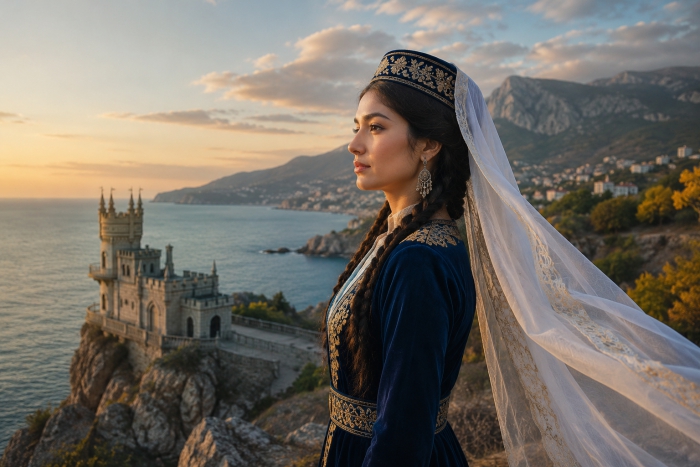 Crimean Tatar Women
Agence CQMI
Crimean Tatar Women
Agence CQMI
Crimean Tatar Women: 9 Myths Debunked About a Deported People Who Never Gave Up
Quick answer: a Crimean Tatar woman is neither a "Muslim Russian woman" nor a relative of the Tatar woman from Tatarstan we already covered on this blog. She belongs to a Turkic-speaking Sunni Muslim people, native to the Crimean Peninsula, heir to a khanate that dominated the Black Sea for more than three centuries before being wiped off its own homeland in 1944 by a mass deportation ordered by Stalin — the Sürgün. Today, this people still lives scattered between mainland Ukraine, the diaspora, and a Crimea under Russian occupation since 2014. If you are only looking for a fling, look elsewhere: a Crimean Tatar woman, like the vast majority of Ukrainian women we work with, only considers a relationship with marriage in mind.
Article by Antoine Monnier, director and co-founder of CQMI international matchmaking agency, specializing in serious relationships between Western men and women from Russia, Eastern Europe, the Caucasus, and Central Asia since 2014.
A People Almost Everyone Confuses With Another
A few weeks ago, after we published our article on Tatar women from Tatarstan, one of our members, James, from Toronto, wrote to me with the single most common confusion on this subject: "Antoine, I saw you already covered Tatar women, why write another article?" I had to explain, with all the patience fifteen years in this business have taught me, that there isn't one, but several peoples called "Tatar" across Eurasia — the Volga Tatars in Tatarstan, the Siberian Tatars, and the Crimean Tatars, who share with the first group nothing more than a common ethnonym and a distant Turkic kinship. Everything else — language, history, lived religious practice, relationship to the homeland — diverges profoundly.
Crimean Tatars ("Qırımtatarlar" in their own language) are a Turkic-speaking Muslim people native to the Crimean Peninsula on the Black Sea. Their ethnogenesis stacks layers of history rarely found together in Europe: Turkic Kipchak and Cuman tribes from the steppe, blended with the Greek, Gothic, and Genoese populations already settled on the peninsula, then Islamized and politically unified from the 15th century onward under the Giray dynasty, direct descendants of Genghis Khan. What ten years of matchmaking experience have taught us, Boryslava and I: it doesn't matter how confusing the naming is, a Crimean Tatar woman carries an identity of rare historical depth, and she expects a serious man to make the minimal effort of distinguishing her from the rest.
In 2016, singer Jamala — herself a Crimean Tatar whose great-grandmother was deported in 1944 — won the Eurovision Song Contest for Ukraine with "1944," a song dedicated directly to her people's deportation. She remains one of the most popular artists in Ukraine today.
Myth #1 — "A Crimean Tatar Is the Same as a Tatar From Tatarstan"
False, and this is the most common confusion among our English-speaking members. Volga Tatars, in Tatarstan, are a Turkic-speaking people settled since the Middle Ages along the Volga River, around Kazan, Islamized in the 10th century, and integrated into the Russian Empire since Ivan the Terrible. Crimean Tatars are a distinct people, native to a peninsula on the Black Sea, with their own language — Crimean Tatar, which blends Kipchak and Oghuz elements, unlike purely Kipchak Volga Tatar — their own dynastic history, and above all a radically different 20th century: the total deportation of 1944 never touched the Tatars of Tatarstan. Both peoples acknowledge a distant Turkic kinship, but consider themselves two distinct nations.
Verdict: FALSE. Two Turkic-speaking, Muslim peoples sharing the same English name, yet as different from each other as a Breton and a Corsican can be within France.
Myth #2 — "She's Basically a Muslim Russian or Ukrainian Woman"
This is a common misjudgment, born from the fact that Crimean Tatars have been Ukrainian citizens since independence in 1991 (Crimea having been transferred to the Ukrainian SSR in 1954). But a Crimean Tatar woman is neither Slavic nor Orthodox: her traditional mother tongue belongs to the Turkic family, with no link to Ukrainian or Russian, and her religion is Sunni Islam, practiced for centuries in forms largely inherited from the neighboring Ottoman Empire. What we often observe at CQMI: a Crimean Tatar woman today speaks fluent Ukrainian, and often Russian too, but claims an ethnic and religious identity that has nothing Slavic about it.
Verdict: FALSE. She holds Ukrainian citizenship, but a distinct ethnicity and religion — a situation comparable, in relative terms, to a French woman of Kabyle origin.
Myth #3 — "The 1944 Deportation Is Ancient History, It Doesn't Really Concern Them Anymore"
This vastly underestimates what historians consider one of the fastest and deadliest ethnic cleansings of the 20th century. On May 18, 19, and 20, 1944, on Stalin and Beria's orders, roughly 190,000 Crimean Tatars — almost exclusively women, children, and the elderly, as the men were at the front — were rounded up within minutes and deported by cattle car to Uzbekistan, the Urals, and Siberia, under the false pretext of collective collaboration with the Nazi occupier. Nearly half of the deportees died of starvation, disease, or exhaustion during the journey or in the following months. The people were only allowed to return to their homeland starting in the late 1980s, under Gorbachev — after forty-five years of exile. Since 2015, Ukraine, followed by Latvia, Lithuania, Canada, Poland, Estonia, the Czech Republic, and the Netherlands, have officially recognized this deportation as genocide.
What we observe within the agency: a Crimean Tatar woman today has not personally lived through this tragedy, but she almost always carries its direct memory — a grandmother or great-grandparent born in exile in Uzbekistan. This is never a subject to raise lightly, but it should not be avoided out of discomfort either: showing that you know about the Sürgün is perceived as a rare sign of respect from a Western man.
Verdict: NUANCED, but the myth is largely false. The 1944 deportation remains a living wound, passed down and commemorated every year — far from being "ancient history."
Myth #4 — "Muslim and Crimean Tatar Means Veiled and Impossible for a Western Man to Date"
This is a caricature that doesn't match the reality of most Crimean Tatar women today. The Islam practiced in Crimea is Sunni Hanafi, historically moderate, inherited from a khanate that maintained constant diplomatic ties with Christian Europe and the Polish-Lithuanian Commonwealth. As we observe among our Central Asian and North Caucasian members, the religious practice of an urban Crimean Tatar woman living in Kyiv or Lviv today rarely translates into wearing a veil, and much more often shows up in family customs — no alcohol served at grandparents' tables, Ramadan observed, a strong attachment to the extended family. The main factor for success with her, as with any serious woman our agency accompanies, is never religion as such, but the sincere respect you show for what matters to her.
Verdict: FALSE. Religious practice exists and deserves respect, but it does not prevent a serious, fulfilling relationship with a non-Muslim Western man, provided there is mutual openness.
Myth #5 — "The Crimean Khanate Was Just Another Russian Province"
This is historically false, and even the opposite for over three centuries. The Crimean Khanate, founded in 1441 by the Giray dynasty — direct descendants of Genghis Khan — was an independent state, then a vassal of the Ottoman Empire, with Bakhchysaray as its capital from 1532 onward. Far from being a Russian province, this khanate was for generations a feared military power that launched raids as far as Moscow and shaped the diplomatic balance between the Polish-Lithuanian Commonwealth, Muscovy, and the Ottoman Empire. It was only in 1783, after Catherine the Great's victory, that Imperial Russia annexed Crimea, ending three centuries of Tatar sovereignty over the peninsula.
Verdict: FALSE. The Crimean Khanate was one of the most influential states on the Black Sea for more than three centuries, long before any Russian domination.
Myth #6 — "There's No Way to Meet a Crimean Tatar Woman Today, the Region Is Closed"
This is an understandable but inaccurate geographic assumption. Since Russia's illegal annexation of Crimea in 2014, a significant share of the Crimean Tatar population has left the peninsula or been pushed out by pressure on their institutions — the Mejlis, the representative body of the Crimean Tatar people, was declared an "extremist organization" by Russia in 2016, a decision condemned by the International Court of Justice in 2017. Many Crimean Tatar families now live in Kyiv, Lviv, or other major cities in mainland Ukraine, fully accessible through our member network, as well as within a significant historical diaspora, notably in Turkey. We don't do politics at CQMI, but honesty requires us to flag this logistical reality to clients interested in this nationality.
Verdict: FALSE if you're thinking of occupied Crimea itself, but meeting remains entirely possible through Crimean Tatar members living in mainland Ukraine or in the diaspora.
Myth #7 — "Crimean Tatar Folklore Looks Like Any Other Turkic Folklore, Nothing Special"
This underestimates a remarkably refined material heritage. Crimean Tatar goldwork embroidery, called "tepetermeh," ranks among the finest in the Turkic-speaking world, directly influenced by Ottoman workshops in Constantinople due to the khanate's close ties with the Sublime Porte. The cuisine, too, carries its own identity: the chebureki, a fried meat-filled turnover, is considered the national dish, alongside the yantyk, its grilled variant, or the köbete, a layered pie with rice and chicken traditionally served at weddings. The Khan's Palace in Bakhchysaray, with its famous "Fountain of Tears" immortalized by Pushkin, remains one of the most visited architectural monuments on the entire peninsula.
Verdict: FALSE. Crimean Tatar folklore, cuisine, and goldwork form a distinct cultural whole, heavily shaped by Ottoman heritage, unmatched elsewhere in the Turkic-speaking world.
Myth #8 — "She Has No Real National Identity, Administratively She's Just Russian"
False, and even a historical and political contradiction. Since 1954, Crimea has legally been part of Ukraine, and the vast majority of the international community — including the United Nations, which condemned Russia's discriminatory measures against Crimean Tatars in 2016 — continues to recognize Ukrainian sovereignty over the peninsula despite the de facto occupation since 2014. Politically, Crimean Tatars have overwhelmingly supported Ukrainian territorial integrity: several Crimean Tatar volunteer units joined the Ukrainian army as early as 2014. A Crimean Tatar woman today generally identifies fully as a Ukrainian citizen, never as Russian.
Verdict: FALSE. A Crimean Tatar woman's national identity is Ukrainian, paired with a proudly claimed Crimean Tatar ethnic and religious identity — the two are in no way contradictory.
Myth #9 — "This Topic Is Too Politically Sensitive for a Dating Agency, Better to Avoid It"
I understand the caution, but I'll answer here with the same honesty I apply to every nationality we work with at CQMI: knowing a people's real history is not "doing politics" — it is the bare minimum of respect a serious relationship requires. What ten years of matchmaking have taught us, Boryslava and I: couples who fail almost never stumble over a woman's ethnic origin or history. They stumble over the man's lack of genuine curiosity about what shaped her family and her identity.
Verdict: FALSE. Learning about a people's history is not a political act — it is an act of respect, and it is precisely what separates a serious man from a passing sentimental tourist.
What We Often Observe Among Our Crimean Tatar Members
From our experience, after more than ten years at CQMI international matchmaking agency, we find that a Crimean Tatar woman approaches relationships with a singular blend of inherited dignity and pragmatism forged by exile. We often observe that these women, many of whom grew up hearing family accounts of the deportation, place particular value on loyalty, stability, and a man's ability to keep his word over time — qualities that, in a family history marked by the loss of land and property, have taken on an almost sacred value. Like our members from Tatarstan or our Kalmyk members — themselves a people deported by Stalin in 1943 — the main factor for success is never flattering a regional folklore, but showing genuine interest in a person's family history.
The CQMI Method for Approaching a Crimean Tatar Woman
- Always distinguish "Crimean Tatar" from "Tatar from Tatarstan." Confusing the two, in your very first exchanges, is immediately read as a lack of seriousness.
- Learn about the 1944 Sürgün before any deep conversation. Never bring it up lightly, but don't avoid it out of discomfort either: a simple line like "I know what your people went through in 1944" carries considerable weight.
- Never reduce her identity to tourist folklore. The embroidery and cuisine are captivating, but an isolated compliment on this folklore, with no interest in her actual life, rings hollow.
- Value her Ukrainian identity as much as her Crimean Tatar identity. Both coexist and reinforce one another for the vast majority of our members.
- Go through a serious matchmaking agency. This community, more discreet and less courted than average, deserves rigorous, verified support.
The 4 Mistakes to Avoid With a Crimean Tatar Woman
- Confusing her with a Tatar from Tatarstan or a generic "Muslim Russian." This is the most common and most instantly disqualifying mistake.
- Treating the 1944 deportation as a mere historical anecdote. It is a living memory, passed down across generations — not a topic for casual curiosity.
- Ignoring or downplaying her religious practice out of awkwardness. A moderate, culturally-rooted Sunni Islam deserves respect, not avoidance out of discomfort.
- Rushing forward without clarifying your intentions. As with all the Ukrainian women we work with, ambiguity about how serious the relationship is remains the number one cause of failure from the very first exchanges.
Two Stories From the Field
Robert's mix-up. Robert, 54, from Edinburgh, wrote to his member: "Delighted to meet a descendant of Kazan!" She replied, with a mix of amusement and firmness: "Kazan is 2,000 kilometers from where I'm from, but thanks for trying." Robert had the good sense to laugh at his own mistake, look into it properly, and he now admits that exchange changed the entire quality of their conversation.
James's sincere question. James, our client from Toronto, had read our earlier article on the Crimean Khanate before his first video call. He simply asked his member: "Was your family affected by the 1944 deportation?" She later told me: "Antoine, that was the first time a Western man asked me that before even asking my age."
Crimean Tatar Woman, Tatar Woman From Tatarstan, Ukrainian Woman: The Real Differences
| Criteria | Crimean Tatar Woman | Tatar Woman From Tatarstan | Ukrainian Woman (Kyiv, Lviv) |
|---|---|---|---|
| Homeland | Crimean Peninsula, Black Sea | Republic of Tatarstan, Volga | Major Ukrainian cities |
| Religion | Sunni Hanafi Islam | Sunni Hanafi Islam | Ukrainian Orthodoxy |
| Traditional language | Crimean Tatar (Kipchak-Oghuz) | Volga Tatar (Kipchak) | Ukrainian |
| Key historical event | Sürgün: 1944 deportation | Ivan the Terrible's conquest (1552) | 1991 independence, 2022 war |
| Current territorial status | Occupied by Russia since 2014 | Republic within the Russian Federation | Sovereign Ukraine |
| Dating logistics | Kyiv, Lviv, or diaspora (Turkey) | Kazan, via Russia | Kyiv, Lviv: direct access |
Frequently Asked Questions About Crimean Tatar Women
Does a Crimean Tatar woman speak any language besides Ukrainian?
Yes. Many also speak Russian, and a growing but still minority share speaks Crimean Tatar itself, a language classified as "severely endangered" by UNESCO due to decades of exile and forced Russification.
Do you have to travel to Crimea to meet a Crimean Tatar woman?
No, and it's neither possible nor advisable today given the Russian occupation. Our agency prioritizes meetings with Crimean Tatar members based in mainland Ukraine or in the diaspora.
Are Crimean Tatar women really different from Tatar women from Tatarstan?
Yes, profoundly: homeland, dialect, dynastic history, and above all the experience of the 20th century are radically different between these two Turkic-speaking Muslim peoples.
Is an age gap a problem with a Crimean Tatar woman?
No, the same principles apply as with all our Ukrainian members: a gap of 5 to 15 years, with the man older, is generally the strongest comfort zone.
Why bring up the 1944 deportation in an article about matchmaking?
Because ignoring a people's history to sell a dream would be dishonest, and because a serious man who knows this history immediately earns a respect nothing else can replace.
What You Really Need to Understand About Crimean Tatar Women
A Crimean Tatar woman is neither a regional variant of the Ukrainian woman, nor a cousin of the Tatar woman from Tatarstan: she carries the legacy of a Turkic-speaking Muslim people who built a sovereign state for over three centuries before enduring, within a few days in May 1944, one of the most brutal deportations of the 20th century. What CQMI international matchmaking agency's experience confirms, after more than 350 successful marriages since 2014:
- Her history, however painful, deserves to be understood — never avoided out of discomfort.
- Her Ukrainian identity and her Crimean Tatar identity fully coexist; never choose between the two.
- Like the vast majority of Ukrainian women, she is looking for a serious marriage, not a fling.
If you are a serious man — in Canada, the UK, the US, or Australia — looking to build a real life together with a verified Ukrainian woman, including one from Crimea, our article on Circassian women of the Caucasus — another people whose history was shaped by forced exile — will help you better understand the full mosaic of nationalities we represent.
Ready to Meet a Serious Ukrainian Woman?
CQMI international matchmaking agency has been operating since 2014. Our $350 CAD/month plan gives you access to 10 verified contacts of women genuinely motivated to build a lasting relationship. Over 40% of female applications are rejected during our screening process.
350+ successful marriages · Divorce rate under 7% · 1,750 verified members · No chatbots, no ghost translators
Questions? Write directly to Antoine: This email address is being protected from spambots. You need JavaScript enabled to view it.
Read More
Latest from Antoine Monnier
- Hutsul Women of the Ukrainian Carpathians: 9 Myths Debunked
- Turkmen Women: 9 Myths Debunked — What You Never Knew About Women from Turkmenistan
- Kabardino-Balkarian Women: Two Peoples, One Republic in the Caucasus
- Albanian Women: 9 Myths Debunked About the Balkans' Only Non-Slavic People
- Macedonian Women: The Overlooked Balkan Charm Between Slavic and Mediterranean

 +1 514 794-5053