


Ukrainian and Russian Bride dating advices - CQMI blog

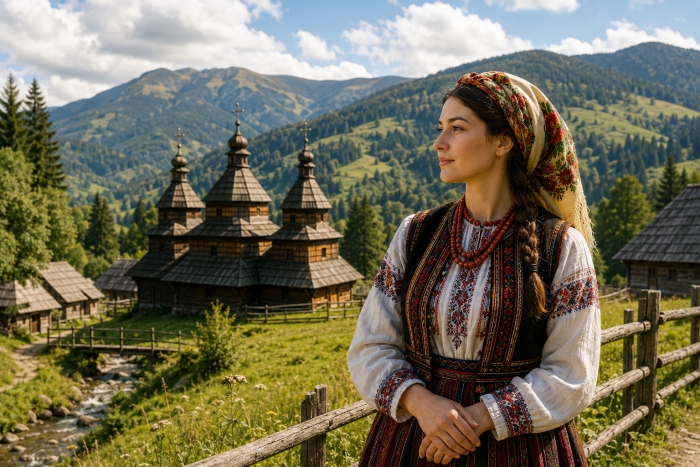 Boyko Women of the Ukrainian Carpathians
Agence CQMI
Boyko Women of the Ukrainian Carpathians
Agence CQMI
Boyko Women of the Ukrainian Carpathians: 9 Myths Debunked
A People of "Verkhovyntsi," the Highlanders of the Central Carpathians
A few months ago, one of our members, Robert, from Edinburgh — whom we already met in our articles on Serbian and Azerbaijani women — wrote to me after a video call with a member from the Drohobych region: "Antoine, she told me she was Boyko. I couldn't find anything like that on my atlas, nor on any passport." What fifteen years working alongside Boryslava in this business has taught me is that this reaction is almost universal: unlike the Crimean Tatars or the Hungarians of Transcarpathia already covered on this blog, the Boykos do not form a recognized national minority with their own citizenship or passport. According to the overwhelming majority of Ukrainian scholars, they are an ethnographic group of Ukrainian highlanders in the central Carpathians, in the same way as the Hutsul women already presented on this blog — but with their own dialect, their own architecture, and their own history.
The origin of the name "Boyko" remains, to this day, uncertain. The most credible hypothesis, defended since the 19th century by the priest and linguist Yosyp Levytsky, traces the name to a local exclamation particle, "boi, boie" ("that's exactly right!"), heavily used by the local population — essentially a verbal tic that became an ethnonym. Other hypotheses, now largely dismissed by historians including Mykhailo Hrushevsky, once tried to link the name to the Celtic Boii tribe (the origin of the word Bohemia) or to the White Croats mentioned in the 10th century by the Byzantine emperor Constantine VII Porphyrogenitus. This last theory, though unprovable, remains the most cited: the Boykos would be descendants of this ancient East Slavic tribe, mixed from the 15th century onward with Vlach shepherds who migrated from the Balkans and Transylvania — which explains part of their pastoral customs.
Quick answer: a Boyko woman is a Ukrainian citizen from the Boikivshchyna, the historical region of the central Carpathians covering the southern Lviv Oblast (Stryi, Drohobych and Sambir districts), the western Ivano-Frankivsk Oblast (Kalush district), and part of northeastern Zakarpattia. Considered in Ukraine as an ethnographic sub-group of Ukrainians rather than a distinct ethnicity, she shares with the Hutsuls and the Lemkos (nowadays almost entirely displaced to Poland) the status of Carpathian "Rusyn." Like the majority of Ukrainian women, she is looking for a serious marriage, not a fling.
Did you know? In 1970, the Boyko population was estimated at around 230,000, down from as many as 400,000 in the old Boikivshchyna before the upheavals of the 20th century. Yet in the 2001 Ukrainian census, only 131 people declared themselves "Boyko" rather than "Ukrainian." This paradox — a living culture, an almost nonexistent administrative self-identification — is the first thing to understand before approaching a woman from this region.
Myth #1 — "Boykos form a national minority, like the Hungarians of Transcarpathia"
This is a common but inaccurate confusion. Unlike the Hungarian women of Transcarpathia, whose language, religion, and history differ radically from those of Ukrainians, Boykos are considered by nearly all Ukrainian institutions as a sub-group of Ukrainians themselves — in the same way as the Hutsuls or the Polishchuks. A genuine scholarly debate does exist: some researchers group Boykos, along with Lemkos and Hutsuls, into a broader category of "Carpathian Rusyns" whose ethnic status remains debated in Ukraine. But on the ground, a Boyko woman holds a Ukrainian passport, speaks Ukrainian, and identifies first and foremost as Ukrainian — her "Boyko-ness" belongs to regional and cultural identity, not to nationality.
Verdict: FALSE. There is no recognized "Boyko" national minority; it is an ethnographic group fully integrated into the Ukrainian nation.
Myth #2 — "Boykos, Hutsuls, Lemkos: it's all the same thing, just a different name"
This underestimates a precise geography that Ukrainian ethnographers have distinguished since the 18th and 19th centuries. The three groups follow one another from west to east along the Carpathian range: the Lemkos, nowadays almost entirely displaced to Poland after the 1947 Operation Vistula, once occupied the western end; the Boykos occupy the central portion, between the Syan and Terebovlia rivers to the west and the Limnytsia to the east; the Hutsul women of the Ukrainian Carpathians, already covered on this blog, occupy the eastern end, in the Ivano-Frankivsk and Chernivtsi regions. Each group has its own Carpathian dialect, its own embroidery, its own wooden church architecture — three style families, jointly recognized by UNESCO under the common designation of "wooden tserkvas of the Carpathian region," but with clearly different forms.
Verdict: FALSE. These are three neighboring but distinct ethnographic groups, each with its own linguistic, architectural, and clothing traditions.
Myth #3 — "This region has always been part of Ukraine"
This is historically inaccurate. Before the Second World War, the Boikivshchyna extended on both sides of what is now the Polish-Ukrainian border, notably in the former counties (powiats) of Sanok, Lesko, and Przemyśl, in today's Podkarpackie Voivodeship. After 1945, as part of the population exchange between Poland and the USSR and then, in 1947, Operation Vistula, the Rusyn populations of these territories — Lemkos and Boykos alike — were forcibly deported either to Poland's newly acquired "recovered territories" in the west or to Soviet Ukraine. In memory of the Boykos deported from the village of Czarna, in the Bieszczady Mountains, Ukraine's Verkhovna Rada even renamed an entire district — Telmanove Raion, in Donetsk Oblast — into Boykivske Raion in 2016.
Verdict: FALSE. A significant part of the historical Boyko territory lies today in Poland, and the Boykos on that side were deported after 1945.
Myth #4 — "They speak standard Ukrainian, with no distinguishing features"
This ignores one of the most thoroughly studied dialects of western Ukraine. The Boyko dialect belongs to the southwestern Carpathian dialect group and, according to linguists, preserves a remarkable number of archaic phonetic and morphological features that have disappeared elsewhere in Ukraine. It is not a simple regional accent: it has been an object of scholarly study since the 19th century, documented by Galician folklorists, and it continues — in a softened form — to be passed down in the most remote mountain villages of the Stryi or Kalush districts.
Verdict: FALSE. The Boyko dialect is a distinct Carpathian dialect, with its own phonetic and lexical particularities.
Myth #5 — "It's a poor, isolated region with no cultural interest"
This is a misjudgment that overlooks a genuine architectural and intellectual heritage. On the religious side, the Boikivshchyna developed a unique style of wooden church — three domes aligned on the same axis, with the center dome slightly larger than the other two — today protected as UNESCO World Heritage alongside the Hutsul and Lemko styles. On the intellectual side, the region produced major figures in Ukrainian history: Yuriy Drohobych (1450-1494), the first doctor of medicine born in what is now Ukraine, rector of the University of Bologna and professor at the Jagiellonian University in Krakow; the Cossack hetman Petro Konashevych-Sahaidachny (1582-1622); and above all Ivan Franko (1856-1916), one of the greatest Ukrainian writers and intellectuals, born and rooted in this very region.
Verdict: FALSE. The Boikivshchyna has left behind a UNESCO-listed architectural heritage and prominent intellectual figures in Ukrainian history.
Myth #6 — "They are all Orthodox, like most Ukrainian women"
This is inaccurate for this specific region of western Ukraine. The vast majority of Boykos belong to the Ukrainian Greek Catholic Church (Uniate), which recognizes the authority of the Pope while preserving the Eastern Byzantine rite — a direct legacy of the 1596 Union of Brest and Galicia's long history within the Austro-Hungarian Empire. Only a minority is Orthodox. What we often observe at CQMI, with Boryslava, is that this predominantly Greek Catholic identity places a Boyko woman religiously much closer to a Hutsul woman or a woman from Lviv than to a woman from Kyiv or Kharkiv, who are mostly Orthodox.
Verdict: FALSE. The majority of Boykos are Greek Catholic — an important nuance within western Ukraine itself.
Myth #7 — "With the war since 2022, this region is directly exposed to fighting"
This is inaccurate. Located at the far western edge of Ukraine, in the Lviv and Ivano-Frankivsk oblasts, Boyko areas have seen no direct ground combat since 2022. As with the Hutsul region already covered on this blog, this part of the country remains a relatively stable refuge, several hundred kilometers from the front line. The situation is more tense for men of mobilization age. Female residents, however, remain very much present in the towns of Drohobych, Stryi, Sambir, and Kalush, where our network of members is active.
Verdict: FALSE. Meeting someone from this region remains entirely possible; this part of western Ukraine is not a conflict zone.
Myth #8 — "It's too niche, too regional a topic, no use for seduction"
I answer this myth with the same conviction as for every nationality already covered on this blog: learning about a woman's real history is never a waste of time — it is the very foundation of the respect that a serious relationship demands. What ten years of matchmaking experience have taught us, with Boryslava, is that couples who last are not the ones where the man has perfectly mastered his partner's history, but the ones where he showed, from the very first exchanges, sincere curiosity and a genuine effort to understand.
Verdict: FALSE. Taking the time to learn about this history is a sign of seriousness immediately recognized by a woman used to having to explain everything to impatient men.
What We Often Observe Among Our Boyko Members
Based on our experience, after more than ten years at CQMI international matchmaking agency, we find that a woman from the Boikivshchyna approaches relationships with a mountain dweller's pragmatism, shaped by generations used to a harsh climate and unforgiving land. We often observe that these women, less exposed to tourism and the clichés attached to Ukraine's big cities, remain particularly attached to keeping one's word and to the stability of the household. The key success factor is never knowledge of the local dialect, but the man's ability to respect this regional rootedness without ever treating it as mere folklore.
The CQMI Method for Approaching a Boyko Woman
- Never assume she belongs to a separate "minority": she is Ukrainian, and her "Boyko-ness" is a regional identity, not a nationality.
- Never confuse Boykos and Hutsuls: instead, ask her to tell you about her region and her home village.
- Show interest in the region's wooden religious architecture, now UNESCO-listed: most of our members take great pride in it.
- Learn about the fate of the Boykos deported from Poland after 1947. A simple sentence showing this knowledge has a considerable impact.
- Go through a serious, verified matchmaking agency. This region, even less covered by the media than Bukovina or Transcarpathia, deserves rigorous support and real on-the-ground knowledge.
3 Mistakes to Avoid with a Boyko Woman
- Presenting her as a separate "ethnic minority." This misreads her genuinely, and often proudly claimed, Ukrainian identity.
- Reducing her regional identity to picturesque folklore of costumes and embroidery. This ignores a very real history of deportation and shifting borders.
- Rushing forward without clarifying your intentions. As with all Ukrainian women we support, ambiguity about the seriousness of the relationship is the number one cause of failure from the very first exchanges.
Two Stories from the Field
Robert's mistake. Robert, our member from Edinburgh, had written to his match from the Stryi region: "You're Hutsul, like in that Carpathian film I watched?" She replied, amused but firm: "No, I'm Boyko. It's not the same region, nor the same dialect." Robert had the good sense to apologize and learn more; he now credits that exchange with changing the course of their relationship.
James's curiosity. James, our member from Toronto, had read an article about Carpathian wooden churches before his first video call. He simply asked his match: "Did your grandmother's village have one of those three-domed churches?" She later told me: "Antoine, that was the first time a Western man asked me about my own region instead of talking about his."
Boyko Woman, Hutsul Woman, Lemko Woman, Ukrainian Woman of the Plains: the Real Differences
| Criteria | Boyko woman | Hutsul woman | Lemko woman (heritage) | Ukrainian woman of the plains |
|---|---|---|---|---|
| Citizenship | Ukrainian | Ukrainian | Mostly Polish today | Ukrainian |
| Dominant religion | Greek Catholic | Greek Catholic | Greek Catholic / Orthodox | Orthodox |
| Geographic area | Central Carpathians (Lviv, Ivano-Frankivsk, Zakarpattia) | Eastern Carpathians (Ivano-Frankivsk, Chernivtsi) | Western Carpathians (now in Poland) | Central and eastern Ukrainian plains |
| Key historical event | 1945-1947 deportations, division of the Boikivshchyna | Mountain isolation, resistance to successive regimes | Operation Vistule 1947, near-total displacement | Collectivization, Holodomor |
| Situation since 2022 | Stable, far from the front | Relatively unaffected | Not applicable (outside Ukraine) | Variable by region |
| Where to meet | Drohobych, Stryi, Sambir, Kalush | Ivano-Frankivsk, Kolomyia | Diaspora in Poland, barely present in Ukraine | Kyiv, Kharkiv, Dnipro |
Frequently Asked Questions About Boyko Women
Is a Boyko woman a different nationality from Ukrainian?
No. Boykos are an ethnographic group, not a recognized national minority. A Boyko woman is Ukrainian by citizenship and, in the vast majority of cases, by self-identification.
What is the difference between a Boyko woman and a Hutsul woman?
They are two neighboring but distinct ethnographic groups of the Ukrainian Carpathians, with different dialects, wooden church architecture, and traditional dress. Boykos occupy the central part of the range, Hutsuls the eastern part.
Why do some Boykos live in Poland instead of Ukraine?
Part of the historical Boyko territory was located, before 1945, in what is now Poland. After the war, these populations were deported during the population exchange between Poland and the USSR, and then during the 1947 Operation Vistula.
Do you need to travel to the Ukrainian Carpathians to meet a Boyko woman?
No, CQMI international matchmaking agency has members from this region accessible online. A first trip on the ground is still recommended to maximize the chances of a successful, serious relationship.
Is an age difference a problem with a Boyko woman?
No — as with all the Ukrainian women we support, a reasonable age difference is not an obstacle if the commitment is sincere and intentions are made clear from the start.
What You Really Need to Understand About Boyko Women
A Boyko woman is not one more "exotic minority" to check off an ethnographic list: she is Ukrainian, heir to a highland group from the central Carpathians whose identity, unlike that of the Hutsuls or Lemkos, remains largely absorbed into Ukrainian national identity — to the point that only 131 people declared themselves "Boyko" in the 2001 census. What the experience of CQMI international matchmaking agency confirms, after more than 350 successful marriages since 2014:
- Her regional identity never erases her Ukrainian citizenship; the two coexist without contradiction.
- Her history, however little known it may be in the West, deserves to be understood before it is brought up — never avoided out of ignorance.
- Like the vast majority of Ukrainian women, she is looking for a serious marriage, not a fling. Also check out our dedicated profile of Ukrainian women to better place this regional profile within the country as a whole.
If you are a serious man — in Canada, the UK, the US, or Australia — looking to build a genuine life together with a verified Ukrainian woman, including one from the central Carpathians, our CQMI international matchmaking agency can support you through this process, with full transparency about the romance scam risks that specifically target men searching online on their own.
CQMI international matchmaking agency has been operating since 2014. Our $350 CAD/month plan gives you access to 10 verified contacts of women genuinely motivated to build a lasting relationship. More than 40% of female applications are rejected during our screening process.
350+ successful marriages · Divorce rate < 7% · 1,750 verified members
Discover our process →
Questions? Write directly to Antoine: This email address is being protected from spambots. You need JavaScript enabled to view it.
Latest from Antoine Monnier
- Bukovina Women: 9 Myths About This Romanian-Ukrainian Crossroads
- Hungarian Women of Transcarpathia: 9 Myths About This Ukrainian Minority
- Crimean Tatar Women: 9 Myths Debunked About a Deported People Who Never Gave Up
- Hutsul Women of the Ukrainian Carpathians: 9 Myths Debunked
- Turkmen Women: 9 Myths Debunked — What You Never Knew About Women from Turkmenistan

 +1 514 794-5053