


Ukrainian and Russian Bride dating advices - CQMI blog

 Bukovina Women
Agence CQMI
Bukovina Women
Agence CQMI
Bukovina Women: 9 Myths About This Romanian-Ukrainian Crossroads
Bukovina Women: 9 Myths About This Romanian-Ukrainian Crossroads
In short: a Bukovina woman is neither a Romanian who happens to live in Ukraine, nor an ordinary Ukrainian woman with an exotic-sounding regional label. She comes from a 10,442 km² territory wedged between the eastern Carpathians and the Dniester River, split since 1947 between Ukraine (Chernivtsi Oblast, in the north) and Romania (Suceava County, in the south). Passed in just over two centuries from Ottoman suzerainty to the Austrian Empire, then to the Kingdom of Romania, to the USSR, and finally to independent Ukraine, Bukovina built a unique identity where Ukrainian, Romanian and Moldovan families still share, sometimes in the very same village, a common Orthodox faith. Like the vast majority of Ukrainian women we work with at the agency, a Bukovina woman is not looking for a passing fling, but for marriage and a real life project.
Article by Antoine Monnier, director and co-founder of CQMI international matchmaking agency, specializing in serious relationships between Western men and women from Russia, Eastern Europe, the Caucasus and Central Asia since 2014.
A "Land of Beech Trees" That Changed Sovereignty Four Times
A few months ago, one of our members, Gerard, from Brussels — whom we've already mentioned in our articles on Serbian and Azerbaijani women — wrote to me after a video call with a member from Chernivtsi: "Antoine, she told me she was Bukovinian. I looked it up on a map and found nothing like it, neither in Romania nor in Ukraine." What fifteen years alongside Boryslava in this business have taught me is that this reaction is the rule rather than the exception: Bukovina doesn't exist on any current political map, and yet it remains a perfectly living cultural and human reality on both sides of a border drawn after the Second World War. The name likely comes from Old Slavic or Romanian for beech tree, a species that still covers these Carpathian foothills — the "land of beech trees," as it has been known since the 15th century. This article focuses on the Ukrainian side of the region, home to our members, without which one cannot understand their family history, their very particular relationship to a dual Romanian-Ukrainian identity, or the situation of the neighboring Hungarian minority of Transcarpathia, already covered on this blog, with which Bukovina shares a good deal of historical common ground.
Myth #1 — "A Bukovina Woman Is Just a Romanian Who Ended Up in Ukraine"
This is an understandable but inaccurate assumption in the vast majority of cases. A Ukrainian Bukovina woman is, three times out of four, ethnically and legally Ukrainian: she was born, raised and educated in Ukraine, in a family settled on this territory for generations. What we often observe at CQMI, with Boryslava, is that it is mostly Western men who confuse the region with neighboring Romania, while the reality is an ethnic patchwork: alongside the Ukrainian majority sits a genuine Romanian minority (12.5% of the oblast's population according to the 2001 census, about 114,600 people) and a separately-registered Moldovan minority (7.3%, about 67,200 people), both speaking Romanian as their mother tongue but recorded separately since Soviet times — a distinction Romanian organizations in the region have long contested.
Verdict: FALSE as a generalization. Ukrainian Bukovina is majority Ukrainian, but with a genuine Romanian and Moldovan minority, concentrated in specific districts such as Hertsa, where Romanians are locally the majority.
Myth #2 — "Bukovina Is Basically Romania, or Else It's the Republic of Moldova"
This is a double geographical confusion that deserves untangling. Bukovina is neither Romania nor the Republic of Moldova (former Soviet Bessarabia, independent since 1991): it is a third historical entity, further north, once forming the "Upper Country" (Țara de Sus) of the old medieval Principality of Moldavia — itself not to be confused with today's Republic of Moldova. Since the 1947 Paris Peace Treaty, Bukovina has been split in two: its southern half, with the city of Suceava, belongs to Romania; its northern half, with Chernivtsi, belongs to Ukraine. So it is three distinct present-day states — Ukraine, Romania, and the Republic of Moldova — that share the legacy of the old Principality of Moldavia, of which Bukovina is only one historical component among others.
Verdict: FALSE. Bukovina is a historical region straddling two current countries (Ukraine and Romania), distinct from the modern state of the Republic of Moldova.
Myth #3 — "This Region Has Always Belonged to Either Romania or Ukraine"
This is historically inaccurate, and Bukovina is in fact one of the European regions that has changed hands the most in two centuries. A vassal of the Principality of Moldavia and then the Ottoman Empire, Bukovina was ceded by the Porte to Habsburg Austria in 1775, in thanks for its neutrality in the Russo-Turkish war — it was at this point that the Austrian Duchy of Bukovina officially adopted its current name. It remained Austrian for nearly a century and a half, until the fall of the Empire in 1918: the Assembly of Bukovina, where Romanians were then the majority, voted for union with the Kingdom of Romania. In June 1940, in the wake of the Molotov-Ribbentrop Pact, the USSR annexed the northern half of the region, which became the Soviet oblast of Chernivtsi; Romania retook it from 1941 to 1944 after the Axis invasion of the USSR; the Red Army reconquered it in 1944. The 1947 Paris Peace Treaty formalized the north-south split that still stands today.
Verdict: FALSE. In under two centuries (1775-1947), this region changed effective sovereignty five times. Its status as part of independent Ukraine dates only from 1991.
Myth #4 — "All Bukovina Women Speak Romanian at Home"
This is an overgeneralization. In the great majority of households in Chernivtsi Oblast, the language spoken is Ukrainian, with an overwhelming Ukrainian-speaking majority (75% according to the 2001 census). The Romanian-speaking presence, while real, is geographically concentrated: the district of Hertsa, on the Romanian border, is majority Romanian; the village of Krasnoilsk, home to the country's most famous Malanka carnival, is populated by roughly 95% ethnic Romanians. What we observe among our Bukovina members, with Boryslava: far from being one uniform linguistic bloc, Ukrainian Bukovina is a mosaic of villages, some entirely Ukrainian-speaking, others entirely Romanian-speaking, sometimes just a few kilometers apart.
Verdict: FALSE. Romanian is the native language of only a minority of the region, geographically concentrated near the Romanian border.
Myth #5 — "The Deportations from This Region Are the Same Story as the Crimean Tatars or the Hungarians of Transcarpathia"
This underestimates a distinct episode, largely unknown outside the region. Following the Soviet annexation of 1940, and especially after the 1944 reconquest, Soviet authorities deported to Siberia and Central Asia roughly 60,000 Romanians between July 1940 and June 1941, then a further 253,000 between 1944 and 1955, according to correspondence between Soviet minister Kruglov and Stalin cited by historian Nikolai Bugai. A Romanian partisan resistance against Soviet rule even persisted locally until 1958. Survivors were then arbitrarily split into two administrative categories by Moscow: those living east of Chernivtsi were classified as "Moldovan," with no right to leave the USSR; the others were classified as "Romanian," with a theoretical right to apply to emigrate to Romania. It is this Soviet administrative division, still disputed today, that explains the present-day coexistence of two "Romanian" and "Moldovan" minorities who actually speak the same language.
Verdict: FALSE as a shortcut. Bukovina's deportations form a distinct chapter from the other Stalinist deportations already covered on this blog, with their own scale (over 300,000 people total) and their own administrative logic.
Myth #6 — "This Region Has Been Directly Ravaged by the Fighting Since 2022"
This is inaccurate, even though the situation remains marked by the conflict. Bordering Romania and Moldova, and close to Poland and Slovakia, Chernivtsi Oblast has seen no ground fighting and has instead become a transit and refuge zone for hundreds of thousands of people displaced from other regions of Ukraine, as well as a logistics corridor into the European Union via the Siret border crossing. The situation is far more strained, however, for men of mobilization age, some of whom have sought refuge across the Romanian or Hungarian border. Women, on the other hand, remain very much present in Chernivtsi, Storozhynets or Hlyboka, and our network of members covers all of these locations.
Verdict: FALSE. Meeting someone from the region remains entirely possible; it is the situation of the region's men, not its women, that has been most directly affected by the war and mobilization.
Myth #7 — "Ukrainians, Romanians, Moldovans: These Communities Share No Common Religion"
This is a mistake, and it's actually one of the points that sets Bukovina apart from neighboring Hungarian Transcarpathia, where the Magyar minority is largely Reformed Protestant against an Orthodox Ukrainian majority. In Bukovina, by contrast, nearly the entire population — whether Ukrainian, Romanian, or Moldovan — shares the same Orthodox Christian faith, inherited directly from the old Principality of Moldavia and reinforced by the magnificent painted monasteries of the 15th and 16th centuries that made the whole region architecturally famous, including on its present-day Romanian side. What we observe among our Bukovina members, with Boryslava: this shared religion, far from erasing linguistic and identity differences, has instead served as a social foundation that allowed communities to coexist peacefully for centuries, including under Austrian rule.
Verdict: FALSE. Orthodoxy is a strong point of religious convergence between the region's different ethnic communities, unlike some other minorities in western Ukraine.
Myth #8 — "The Region's Folklore Is Just Like Anywhere Else in Ukraine"
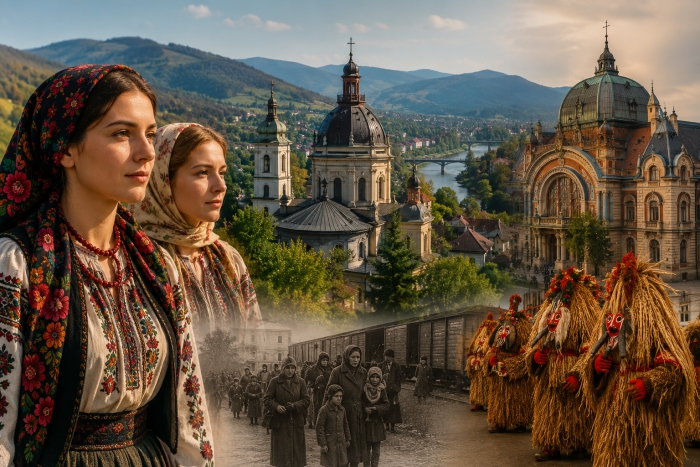
This overlooks one of the most spectacular and singular traditions in the entire country. Every year, on the night of January 13-14 — New Year's Eve according to the Julian calendar still used by the Orthodox Church — the village of Krasnoilsk, just a few kilometers from the Romanian border, holds Ukraine's most famous Malanka: hundreds of residents parade in enormous costumes woven from reeds, representing bears, Roma figures, an old couple, a king and a queen, in a deliberate blend of Ukrainian and Romanian traditions that survived Soviet bans. A "commander" coordinates each of the village's districts, which stage no fewer than five rival Malankas on the same day. This carnival, now recognized even in the international press, illustrates on its own the hybrid, living identity of Ukrainian Bukovina.
Verdict: FALSE. Bukovinian folklore, particularly the Krasnoilsk Malanka, is a syncretic Romanian-Ukrainian tradition unlike anything found in other regions of the country.
Myth #9 — "This Is Too Regional and Complicated a Topic to Matter When Meeting a Woman"
I answer this myth with the same conviction as for every nationality already featured on this blog: taking time to learn a woman's real history is never wasted time — it is the very foundation of the respect a serious relationship demands. What ten years of matchmaking work have taught us, with Boryslava: the couples who last are not the ones where the man perfectly masters his partner's history, but the ones where he showed, from the very first exchanges, genuine curiosity and a real effort to understand.
Verdict: FALSE. Learning this history is not a superfluous detail — it is a mark of seriousness immediately recognized by a woman used to explaining everything to impatient men.
What We Often Observe Among Our Bukovina Members
Based on our experience, after more than ten years at CQMI international matchmaking agency, we find that a Bukovina woman approaches a relationship with a distinctive blend of regional pride and pragmatism forged by two centuries of shifting borders. We often observe that these women, raised from childhood with this crossroads identity — shaped by Austro-Hungarian, Moldovan and Soviet legacies — develop a remarkable capacity to adapt, a real asset for a Western man considering a binational relationship. The main factor for success is never mastery of Romanian or Ukrainian, but the man's ability to respect this composite identity without ever trying to force it into a simpler box.
The CQMI Method for Approaching a Bukovina Woman
- Never confuse "Bukovina" with "Romania." Ask her to tell you about her region and her village instead of assuming she comes from Bucharest or Chisinau.
- Learn about the 1940-1955 deportations before any in-depth conversation. A simple sentence showing you know this chapter of history has a considerable impact.
- Never assume her ethnic background — Ukrainian, Romanian or Moldovan — based solely on her first or last name.
- Take an interest in Chernivtsi and its multicultural Austrian past: most of our members are proud of it and love talking about it.
- Go through a serious, verified matchmaking agency. This region, less covered in the media than Kyiv or Lviv, deserves careful support and real on-the-ground knowledge.
4 Mistakes to Avoid With a Bukovina Woman
- Presenting her as "just Ukrainian" or "just Romanian." This denies the real complexity of a regional identity that fits neither label alone.
- Taking recent linguistic tensions (the 2017 education law) lightly. They directly affect the daily life of the region's Romanian-speaking minorities.
- Ignoring the question of mobilization and its family consequences. Many families have lived apart since 2022, a topic that requires tact.
- Rushing without clarifying your intentions. As with all the Ukrainian women we work with, ambiguity about how serious the relationship is remains the number one cause of failure from the very first exchanges.
Two Stories From the Field
Philippe's misstep. Philippe, our member from Lyon, had written to his Chernivtsi match: "I saw photos of your carnival — it looks like Halloween!" She replied, amused: "Halloween lasts one evening. Our Malanka, in Krasnoilsk, brings a whole village together for two days, with costumes people prepare all year." Philippe had the good grace to laugh at his hasty comparison and dig deeper; he now says that exchange changed the course of their relationship.
Robert's curiosity. Robert, our member from Edinburgh, had read an article on Chernivtsi's Austrian history before his first video call. He simply asked his match: "Does your family have any memories from when your city was still called Czernowitz?" She later told me: "Antoine, that was the first time a Western man showed interest in my city's history before talking about his own country."
Bukovina Woman vs. Hutsul Woman vs. Romanian Woman vs. Hungarian Woman of Transcarpathia: the Real Differences
| Criterion | Bukovina Woman (Ukraine) | Hutsul Woman (Carpathians) | Romanian Woman (Romania) | Hungarian Woman of Transcarpathia |
|---|---|---|---|---|
| Citizenship | Ukrainian | Ukrainian | Romanian | Ukrainian (often dual) |
| Dominant native language | Ukrainian (majority), Romanian (minority) | Ukrainian | Romanian | Hungarian (Uralic) |
| Dominant religion | Orthodox Christianity | Greek Catholic Christianity | Orthodox Christianity | Reformed, Catholic |
| Key historical event | 1940-1955 deportations, 1947 partition | Mountain isolation, resistance to regimes | 1918 union, communism until 1989 | "Malenki robot" deportation 1944-1945 |
| Situation since 2022 | Refuge and transit zone | Relatively spared | Refugee host country | Refuge zone toward Hungary |
| Meeting logistics | Chernivtsi, Storozhynets, Hlyboka | Ivano-Frankivsk, Kolomyia (see our dedicated article) | Suceava, Bucharest | Uzhhorod, Berehove |
Frequently Asked Questions About Bukovina Women
Does a Bukovina woman speak Romanian or Ukrainian?
It depends entirely on her home village. Most of the population of Chernivtsi Oblast is Ukrainian-speaking, but some border districts, such as Hertsa, or some villages like Krasnoilsk, are overwhelmingly Romanian-speaking. It's therefore essential never to assume, and simply to ask her.
Do you need to travel to Bukovina to meet a woman from the region?
Not necessarily: many members from Chernivtsi and the surrounding region are accessible through our network and video correspondence, well before any organized trip to Ukraine.
Is a Bukovina woman different from a Romanian woman from Romania?
Yes, fundamentally, even when she is ethnically Romanian: she is a Ukrainian citizen, was raised within the Ukrainian education and administrative system, and has directly lived through the consequences of the war since 2022, unlike a Romanian woman from Bucharest or Suceava.
Why bring up the 1940-1955 deportations in a matchmaking article?
Because this family memory, passed down from generation to generation, remains a strong marker of identity for many members from the region. Being aware of it is a sign of respect that is immediately noticed.
Is an age difference a problem with a Bukovina woman?
No, as with all Ukrainian women supported by our agency, a reasonable age gap (between 2 and 15 years depending on the case) is not an obstacle if the relationship is sincere and the intentions are clearly stated from the start.
What You Really Need to Understand About Bukovina Women
A Bukovina woman is neither a Romanian who ended up in Ukraine, nor an ordinary Ukrainian woman: she carries the legacy of a crossroads region that changed sovereignty five times in two centuries and remains, to this day, split between Ukraine and Romania. What CQMI international matchmaking agency's experience confirms, after more than 350 successful marriages since 2014:
- Her ethnic and linguistic identity — Ukrainian, Romanian or Moldovan — should never be assumed in advance, though her Orthodox roots are, in fact, widely shared.
- Her history, however little known abroad, deserves to be understood before being brought up, never avoided out of ignorance.
- Like the vast majority of Ukrainian women, she is looking for a serious marriage, not a fling. You can also read our dedicated profile of Romanian women to better distinguish the two.
If you are a serious man — in Canada, the UK, the US or Australia — looking to build a real life with a verified Ukrainian woman, including one from Bukovina, our agency can guide you through this process, with full transparency about the romance scams that specifically target men searching alone online.
CQMI international matchmaking agency has been operating since 2014. Our $350 CAD/month plan gives you access to 10 verified contacts of women genuinely motivated to build a lasting relationship. More than 40% of female applications are rejected during our screening process.
350+ successful marriages · Divorce rate under 7% · 1,750 verified members
Discover our process →
Questions? Write directly to Antoine: This email address is being protected from spambots. You need JavaScript enabled to view it.
Latest from Antoine Monnier
- Hungarian Women of Transcarpathia: 9 Myths About This Ukrainian Minority
- Crimean Tatar Women: 9 Myths Debunked About a Deported People Who Never Gave Up
- Hutsul Women of the Ukrainian Carpathians: 9 Myths Debunked
- Turkmen Women: 9 Myths Debunked — What You Never Knew About Women from Turkmenistan
- Kabardino-Balkarian Women: Two Peoples, One Republic in the Caucasus

 +1 514 794-5053