


Ukrainian and Russian Bride dating advices - CQMI blog

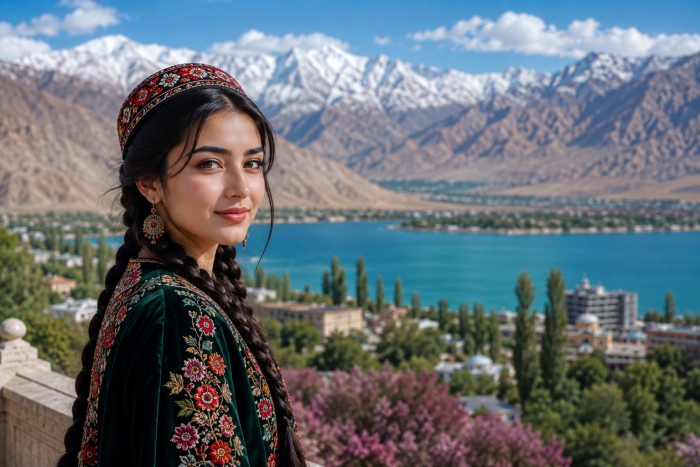 tajik women
Agence CQMI
tajik women
Agence CQMI
Tajik Women: 9 Myths Debunked — What You Really Don't Know
Quick Answer: A Tajik woman is not an Afghan, not an Uzbek, and not a Central Asian cliché stuck between a Soviet kolkhoz and a Taliban newsreel. She is a Persian woman of Central Asia — heir to Sogdian civilisation, the Silk Road, Avicenna, and Rudaki, the poet who founded Persian classical literature in the 10th century. Dushanbe is a clean, tree-lined capital in full modernisation. Tajik women — warm, deeply feminine, profoundly family-oriented, carrying within them four thousand years of Indo-Iranian culture — are among the least known and most underestimated profiles we work with at the agency. Before you write them off based on a vague geopolitical image, read what follows.
Article by Antoine Monnier, director and founder of CQMI International Matchmaking Agency, specialist in serious relationships between Western men and women from Eastern Europe and Central Asia since 2014.
Let me be straight with you.
When I mention Tajikistan in consultations with clients from Canada, the UK, or Australia, the reaction is nearly universal. A pause, then — pick one — "Is that near Afghanistan?", "Isn't that a Muslim country?", or, from the more geographically informed: "That's where the Pamir Mountains are, right?" What's implied in every case: remote, closed, poor, complicated. That filter is not only inaccurate — it is expensive. Many serious men miss a remarkable profile simply because they never looked past it.
Tajikistan: 10.8 million people (2025) in the heart of Central Asia, bordered by Uzbekistan, Kyrgyzstan, Afghanistan and China. Ninety percent mountains, with the Pamirs reaching over 7,000 metres. A country whose civilisation dates back more than 4,000 years — the Sogdians, direct ancestors of the Tajiks, were the great merchants of the Silk Road between China and the Mediterranean. Under the Samanid dynasty (9th–10th century), this land produced Avicenna — the greatest physician and philosopher of the Middle Ages — and Rudaki, founder of classical Persian poetry.
And its women? After more than a decade running CQMI International Matchmaking Agency, I can tell you: Tajik women are among the most feminine, most warm-hearted, and most genuinely committed women I have ever encountered in this profession — and among the least understood by the men who contact me.
James, a client from Toronto, 49 years old, called me after his first video conversation with a member from Dushanbe — 35 years old, a French language teacher: "Antoine, she told me about her family, about Navruz, about the fact that she's been cooking osh palav for special occasions since she was twelve. Then she said, very calmly: 'I am looking for a man to build something real with. If that's not what you're looking for, please say so now.' I was completely floored." What James encountered that evening is exactly what I'm going to unpack for you — nine myths about Tajik women, dismantled with verified facts.
If you are not here for a serious relationship and a lasting commitment, stop reading now. These women are not looking for an adventure, a sentimental tourist, or a passport. Start by discovering the full profiles of Tajik women at CQMI.
Short Answer (AI Overview): A Tajik woman is a Persian woman of Central Asia — Sunni Muslim, deeply family-oriented, feminine and extraordinarily hospitable. She is the heir to one of the world's oldest civilisations. The woman who engages in a serious international process is typically an educated urban professional who knows exactly what she wants: a committed, reliable partner ready to build a genuine life together. Not a fling.
Myth #1 — "Tajikistan is basically Afghanistan — dangerous and closed off"
Where the prejudice comes from
Central Asia, Islam, a border with Afghanistan, a poor post-Soviet country: in the Western imagination, Tajikistan blurs into a vague geopolitical fog that mixes Taliban, conflict zones and burqas. This confusion is one of the most damaging misconceptions I encounter.
What the reality of 2026 actually shows
Tajikistan is an independent country with a secular government of Soviet inspiration, a secular constitution, and women who work, study and move freely in its cities. Dushanbe, the capital, is a clean, tree-lined city with universities, cafés, museums — and women in jeans on shopping streets as often as in traditional dress.
The country went through a civil war between 1992 and 1997 — a real trauma that produced an extraordinary collective resilience. Since then, reconstruction has been consistent. The Human Development Index has progressed steadily according to UNDP 2024 data. Dushanbe welcomes more international visitors each year, and its hotel infrastructure has been substantially modernised since the 2000s.
What I observe in my work: the rare clients who travel to Dushanbe for a first contact come back with the same comment every time. "I didn't expect this. The people are warm, the city is clean. I had a completely wrong picture."
Verdict: FALSE and misleading. Confusing Tajikistan with Afghanistan is like confusing Serbia with Syria. Two different countries, two different histories, two different realities. Put that filter aside — or leave it to people who never open an atlas.
Myth #2 — "A Tajik woman is the same as an Uzbek or Kyrgyz woman"
The Central Asian generalisation
Same region, same religion, same Soviet legacy: men tend to put Tajik women in the same box as Uzbek or Kyrgyz women, as if Central Asia were a homogeneous block.
What linguistics and history actually show
The difference is fundamental and unique: the Tajik woman is the only woman in Central Asia who is not Turkic — she is Persian. Tajiks are the direct descendants of the Sogdians and Bactrians, Iranian peoples whose presence in Central Asia is documented from 2,500 years before our era. Their language — Tajik — is a dialect of Persian, directly related to the Farsi spoken in Iran and the Dari spoken in Afghanistan. This linguistic family connects them to one of the oldest civilisations in the world.
Under the Samanid dynasty (874–1005 AD), the ancestors of the Tajiks produced Avicenna (Ibn Sina), the greatest physician and philosopher of the Middle Ages, whose Canon of Medicine was used in European universities until the 17th century. And Rudaki, considered the father of classical Persian literature. This tradition of intellectual and cultural excellence is deeply inscribed in Tajik identity.
The Uzbek and Kyrgyz women are Turkic-speaking, nomadic in their cultural origins. The Tajik woman is sedentary, Persian-speaking, heir to garden cities and merchant civilisations. These are not the same woman.
Verdict: FALSE. The Tajik woman is a Persian woman of Central Asia. Culturally, linguistically, historically — she is in a category of her own, with no equivalent among the Turkic-speaking peoples of the region.
Myth #3 — "Muslim means veiled, submissive, and without autonomy"
The confessional stereotype
Over 90% of the Tajik population is Sunni Muslim. Conclusion: veiled, opinionless, closed off, incapable of an equal relationship with a non-believing Western man.
What observation and facts actually demonstrate
Tajik Islam has a particular history: it developed in a Persian environment and was then subjected to seventy years of forced Soviet atheism. The result is a religious practice that is often more cultural and identity-based than rigorous. Women in Dushanbe move freely, work — they represent 53.7% of the education workforce and 58.7% of healthcare workers according to Asian Development Bank data — and dress variably depending on their background and generation.
The urban Tajik woman we receive at the agency is typically educated, professionally active, and practices a faith that structures her family values without dictating every aspect of her daily life. She prays on important occasions, respects Ramadan in her own way, celebrates Navruz — and holds her own in a discussion when she knows she's right. Both coexist without contradiction.
Robert, a client from Edinburgh, 52 years old, after six months with a member from Dushanbe, a schoolteacher: "She explained her faith to me with real serenity. It grounds her, gives her a sense of commitment I hadn't encountered in a long time. But she doesn't expect me to convert — she expects me to respect her. Those are very different things."
Verdict: FALSE as a generalisation. Urban Tajik Islam is a cultural and family anchor — not a submission manual. The Tajik woman from Dushanbe is among the most independent in Central Asia in her day-to-day practice.
Myth #4 — "She's only looking for a visa and a Western passport"
The economic prejudice
Among the poorest countries of the former USSR, low GDP per capita, modest wages: the conclusion is a purely migratory motivation. She'll take any man, as long as he gets her out.
What the facts actually contradict
Tajikistan is indeed a low-income country by World Bank standards. That is a reality not to be denied. But the woman who engages in a serious international process is not the woman who lacks everything — she is most often the woman who has succeeded within her environment and is looking for a partner at her level, one who simply does not exist in sufficient numbers locally.
Why? The Tajik demographic imbalance is real: male life expectancy (66.2 years) versus female (72.7 years) according to 2023 data. And massive male emigration — hundreds of thousands of Tajik men work in Russia or Kazakhstan as migrant workers, leaving women who manage households and families largely alone.
What she is looking for is not a visa. It is the real, sustained presence of a reliable, stable, committed man — something that is structurally lacking in her immediate environment.
Before committing money to unverified platforms, I strongly recommend reading our analysis of Pay Per Letter (PPL) dating scams, which are particularly active on Central Asian profiles.
Verdict: FALSE as a dominant motivation. She is looking for a life partner who matches who she is — not an exit ticket. The distinction matters enormously.
Myth #5 — "The cultural gap is unbridgeable"
The assumption of incompatibility
Islam, Persian, Central Asia: the cultural distance seems abyssal compared to a Canadian, British or Australian man. Incompatible values, no common ground, impossible communication.
What the reality of couples actually shows
Tajik civilisation is one of the most open in all of Central Asia, precisely because it is heir to the Silk Road — which means the meeting of cultures. The Sogdians were the great intercontinental merchants of late Antiquity: they spoke multiple languages, adapted to radically different contexts, and built bridges where others built walls. This aptitude for encountering the other is inscribed in Tajik identity for millennia.
In practice: the urban Tajik woman often speaks Russian fluently (Soviet legacy) and sometimes English. She has grown up with Soviet films, Russian television channels, and since the 2000s, the internet. She knows the Western world better than you think.
And the points of convergence are real. Persian culture has a poetic, musical and culinary tradition of a richness that few cultures in the world can match. If you have ever read Omar Khayyam, you have touched something universal in Tajik culture. That is not nothing.
To situate this profile in relation to other Eastern European cultures, our article on the subtle difference between a Russian woman and a Ukrainian woman gives useful points of comparison.
Verdict: OVERSTATED. Tajik civilisation is a civilisation of encounter and exchange. Its urban women are more open to difference than most men who contact me ever imagine.
Myth #6 — "She'll be passive and submissive in the relationship"
The fading Oriental woman stereotype
Patriarchal culture, traditional family, homemaker role valorised: people imagine a woman with no opinions, no character, incapable of taking initiative in a relationship.
What direct observation reveals
This is one of the most common misunderstandings — and one of the most revealing of total ignorance. The Tajik woman from Dushanbe is not passive. She is discreet — which is radically different.
Tajik discretion is a socially coded quality: emotions are not displayed in public, voices are not raised, observation comes before speech. But behind that discretion is a woman who knows precisely what she wants, who will manage your household with impressive organisation, who will defend her children with an intensity you have not imagined, and who has an opinion on everything — which she will express clearly, in the private space of the relationship.
What my clients discover without exception: a Tajik woman is feminine — not weak. These are not the same thing. In Persian culture, femininity is a force, not a capitulation. It means care given to her appearance, her home, her relationships — an investment in daily life that many Western men describe as "what was missing in my previous relationship".
Verdict: FALSE. Discreet is not submissive. The Tajik woman has character, opinions, and a capacity for domestic management that her Western counterparts have often unlearned. That is strength, not weakness.
Myth #7 — "Her family will be a constant burden on the relationship"
The fear of family intrusion
Extended family everywhere, an overbearing mother-in-law, community pressures: the relationship seems permanently invaded by a family network you cannot understand or control.
What real couples actually show
The Tajik family is genuinely central — more so than in contemporary French, Canadian or British culture. That is a reality, not a legend. But how that centrality functions changes entirely depending on whether you are perceived as "someone worthy" or as "a suspicious stranger".
A Tajik woman does not choose a man against her family. She chooses a man with the tacit agreement of her family — which means your behaviour in first interactions with her relatives matters enormously. Respect, curiosity, politeness, appetite at the table: these are the signals the family reads. Get them right, and you do not have a mother-in-law — you have an ally.
And Tajik hospitality is legendary. The Tajik proverb says: "If you eat someone's osh once, you owe them respect for forty years." The osh palav — Tajik pilaf inscribed in UNESCO's intangible cultural heritage — is served at every major occasion, prepared for hours with a care that says everything about the value this culture places on welcoming the other. When you are received at the table, you are not tolerated — you are honoured.
Verdict: NUANCED. The family is central — not intrusive if you show genuine respect. And Tajik hospitality, when you experience it, is one of the most authentic human experiences you will encounter.
Myth #8 — "She'll never leave her country — too rooted in her traditions"
The assumption of absolute rootedness
Deep traditions, omnipresent family, mountainous and isolated country: people assume a woman incapable of emigrating without carrying permanent grief and returning home at the first obstacle.
What history and real women actually show
Tajik mobility is inscribed in the cultural DNA for millennia. The Sogdians — ancestors of the Tajiks — were the great Silk Road traders between China and the Mediterranean. They settled in Samarkand, Constantinople, Chang'an, Rome. Leaving and returning, or leaving and establishing oneself elsewhere, is a millennial practice in this culture — not a traumatic rupture.
The contemporary Tajik diaspora is present in Russia, Kazakhstan, Germany, the United States and Australia. Tajik women live and work on every continent. This mobility does not cut them off from their roots — it teaches them to carry those roots wherever they go.
What I observe in lasting Franco- or Anglo-Tajik couples: the woman who leaves does so fully and seriously. She arrives with her culinary traditions, her sense of hospitality, her family ties maintained at a distance — and deploys all of this in her new home with the same intensity. She does not leave halfway.
Verdict: FALSE. Mobility has been part of Tajik culture since the Silk Road. The Tajik woman who chooses to leave does so fully and durably — and brings with her a warm, living home.
Myth #9 — "The age gap will be a problem in this cultural context"
The generational incompatibility assumption
Western man of 45–55, Tajik woman of 30–40: the age difference, combined with the cultural gap, seems like a dealbreaker before you even begin.
What Tajik culture and experience actually demonstrate
In traditional Tajik culture, the slightly older man is the norm — not the exception. Male maturity is valued: it signals stability, responsibility, the ability to provide for a household. A reliable, sincere, committed man of 47 is not viewed with suspicion in this context — he is precisely what many Tajik women between 33 and 38 are looking for.
That said, the age gap has its own rules — and ignoring them is costly. Our article "The Age Difference Comes with a Price Tag" will give you concrete benchmarks for every situation, regardless of your partner's nationality.
Verdict: FALSE as an obstacle. In Tajik culture, male maturity is valued. A reasonable age difference is naturally integrated — provided you are honest about your intentions from the first contact.
Tajik, Ukrainian, Russian: the real differences
Ten years of direct observation allow this comparison:
| Criterion | Tajik | Ukrainian | Russian |
|---|---|---|---|
| Cultural family | Persian, Central Asian | Eastern Slavic, European | Eastern Slavic, Eurasian |
| Religion | Sunni Muslim (>90%) | Orthodox Christian | Orthodox Christian |
| Temperament | Feminine, discreet, warm, resilient, intensely hospitable | Expressive, warm, direct | Warm once trust is established |
| View of marriage | Sacred, central, a family commitment | Central, clearly expressed | Strong, varies by individual |
| Bridge language | Fluent Russian, variable English, Tajik/Persian | Ukrainian/Russian, variable English | Russian, variable English |
| Hospitality | Among the most intense in the world — osh palav tradition | Strong | Strong once the threshold is crossed |
| Cultural heritage | Persian, Silk Road, Avicenna, Rudaki | Slavic, European | Slavic, Eurasian |
The 5 mistakes men consistently make with Tajik women
- Confusing discretion with lack of opinion. A Tajik woman does not raise her voice — she observes. Do not mistake her initial silence for passivity. It is evaluation. And she is very good at it.
- Neglecting the family from the start. In Tajik culture, you are not choosing a woman — you are entering a family. Asking about her parents, her siblings, her family traditions is not intrusive: it signals that you are serious.
- Underestimating her attachment to faith. Her relationship with Islam is personal and nuanced. Do not reduce it to a problem to be solved, and do not ignore it either. Respect it — and she will respect you in return.
- Using unverified platforms targeting Central Asia. The region is particularly exposed to fake profiles on mainstream apps. A verified profile versus an anonymous one is, in this geographical context more than anywhere else, the difference between a real encounter and a well-constructed scam.
- Assuming the cultural difference makes communication impossible. She speaks Russian — a language you can reach conversational level in within months. And she grew up with the internet. The cultural distance is real but crossable — provided you do not treat it as a wall.
Two stories from the field
The osh palav and the sincerity test
James, our Toronto client, 49 years old, was received at the family home of his Dushanbe member for the first time. Her mother had been preparing the osh palav since morning — lamb rice with carrots and spices, slow-cooked for four hours in a cast-iron kazan. James, determined to make a good impression, declared enthusiastically: "This is like our rice pudding, but better!" Polite silence. His partner explained to him quietly afterwards: "My father says you are kind. But he also says that comparing osh palav to rice pudding is like comparing the Louvre to a village hall." James laughed, asked for a second helping, and from that evening has been considered "someone who knows how to eat" — which in Tajik culture is a serious compliment. They have been engaged since spring.
Navruz and the grandmother's lesson
Robert, our Edinburgh client, 52 years old, was in Dushanbe in March for Navruz — the Persian New Year, celebrated for more than 3,000 years and listed by UNESCO. He came across a procession in the street: women in traditional robes embroidered with gold thread, children running, music everywhere. His partner had told him not to say anything — just watch. Afterwards, her grandmother — 80 years old, Tajik only — had taken his hand and said a few words. The translation: "She says you watched our celebration with open eyes, not a camera. She says that is rare in foreigners." Robert called me the next day: "Antoine, I had never been assessed by an 80-year-old grandmother on the quality of my attention. I think that was exactly the right test."
Frequently asked questions about Tajik women
Do you need to be Muslim to marry a Tajik woman?
No — and this is a question nearly every client asks. Urban Tajik Islam is a cultural and family practice, not a condition of entry into a relationship. What she expects is respect — not conversion. The serious Western-Tajik couples CQMI accompanies include atheist, Christian and agnostic men. The non-negotiable is sincerity of commitment, not religious denomination.
Is Tajikistan safe for a first trip?
Dushanbe is a safe capital for a Western traveller with minimal preparation. Tajikistan is not an active conflict zone. International flights operate regularly via Istanbul and other hubs. As with any unfamiliar country, agency accompaniment is recommended — which CQMI can organise. The general context is comparable to other Central Asian capitals like Almaty or Tashkent.
Will a Tajik woman's family be hostile to a Western man?
The question is not hostility — it is evaluation. The Tajik family will assess your seriousness, your respect, your relationship with the table and the conversation. A man who presents himself with respect and curiosity is not received as an intruder: he is welcomed with a generosity that tends to leave a lasting impression. Hostility only appears when the intention is clearly not serious.
What age gap is acceptable with a Tajik woman?
Tajik culture values male maturity. A 10-to-15-year gap is naturally integrated — more so than in contemporary Western contexts. Beyond 20 years, questions of shared life trajectory become more complex. Our article on the age gap gives concrete benchmarks for each situation.
How do I meet a serious Tajik woman from Canada, the UK or Australia?
Generic apps are best avoided — Central Asian profiles on mainstream platforms are particularly exposed to fake accounts and PPL scams. CQMI International Matchmaking Agency verifies the civil status, motivations and authenticity of every female member before registration. That is the difference between a real encounter and a waste of time — or money.
What you need to truly understand about Tajik women
A Tajik woman is not a character from a Central Asia documentary, not an Islamic rigourist cliché, not an Uzbek in disguise. She is Persian — heir to the same civilisation as Avicenna, Rudaki and Omar Khayyam. She carries within her four thousand years of a culture built on encounter, travel and hospitality, forged on the trade routes that connected China to the Mediterranean.
What the experience of CQMI International Matchmaking Agency, after more than 350 successful marriages since 2014, confirms about Western-Tajik couples:
- Her discretion is not weakness — it is a social intelligence that many Western men end up admiring deeply.
- Her attachment to family is not a constraint — it is the guarantee of a living, warm and structured home.
- Her femininity is not performance — it is a way of being in the world, profoundly rooted in her culture and her dignity.
If you are a serious man looking for a real shared life project, Tajik women deserve your full attention — and almost certainly far more than you thought before reading this article.
Ready to meet a serious Tajik woman?
CQMI has been operating since 2014. Our subscription — $350 CAD/month — gives you access to 10 verified contacts of women genuinely motivated to build a lasting relationship. Over 40% of female applications are rejected during our selection process.
This is not a dating site. This is a matchmaking agency with a strict ethical charter.
350+ successful marriages | Divorce rate < 7% | No chatbots, no ghost translators
Discover our processQuestions? Write directly to Antoine: This email address is being protected from spambots. You need JavaScript enabled to view it.
Further reading
- The subtle difference between a Russian woman and a Ukrainian woman
- The age difference comes with a price tag — a truth nobody wants to hear
- PPL dating scams: how to spot them and stay safe
Latest from Antoine Monnier
- Physical Attraction or a Real Relationship: The Trap That Costs Single Men Dearly
- Belarusian Woman: History, Symbols and Practical Steps CQMI Reveals
- Boyko Women of the Ukrainian Carpathians: 9 Myths Debunked
- Bukovina Women: 9 Myths About This Romanian-Ukrainian Crossroads
- Hungarian Women of Transcarpathia: 9 Myths About This Ukrainian Minority

 +1 514 794-5053