


Ukrainian and Russian Bride dating advices - CQMI blog

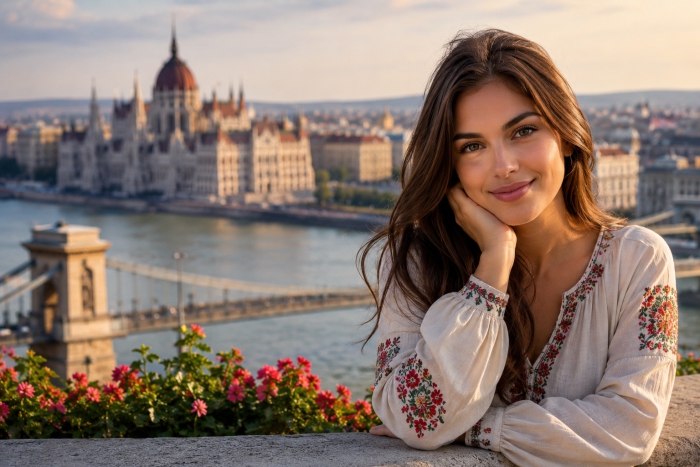 Hungarian Women: 9 Myths Debunked
Agence CQMI
Hungarian Women: 9 Myths Debunked
Agence CQMI
Hungarian Women: 9 Myths Debunked — What You Really Don't Know
In brief:
A Hungarian woman is neither Slavic, nor Germanic, nor Balkan. She is the heir to a civilization unique in Central Europe — that of the Magyars, steppe horsemen who settled in the Carpathian Basin in the 9th century. A Finno-Ugric language unlike any other, a blend of Catholicism and Calvinism, deep family attachment, and the highest marriage rate in the EU since 2018: the Hungarian woman embodies a cultural synthesis with no equivalent on the continent. Before forming an opinion, read what follows.
Article by Antoine Monnier, director and founder of the international marriage agency CQMI, specialist in serious relationships between Western men and women from Central and Eastern Europe since 2014.
Let me be straightforward with you.
When I talk about Hungarian women to my clients — men from Canada, the UK, Australia, or the United States looking for a serious relationship with a Central European woman — the reaction is almost always the same: a puzzled silence, followed by "But aren't Hungarian women basically Western by now?" Some assume they're too close to Vienna or Munich to retain traditional values. Others confuse them with Slavic women, as if being neighbors with Poland or Romania places them in the same category. Almost no one, in reality, genuinely knows what Hungarian women are about.
And yet.
The first time I found myself in Budapest — that remarkable double capital, medieval Buda on its hill and dynamic Pest on the plain, united across the Danube in 1873 — I was struck by something unexpected. A quiet intensity. Women who actually listen, who argue with precision, who hold their positions without aggression. A blend of Central European warmth and a particular pride you encounter nowhere else — the pride of a people who survived the Ottoman Empire, Soviet occupation, and remain standing while speaking a language that no one else understands.
James, a client from Toronto, 52, told me after his first exchanges with a member from Budapest: "Antoine, I expected someone reserved, almost Austrian in their formality. And right in the first video call, she's talking about her architecture work, her passion for the Széchenyi baths, and she gently corrects my pronunciation of Budapest — not to embarrass me, but so I'd say her city's name properly. I loved that."
What James discovered, I will explain — with verified data, more than ten years of direct experience at CQMI since 2014, and nine myths to dismantle one by one.
If you are not serious, look elsewhere. These women are looking for a marriage, not a sentimental tourist. Discover the full profile of Hungarian women on the CQMI Agency.
Myth #1 — "A Hungarian woman is basically a Slavic woman"
Where the confusion comes from
Hungary sits at the heart of Central Europe, surrounded by Slavic countries — Slovakia, Croatia, Slovenia, Poland to the north, Ukraine to the east. For a Western man unfamiliar with this geography, it seems logical to group this entire bloc under the convenient label "Eastern European woman."
What history demonstrates
The error is fundamental. Hungarians are not Slavic. They are Magyar — descendants of a Finno-Ugric people originating from the Eurasian steppes southwest of the Ural mountains, who settled in the Carpathian Basin under Prince Árpád around 895 AD. The Hungarian language — magyar — belongs to the Finno-Ugric family, like Finnish and Estonian. It is the only non-Indo-European language in Central Europe. A Hungarian and a Polish person meeting without having studied each other's language understand absolutely nothing of what the other says.
This linguistic uniqueness is not a minor detail — it is the key to the entire Hungarian identity psychology. This people survived a thousand years surrounded by neighbors who bore no resemblance to them, preserving their language, their traditions, and their state. The Hungarian woman carries this heritage: a quiet but absolute pride in being what she is — neither Slavic, nor Germanic, nor Latin. Magyar.
The decisive turning point: in the year 1000, Prince Vajk received the royal crown from Pope Sylvester II and was baptized as Stephen I (István). Hungary entered Western Christian Europe, Catholic and Calvinist — not the Russian or Byzantine Orthodox orbit. This fundamental religious distinction permanently separates the Hungarian woman from the Ukrainian or Russian profile.
Myth #2 — "Hungarian women are too Westernized to value marriage"
The modernization bias
Hungary has been a European Union member since 2004, Budapest is a cosmopolitan capital with trendy cafés, tech startups, and a vibrant cultural scene. How could a woman in this environment still value traditional marriage?
What European data contradicts
The reality is the exact opposite of this assumption. Hungary has been, since 2018, the European Union country with the highest marriage rate — surpassing all its neighbors. The Oeconomus Economic Research Foundation (2024) confirms this rate has been well above the European average for several consecutive years. Better still: Hungarian women get married for the first time at an average age of 29.7 years — 1.5 years earlier than the European average of 31.2 years (Eurostat, 2024). Hungary records the smallest shift in women's age at first marriage in the entire EU.
This is not a demographic accident. Hungary has implemented active family policies since 2014 — direct financial incentives for couples who marry and have children. But these policies do not create desire where none exists: they amplify a pre-existing cultural value. Marriage in Hungary remains a deeply embedded institution in popular culture, not just among conservative circles.
And there is one fact that says everything: eight out of ten children are born to married parents in Hungary (Ministry of Culture and Innovation, 2024). In France or Canada, the ratio is reversed.
Myth #3 — "Hungarian women are looking to escape their country"
The economic migration theory
Hungary is not a wealthy country by Western European standards. A Western man who learns this sometimes concludes that any Hungarian woman interested in an international relationship is primarily looking for a way out.
What reality demonstrates
Several facts dismantle this reasoning.
First fact: Hungary has been a European Union member since 2004. A Hungarian woman holds a European passport giving her the right to work freely in France, Belgium, Canada, or anywhere in the EU without needing a foreign husband. If she simply wanted to emigrate economically, she would — and thousands of Hungarians do so every year through professional channels.
Second fact: Budapest is an expanding economic capital. Technology, finance, tourism, medicine, architecture — educated women from Budapest have real careers and incomes that ensure their independence. The still-moderate cost of living compared to Western Europe creates genuine quality of life for the educated classes.
Third fact: what I consistently observe in our Hungarian members is a deep attachment to their country — to Budapest, to the Puszta, to the thermal baths, to the gastronomy, to the traditions of the Busójárás in Mohács or the wine harvest festivals of Eger. A Hungarian woman who chooses a Western man has weighed that choice carefully. She is not running away — she is choosing someone worthy of what she carries.
Myth #4 — "Hungarian women don't have the family values of Eastern European women"
The "too European" assumption
Twenty years in the EU, cosmopolitan Budapest, historical Austrian and German influence: men looking for traditional family values sometimes wonder if Hungary is "too European" to offer what they seek.
What the field contradicts
Hungarian social life remains deeply family-centered. The Sunday family lunch is a living national tradition — not a nostalgic ritual for retirees, but a practice that Hungarian women in their thirties actively maintain. The Catholic and Calvinist calendar structures collective life: Christmas (Karácsony), Easter (Húsvét), St. Stephen's Day on August 20 — the national holiday celebrating the founding of the kingdom by King Stephen I — are lived family landmarks, not merely commemorated ones.
What I observe in our Hungarian members: a relationship to the extended family — parents, grandparents, siblings — comparable to what one finds in Ukraine or Poland. Strong, present, structuring. The difference from Eastern Slavic women is perhaps that the Hungarian woman expresses it with greater confidence and less ceremony. She does not lecture about family values — she lives through them.
Demographics confirm it: 8 out of 10 children are born within marriage in Hungary, while Canada and most Western countries show the opposite trend. This figure does not reflect social constraint — it reflects a culturally valued choice.
Myth #5 — "Hungarian women are poorly educated"
The bias of the unknown country
Hungary does not top Western economic rankings. Associated in the popular imagination with a Central Europe still in transition, it is sometimes underestimated intellectually.
What OECD and Eurostat data contradict
The reality is substantially different. According to the OECD (Education at a Glance 2025), 79% of Hungarian women aged 25-34 have completed higher education — compared to 64% for men of the same age group, a gap of 15 percentage points in favor of women, above the OECD average of 12 points. The master's degree attainment rate among 25-34 year-olds reaches 21%, above the OECD average of 16%.
Hungary's intellectual tradition is deep and well-documented. Budapest is home to one of Central Europe's oldest universities — Eötvös Loránd University, founded in 1635. Hungary has produced a disproportionate number of Nobel Prize winners for a country of 10 million: 13 laureates, including several in physics, chemistry, and medicine. Franz Liszt, Béla Bartók, Zoltán Kodály in music. Ernő Rubik — the inventor of the Rubik's Cube — in design and mathematics. This is not the product of chance: it is the mark of a culture that values intellectual excellence.
A major practical advantage for an English-speaking man: a significant proportion of educated Hungarian women speak fluent English — and many speak German or French as well, a legacy of the Austro-Hungarian historical influence and Erasmus programs. The language barrier that complicates early exchanges with Ukrainian or Russian women is often significantly reduced.
Myth #6 — "Hungarian femininity is bland — neither truly Slavic nor truly Latin"
The trap of categorization
Being neither Slavic nor Mediterranean, the Hungarian woman escapes the aesthetic boxes some men have built. Not Nordic reserve, not Balkan expressiveness, not German formality. The result: some conclude hastily that Hungarian femininity is somehow undefined.
What field observation reveals
Hungarian femininity is anything but undefined — it is simply of a different nature. It is a Central European beauty shaped by centuries of genetic mixing: the Finno-Ugric origins of the Magyars, Roman influence on ancient Pannonia, Celtic, Germanic, Turkish, and Slavic contributions accumulated over a thousand years. This diversity produces varied and often surprising physical types — almond-shaped eyes with roots in the Eurasian steppes on a face with finely European features, or the warm complexion maintained by the hot summers of the Danubian plain.
What strikes my clients at first contact: the quality of presence. The Hungarian woman listens actively, takes a genuine interest in her interlocutor, engages in conversation with real intellectual curiosity. She takes care of herself — thermalism is a national culture in Hungary since Roman times, and Budapest's baths (Széchenyi, Gellért, Rudas) are not mere tourist attractions but weekly living spaces. She dresses with care, without ostentation — elegant without performance.
What makes her unforgettable is her rare combination: emotional intensity and self-control, warmth and precision, pride and openness. The bús magyarok — that slight melancholy Hungarians themselves recognize in their national character — translates in her as emotional depth that men looking for something superficial will never know how to appreciate.
Myth #7 — "Communicating with a Hungarian woman is impossible — their language is incomprehensible"
The Finno-Ugric language barrier
Hungarian is widely considered one of Europe's most difficult languages — 18 grammatical cases, free word order, linguistic logic with no equivalent in English, French, or German. A man who discovers this sometimes imagines an insurmountable wall.
What practical reality demonstrates
The difficulty of Hungarian is real — for someone learning it. But the educated Hungarian woman you will meet through CQMI does not ask you to learn Hungarian before the first video call. She speaks English. Often fluently. And in a significant number of cases, she also speaks German or French.
The Austro-Hungarian legacy (the Austro-Hungarian Empire, 1867-1918) embedded a multilingual culture in Hungarian educated classes. Erasmus programs have amplified this since 2004. Result: a 35-year-old Hungarian woman with a university degree from Budapest has very likely spent at least a year abroad — Vienna, Berlin, Paris, London — and communicates comfortably in English in professional and personal contexts.
What I observe in initial exchanges: the Hungarian woman is direct in her communication. This is not the surface politeness that some men find disconcerting with other nationalities. She says what she thinks — tactfully, but without detour. For a man accustomed to indirect communication, this is often a relief. The clarity of communication is one of Hungarian women's strengths in an international relationship.
Before looking on your own through unverified platforms, read our in-depth analysis of the Pay Per Letter (PPL) scams that are rife in online dating with Central and Eastern European women.
Myth #8 — "A too-independent Hungarian woman won't want a Western husband"
The emancipation-as-obstacle argument
Educated, professionally active, a European citizen with full freedom of movement — the modern Hungarian woman seems to hold all the cards to not need a man. Why would she look for a partner abroad?
What data and observation show
This question contains a false premise: the idea that independence and the desire for commitment are mutually exclusive. The most professionally active Hungarian women are often also the most determined in their family-building project. This is not a contradiction — it is a coherent foundation.
What one understands by observing the Hungarian matrimonial market from the inside: demographics play a role. The life expectancy of Hungarian men is more than 7 years lower than that of Hungarian women (Eurostat, 2023). Hungarian men statistically show high rates of premature mortality linked to high-risk lifestyles. An educated Hungarian woman aged 35-45 is looking for a mature, stable man capable of lasting commitment. This profile — which she does not easily find in her immediate environment — is precisely what men contacting CQMI agency often represent.
What she is looking for: not someone to support her — someone to build something with. The nuance is critical. She wants an equal partner, not a guardian. And she brings to this balance a loyalty and commitment that few women in other cultural contexts can offer with the same consistency.
For understanding age difference dynamics in this international context, our reference article "The Age Difference Comes With a Price Tag: A Truth Nobody Wants to Hear" will give you solid reference points.
Myth #9 — "A Hungarian woman will never leave Budapest"
The attachment to national culture
Hungary has a national identity of rare intensity — forged in resistance. Resistance to the Ottoman Empire (150 years of occupation, 1541–1699), resistance to the Habsburg Empire, resistance to Soviet occupation (until 1989), with the Hungarian Revolution of 1956 as its tragic culmination. A people who endured all of this while keeping their language and traditions — how could their women accept leaving?
What history and real couples demonstrate
Hungarian identity is strong — but it is not synonymous with immobility. The Hungarian diaspora is substantial and long-established: more than 5 million Hungarians live outside Hungary. Paris, Vienna, London, Montreal, Munich — Hungarians have a long tradition of international mobility, especially since 1989 and even more so since EU accession in 2004.
What I observe in lasting couples: Hungarian women integrate with remarkable efficiency into their adopted country. Their language skills allow them to insert themselves rapidly into any European or North American professional environment. Their sense of hospitality — deeply embedded in Hungarian culture, where receiving guests is a demonstration of national identity as much as personal character — makes them women who adapt without losing their distinctiveness.
A Hungarian woman who chooses a Western man has thought this choice through carefully. She leaves with conviction. And she brings with her an extraordinary culinary culture (gulyás, pörkölt, lángos, rétes — Hungarian strudel), a sense of celebration (pálinka fruit brandy, the Eger wine harvest), and a collective memory that gives weight to every commitment.
For understanding the nuances between different women from Central and Eastern Europe, our reference article on the subtle difference between a Russian woman and a Ukrainian woman will give you useful comparative points.
Hungarian, Ukrainian, Russian women: the real differences
Ten years of direct observation make this comparison possible:
| Criterion | Hungarian | Ukrainian | Russian |
|---|---|---|---|
| Cultural family | Finno-Ugric (Magyar), Catholic/Calvinist, EU since 2004 | East Slavic, Orthodox, European culture | East Slavic, Orthodox, Eurasian culture |
| Communication | Direct, precise, deep — Central European intensity | Expressive, direct, warm | Warm once trust is established |
| Language bridge | English often fluent, sometimes French/German | Ukrainian/Russian, variable English | Russian, variable English |
| EU status / visa | EU citizen — no visa required | Visa-free Schengen (short stay) | Visa required (2022 restrictions) |
| Relationship to marriage | #1 EU marriage rate — culturally and politically valued | Central, clearly expressed | Strong, varies by individual |
| Family values | Very strong — Sunday lunch tradition, 80% births within marriage | Central, clearly expressed | Strong, varies by individual |
| Religion | Catholic / Calvinist — national and family identity | Orthodox — strongly affirmed since 2014 | Orthodox — strong cultural foundation |
| Education level | 79% of 25-34 year-olds hold higher education degrees (OECD 2025) | Very high — solid university tradition | High — Soviet university tradition |
The 5 mistakes men consistently make with Hungarian women
- Confusing her with a Slavic woman. She is not. Telling her about her "Slavic spirit" or drawing comparisons with Ukrainian or Polish women shows immediately that you have not made the effort to know her. She will sense it in thirty seconds.
- Underestimating her intellectual level. An educated Hungarian woman from Budapest often has an academic background that rivals or exceeds your own. She has read widely, traveled, and holds well-formed opinions. Come as an equal, not as a teacher.
- Being thrown off by her directness. She says what she thinks — without detour, but without brutality. This is not rudeness. It is the communication culture of a people who learned not to waste words when history can shift rapidly. Answer clarity with clarity.
- Not being serious from the start. A Hungarian woman entering an international process knows exactly what she is looking for. If your goal is not marriage, do not waste her time — or yours.
- Using unverified platforms. The online dating sector is saturated with Pay Per Letter scams. Read our analysis before spending a single dollar on any website.
Two stories from the field
The Rubik's Cube and the lesson in humility
Robert, a client from Edinburgh, 54, managing director of an engineering firm, was on his third video call with a member from Debrecen — Hungary's second-largest city, a major university town and historic Calvinist stronghold. Wanting to break the ice with a Hungarian cultural reference, he produced a Rubik's Cube and said proudly: "Took me ten years to solve this." She looked at it, smiled, disappeared for thirty seconds, came back with her own, and solved it in two minutes forty. Silence. Then, very seriously: "I can teach you, if you'd like." Robert called me the next day: "Antoine, this woman is extraordinary." They are now on a scouting trip to Budapest.
The Sunday gulyás and what it reveals
James, our Toronto client, 52, had traveled to Hungary for a first meeting. His contact's family — a 41-year-old architect — invited him for Sunday lunch. On the table: a gulyás that had been cooking since six in the morning, fresh bread, sour cream, still-warm lángos. The 83-year-old grandmother, who spoke no English, served him his first plate herself, looked him in the eye, and said something in Hungarian. James asked for the translation later. It was: "Eat well. You'll need strength to deserve my granddaughter." He came back three times. They are getting married in September.
Frequently asked questions about Hungarian women
Do I need to speak Hungarian to meet a Hungarian woman?
No — and this is one of the practical advantages of the Hungarian profile. Educated Hungarian women generally speak fluent English, and a significant number also speak German or French, a legacy of the Austro-Hungarian historical influence and Erasmus programs. A few basic words of Hungarian — even just greetings — will be perceived as a mark of genuine respect and a real bonus.
Does a Hungarian woman accept a significant age gap?
Hungarian women are pragmatic and direct in their view of a relationship. A reasonable age difference — between 5 and 12 years depending on the profiles — is entirely accepted provided the shared project is clear and the relationship is built on genuine complementarity. Beyond 15 years, relevance depends greatly on both individuals' profiles. This topic is covered in detail in CQMI coaching.
Does religion play an important role for a Hungarian woman?
Hungary is predominantly Roman Catholic (approximately 50%), with a historically important Calvinist minority, particularly in the east of the country. Active religious practice varies considerably by individual. What is universal, however, is the importance of Christian calendar holidays as family and identity markers — Christmas, Easter, St. Stephen's Day — regardless of personal practice level.
What are the administrative procedures with a Hungarian citizen?
This is one of the simplest administrative profiles in the field. Hungary having been an EU member since 2004, a Hungarian citizen can settle in Canada, the UK, Australia, or the US under favorable conditions with no Schengen visa required for short stays, and EU freedom of movement within Europe. Procedures are notably simpler than for a Ukrainian or Russian national. Consult our CQMI process and pricing page for details.
Where can I seriously meet a Hungarian woman from Canada, the UK, or Australia?
Through the CQMI international marriage agency — the only serious Anglophone agency with a strict verification process (civil status, criminal background, motivations) applied to each member. Our $350 CAD/month subscription gives you access to 10 verified contacts with women motivated by a serious relationship and a marriage project. More than 40% of female applications are rejected during our selection process.
What you really need to understand about Hungarian women
A Hungarian woman is not a Slavic woman in a Central European version, not an Austrian with an exotic accent, and certainly not a default option. She is the heir to a thousand-year civilization — that of the Magyars, steppe horsemen who built a state at Europe's crossroads, defended it against the Ottoman Empire, against Soviet occupation, and preserved their unique language surrounded by neighbors who bore no resemblance to them. This history has forged a psychology of remarkable consistency: emotional depth and self-control, direct honesty and absolute loyalty, family sense and assertive professional independence.
What the experience of the CQMI international marriage agency, after more than 350 successful marriages since 2014, consistently confirms:
- Her directness is not coldness — it is the clarity of a people who learned to count on their words.
- Her independence does not close the door to commitment — it makes it more demanding and more sincere.
- Her educational level is real and documented — an intellectual and professional partner of the highest caliber.
- Her family values are deep — lived daily, not proclaimed.
- As an EU citizen, administrative procedures are among the simplest in the field.
If you are a serious man looking for a genuine shared life project, a Hungarian woman deserves your full attention. Start by discovering the profiles of Hungarian women on the CQMI Agency.
Ready to meet a serious Hungarian woman?
CQMI Agency has been operating since 2014. Our subscription — $350 CAD/month — gives you access to 10 verified contacts with women motivated to build a lasting relationship. More than 40% of female applications are rejected during our selection process.
This is not a dating site. It is a marriage agency with a strict ethical charter.
350+ successful marriages | Divorce rate < 7% | No chatbots, no ghost translators
Discover our process →Questions? Write directly to Antoine: This email address is being protected from spambots. You need JavaScript enabled to view it.
Related articles on the CQMI blog
Latest from Antoine Monnier
- Albanian Women: 9 Myths Debunked About the Balkans' Only Non-Slavic People
- Macedonian Women: The Overlooked Balkan Charm Between Slavic and Mediterranean
- Azerbaijani Women from the South Caucasus: 9 Myths Debunked
- Armenian Women From the South Caucasus: 9 Myths Debunked
- Chuvash Women of Chuvashia: 9 Myths Debunked

 +1 514 794-5053