


Ukrainian and Russian Bride dating advices - CQMI blog

 Agence CQMI
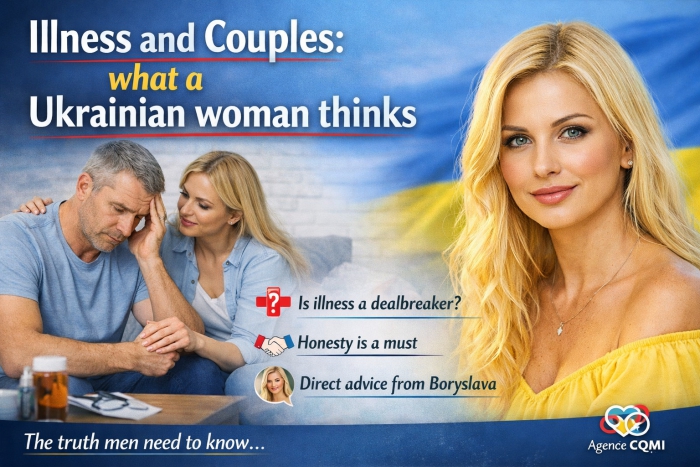
Health Problems and Relationships: What a Ukrainian Woman Really Thinks
Quick Answer
Will a health condition ruin your chances with a Ukrainian or Russian woman?
No — provided you are honest from the start. Women from Eastern Europe value transparency and strength of character far more than physical perfection. What destroys a relationship is not illness: it is concealment, withdrawal, or the expectation that she will somehow "figure it out." Communicate early, act with dignity, and build together — that is what a serious Ukrainian woman expects from a serious man.
There is something a surprising number of men never mention when they first begin corresponding with a Ukrainian or Russian woman. Something that makes them hesitate to register with a matchmaking agency, that pushes them to put off a step they know is right for them. A chronic illness. A past surgery. An ongoing treatment. A disability that is easy to overlook but hard to explain. A health episode that left its mark.
Over more than a decade running the CQMI international matchmaking agency, we have watched this pattern repeat itself: the man stays silent, hoping "it won't be an issue," and postpones the real conversation indefinitely. The result? She discovers his situation at the wrong moment — usually several weeks into an emotional investment — and what breaks is not the relationship itself. It is trust.
My wife Boryslava writes every day for Ukrainian women on our agency blog. When she addressed this topic from the female side, I immediately understood that her perspective needed to reach the men reading us here. What follows is not a reassuring speech. It is a reality you would do well to understand before you start building something serious with a woman from Eastern Europe.
What Boryslava Observes: How Slavic Women Experience Illness in a Relationship
In Ukrainian and Russian culture, illness — especially a partner's — is treated with a seriousness that Western men do not always anticipate. A woman from Eastern Europe who commits to a man expects one fundamental thing from him: solidity. Not perfection. Solidity.
A Ukrainian woman who grew up watching her mother or grandmother care for a sick husband for years — without complaint, without ever contemplating leaving — carries that blueprint deep inside. She is not afraid of illness itself. What she fears is a man who conceals it, minimises it, or manipulates through omission. A man who is physically weakened but assumes his situation with dignity is, in the Slavic mindset, infinitely more admirable than a man in perfect health who behaves immaturely or dishonestly.
That said — and this is the nuanced point Boryslava raises regularly in her writing — women from Eastern Europe also draw a clear line between supporting a man and becoming his full-time nurse. That boundary is yours to respect.
Why Silence Is Always the Worst Strategy
James, 53, a project manager from Toronto, registered with CQMI carrying a reality he considered significant: well-managed Type 2 diabetes and the residual effects of a heart attack three years earlier. His initial strategy: say nothing. His first Ukrainian correspondent, Olena — a 45-year-old woman of character from Kharkiv, mother of a teenage son — was progressing well with him. Then, during a video call, James mentioned a cardiology appointment in passing. Olena stopped mid-sentence: "Why didn't you tell me before?" It was not a medical question. It was a question about trust.
"What hurt me was not his illness. It was that he didn't think it was relevant to tell me. Did he think it didn't concern me? Or that it would scare me away? Either way, he didn't trust me."
— Olena, CQMI member, Kharkiv
This scene repeats itself. Regularly. And every time, the problem is never the illness. It is the concealment. The Ukrainian and Russian women we work with at CQMI have developed — often after difficult relationships with emotionally closed Slavic men — a finely tuned instinct for what is being hidden from them. Do not test that instinct.
If you want to understand the deeper context of why serious Ukrainian women choose Western men in the first place, our article on real stories of men who married Ukrainian and Russian women makes the pattern clear: what works is always authenticity. What fails is always pretence.
When is the right time to bring up your health?
Not in your first message — that would be a timing error. Not after three months of correspondence — that would be too late. The ideal window is between the third and sixth week of regular communication, once you have established a basic connection but before emotional expectations are too deeply set.
Practical tip: address the subject during a video call, never in writing. Tone, eye contact, posture — all of these convey the calm you want to project. A man who looks into the camera and speaks openly about his health inspires confidence. A written message sits there, gets re-read, gets over-interpreted.
What a Ukrainian Woman Actually Looks For: Quiet Strength
There is a concept Boryslava returns to frequently in her Ukrainian articles: тиха сила — "quiet strength." This is not brute force, invulnerability, or performed masculinity. It is a man's capacity to face his own difficulties with composure, clarity, and without unnecessary dramatisation.
A Ukrainian woman who learns that her Western partner lives with a well-managed chronic condition — diabetes, hypertension, an orthopaedic problem, treated cancer in remission — does not automatically think "that's a problem." She thinks: "How does he handle it?"
If she sees an organised man who follows his treatment, takes care of himself, and speaks about his situation with serenity — she reads that as maturity. If she sees a man who victimises himself, uses his illness as an excuse not to invest in the relationship, or alternates between dismissiveness and catastrophising — she reads that as a warning sign.
The health conversation is also deeply linked, in the Slavic mindset, to the question of age difference. A woman of 42 considering a relationship with a man of 55 already knows — and accepts — that health questions may arise. It is not a taboo subject for her. It is a reality she integrates into her thinking, provided she is informed honestly.
Classic Mistakes Western Men Make Around This Topic
Over more than a decade working with hundreds of Anglo-Ukrainian couples, we have identified the most predictable errors. They are avoidable — precisely because they are predictable.
| The mistake | What it signals to her | The alternative |
|---|---|---|
| Hiding everything until the first in-person meeting | Distrust, manipulation | Bring it up in weeks 4–6 |
| Over-sharing on the very first message | Emotional burden, overwhelm | Wait until a basic bond exists |
| Seeking sympathy through self-pity | Emotional immaturity | Present the situation calmly and matter-of-factly |
| Understating a serious condition | Concealment, future betrayal of trust | Be complete but composed |
| Expecting her to manage your health for you | Major red flag — dependency | Show her you actively manage your own health |
That last mistake deserves emphasis: do not turn your future partner into an unpaid carer. Ukrainian women carry a natural generosity and capacity for support — and some men exploit it, consciously or not. A woman who gradually realises she is primarily functioning as a medical assistant doesn't leave immediately, but she retreats inwardly. And once she has crossed that psychological threshold, no conversation will bring her back.
For a broader picture of what Ukrainian women at CQMI actually look for, we highly recommend reading our article on the subtle difference between a Russian woman and a Ukrainian woman — because understanding cultural context is essential before navigating sensitive conversations like this one.
Two Stories From the Field
Robert and his philosophical knee
Robert, 57, a recently retired engineer from Vancouver, arrived at CQMI with what he considered two liabilities: a knee replacement two years earlier and twelve kilos he had been meaning to lose. His plan: mention neither. His first Ukrainian correspondent asked him directly on their third video call: "You seem to favour one leg a little — is everything okay?" Robert was caught off guard. He explained everything. She smiled gently: "My father has had the same thing for five years. He walks fine. I just wanted to know if you were afraid to bring it up." They met in Odessa six months later.
James and his misplaced discretion
James, 49, a business owner from Melbourne, had been managing a depressive episode for two years with a well-adapted medication. He was functional, active, and professionally sharp — but he said nothing about it. His Ukrainian correspondent eventually asked, after a quieter week: "Is everything alright? You seem different these past few days." James replied: "Everything's fine." She didn't push. But she began to watch more carefully. Two weeks later, her messages came less frequently. James couldn't understand why.
The lesson: Ukrainian women don't ask questions in the hope of hearing "everything's fine." They ask because they have already noticed something. The right answer is never denial.
How to Bring It Up: A 5-Step Approach
Here is how we advise CQMI clients to approach the health conversation with their Ukrainian or Russian correspondent. This is not a script — it is a framework.
- Choose the right moment: a video call, when you are both relaxed — not late at night when you are both tired.
- Contextualise briefly: "I wanted to be upfront with you about something — I have been living with [condition] for [time]. It is well managed. Here is how I handle it…"
- Show you have it under control: regular treatment, follow-up appointments, adapted lifestyle habits. She wants to see a man who is organised, not a victim of circumstance.
- Give her space to respond: do not drown her in clinical details. Give her the essentials, then wait for her reaction. If she asks questions, that is a good sign — it means she is still there, thinking, taking you seriously.
- Don't dramatise, don't minimise: find the right register — calm, factual, matter-of-fact. You are informing a potential partner. You are not looking for her pity or her medical validation.
The Cultural Difference Nobody Explains to You
In Canada, the US, the UK, or Australia, talking openly about your health — especially a mental health challenge — can still be perceived as a sign of weakness, or as a private matter to keep close until a relationship is truly established. That reserve is culturally ingrained and understandable.
Eastern European codes are different — and yet similar on one important point: a man does not bare his vulnerabilities to a stranger. But there is a meaningful nuance. In Slavic culture, the ability to name one's difficulties without being consumed by them is seen as a sign of emotional maturity. A man who can say "I went through a hard period, I came through it, and here is where I stand today" inspires more trust than a man who presents himself as flawless — because Ukrainian women have been disappointed too many times by men who appeared flawless.
This is one of the reasons why, as explored in our article on PPL dating scams and the cultures they exploit, serious platforms prey on men's desire to project an image rather than reveal themselves. The men who succeed at CQMI are systematically those who understood the difference between impression management and authentic communication.
What we observe consistently across our work: the men who are most physically fragile but most authentically communicative outperform men in perfect health who are defensive or emotionally closed.
Frequently Asked Questions
- Will a Ukrainian woman still consider a relationship with a man who has a health condition?
- Yes — if the situation is honestly presented, well managed, and the man demonstrates that he is looking after himself. A stabilised chronic condition is not an obstacle in the Ukrainian mindset. What is genuinely disqualifying is concealment.
- Should I mention mental health challenges such as depression or anxiety?
- This is the most delicate area. Mental health remains a topic that is not discussed openly in Slavic culture. If you are in treatment and stable, the best approach is to speak about it simply as a period you worked through — emphasising that you have support and that you are in a good place. Avoid clinical detail before a genuine bond has formed.
- Is a Ukrainian woman going to become my full-time carer?
- No — and you should not allow that dynamic to develop. A woman who commits to a man with a health condition does so out of love and genuine choice, not out of a nursing vocation. Your responsibility is to manage your own health autonomously. She can offer emotional support — but she is not a replacement for your doctor or your physiotherapist.
- Does CQMI help men navigate sensitive topics like this with their correspondent?
- Yes. This is precisely why our service goes beyond a simple contact exchange. We guide our clients on sensitive subjects — how to approach them, when, and in what context. Boryslava, by her culture and professional experience, brings an irreplaceable Ukrainian female perspective to exactly this kind of situation.
- Does a woman from Eastern Europe view illness differently from a Western woman?
- On the substance, no: nobody wants a suffering partner. But in approach, yes. Slavic women often have more direct experience of serious illness in their close circle — and they have developed a form of practical resilience around it. She is not afraid of reality. She is afraid of the denial of reality.
Our formula: 10 verified contacts for $350 CAD / month
At CQMI, we work with serious men — including those living with a chronic condition who know exactly what they bring to a relationship. We have facilitated over 150 marriages since 2015. Our one-month subscription gives you access to 10 contacts with verified Ukrainian and Russian women who are genuinely motivated for a lasting relationship and marriage.
This service is for serious men only. If you are looking for a casual encounter, this is not the right place.
Discover our subscription formulaBrowse our Ukrainian and Russian women's profiles
Questions? Write directly to This email address is being protected from spambots. You need JavaScript enabled to view it.
Latest from Antoine Monnier
- Why 90% of Men Have No Chance With a Ukrainian Woman
- How to Verify a Russian or Ukrainian Woman's Photo Online
- Why There Is a Real Shortage of Men in Ukraine and Russia Since the War
- Orthodox Ukrainian Woman or Muslim Kazakh/Uzbek Woman: What's the Real Difference for Marriage?
- Dating a Russian or Ukrainian Woman: Why Your Playbook Won't Work

 +1 514 794-5053