



Ukrainian and Russian Bride dating advices - CQMI blog

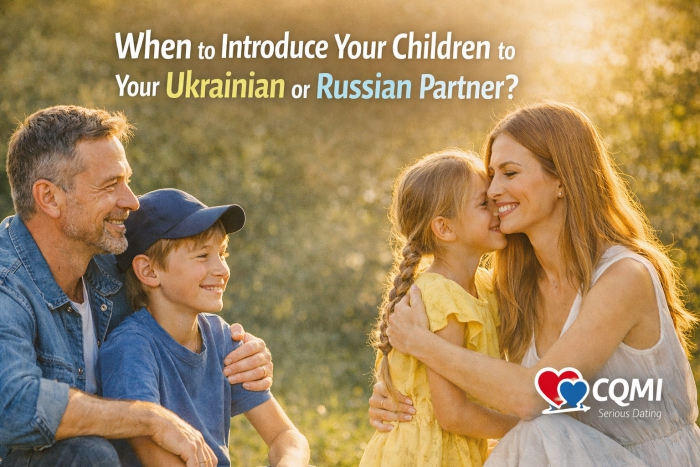 When to Introduce Children to Your Ukrainian Partner
Agence CQMI
When to Introduce Children to Your Ukrainian Partner
Agence CQMI
When Should You Introduce Children to Your Ukrainian or Russian Partner?
This article is adapted from an original text written in Russian by Boryslava Barna, co-founder of CQMI and daily author of our Ukrainian agency blog. Original article: Когда знакомить мужчину с ребёнком (original in Russian) . Boryslava is Ukrainian; we have been married since 2016. She writes for women in Eastern Europe every day — I have adapted her perspective here for you, the Western man.
Quick answer: There is no universal timeline, but the consensus among relationship experts — and our own experience at CQMI — is clear: wait until the relationship is stable and serious, typically after 4 to 6 months of consistent contact and at least one in-person meeting. For a Ukrainian or Russian woman, her children are sacred. She will not introduce them to a man she is not ready to commit to. The same discipline applies to your own children. A successful blended intercultural family is built on patience, clear intentions, and mutual emotional intelligence — not on romantic impatience.
When Should You Introduce Children to Your Ukrainian or Russian Partner?
I have been running the CQMI international matchmaking agency since 2014, and over the years one question keeps surfacing — sometimes asked directly, sometimes avoided altogether: "When do I meet her children? And when do I introduce her to mine?"
It sounds straightforward. It is anything but. And the answer you give — or fail to give — can make or break the future you are trying to build. In our experience at CQMI, we have seen beautiful blended families form with patience and intention. We have also watched promising relationships fall apart precisely because this question was handled carelessly.
My wife Boryslava — Ukrainian, from the Carpathian Mountains, my partner in life and in this agency since 2016 — writes about this every week for the women on her Ukrainian blog. I am giving you her perspective, turned around for you, the Western man standing at the threshold of something new.
The Uncomfortable Truth Most Agencies Will Not Tell You
Let me be direct: the majority of men who come to CQMI underestimate the role children will play in their new relationship. In the excitement of early contact — the correspondence, the first video calls, the anticipation of a first trip to Ukraine — children feel like a distant detail. They are not.
For a Ukrainian or Russian woman, her child is the absolute centre of her world. Not beside you. Not behind you. At the centre. If she has a child, that child is her non-negotiable priority — before romance, before marriage, before you. If you have children, she will pay close attention to what kind of father you are, because that will tell her everything she needs to know about the kind of man you are.
This is not a warning. It is an invitation. If you can step into this awareness with grace and sincerity, you have a significant advantage over the many men who never think about it at all.
To understand the full cultural context, I strongly recommend reading our article on the subtle differences between Russian and Ukrainian women — family structures and maternal instincts, while similar, have distinct cultural nuances.
The Most Common Mistakes — and Why Men Make Them
Before we talk about timing, let us look at what goes wrong. These mistakes are not rare. At CQMI, we encounter versions of them regularly:
Mistakes that sink blended families before they start:
- Introducing children before you have had an honest conversation about marriage and long-term intentions
- Bringing your own children on a first trip to Ukraine — far too much pressure for everyone involved
- Treating her child as a footnote in your correspondence — she notices this, always
- Making promises to her child — "you'll come live with me one day" — before the relationship is settled
- Hiding your own children from her — perceived as a serious breach of trust in Slavic culture
- Expecting immediate warmth between the children — chemistry between kids cannot be scheduled
Most of these mistakes share the same root: impatience dressed up as enthusiasm. The desire to accelerate the family dynamic before the couple itself is stable. Slow down. Build the foundation first.
A real moment from the agency — James, a 49-year-old from Vancouver, called me in a mild panic: "She sent me a voice message with her son singing in the background. What do I do?" I told him to reply with a voice message of his own — something genuine, something that showed he actually listened. He asked the boy's name. Spent two minutes talking about what it's like when a kid won't stop singing around the house. She wrote back two hours later: "You have no idea how much that meant." They have been together ever since.
A Practical Timeline: What We Recommend at CQMI
Every relationship is different, but this framework has served our clients well. Think of it as a guide, not a rigid rule:
| Phase | Approximate Duration | What to Do Regarding Children |
|---|---|---|
| Discovery | 0 – 2 months | Acknowledge the existence of children naturally in your conversations. Do not hide yours; do not probe hers. Show that you are a responsible, grounded man. |
| Building Trust | 2 – 4 months | Share stories, photos, anecdotes about your children. Let her build an indirect familiarity. She begins to understand your relationship with your own kids. |
| Serious Intent | 4 – 6 months | Once marriage intentions have been clearly expressed by both partners, a first casual, low-pressure introduction may be appropriate. |
| Life Project | 6 months + | Begin gradual, organic integration of children into shared moments. No forced bonding. Let the relationships develop at their own pace. |
The Psychology of the Ukrainian Mother: What You Must Understand
Boryslava says this clearly to the Ukrainian women she writes for — and I translate it directly for you: "A Ukrainian woman does not show her child to a man she is not ready to marry."
That is a short sentence. It carries enormous weight.
In Ukrainian and Russian culture, introducing a child to a man is an act of total trust. It means: "I see you as a potential father for this child." It is a deliberate, considered decision — not a casual gesture. If she introduces you to her son or daughter relatively early, do not trivialise it. It means she is taking you very, very seriously.
On the other hand, do not take it personally if she waits. She is protecting her child. A man who understands this — who respects the waiting without pushing — earns enormous respect. Patience in this context is not passivity. It is emotional intelligence. It is proof that you understand what is at stake.
This is very different from what many Western men are used to — where introducing children early is often treated as a normal step in modern dating. In Eastern European culture, it carries a different gravity. For a broader picture of how family values differ between East and West, take a look at our real stories of Western men who married Ukrainian women — the family dimension comes up in every single one.
Introducing Your Own Children: How to Do It Right
The mirror question is equally important. You may have children from a previous marriage or relationship. How do you prepare them — and how do you introduce your Ukrainian partner to them?
Here is what we observe in the couples who get this right:
- Do not seek immediate approval. Your children do not need to "adopt" your partner after a first meeting. A successful first introduction is simply one that goes smoothly — no drama, no forced warmth.
- Introduce her as a friend first. Not as "Dad's girlfriend." Not as a future stepmother. Let the relationship find its label over time.
- Make her culture an adventure, not a complication. Ukraine, Russia, Eastern Europe — talk about it with curiosity. Children are naturally inquisitive. Turn the cultural difference into something fascinating, not threatening.
- Never ask your children to choose. Between their mother and your new partner. Between the past and the present. This is destructive in any blended family — mixed culture or not.
- Give it time. Robert, a CQMI member from Toronto, told me his teenage son needed almost a year to warm up to Iryna, his Ukrainian partner. Today, they are the ones exchanging voice messages in the morning. These stories are irreplaceable. You cannot rush them.
The Slavic Child: A Profile Worth Knowing
If your partner has a child, that child has grown up in a very different cultural environment. The Slavic educational system is more demanding academically. The relationship with grandparents is closer and more central. The family unit is more collective. And the dynamic between children and adults may feel more formal than what you are accustomed to in Canada, the US, or the UK.
Children from the post-Soviet generation — particularly only children, who were extremely common due to the demographic collapse of the 1990s — were often raised with intense parental attention. They can be intellectually precocious, have strong characters, and take time to accept new figures in their family circle.
Do not take their initial reserve personally. And critically — do not try to be their father. You are their stepfather-in-the-making. That is a beautiful role. It has its own wisdom, its own patience, its own rewards.
The borscht lesson — One CQMI member from London decided to cook borscht from scratch for the first meeting with Kateryna's nine-year-old son. He found a recipe online, sourced the beetroot, spent two hours at the stove. The boy took one spoonful and announced, very seriously: "My grandmother makes it better." The mother laughed for ten minutes. The man did too — eventually. Lesson: do not try to be perfect. Be genuine. Slavic children have a radar for authenticity that would embarrass most lie detectors.
Age Difference and Its Impact on Children
One dimension that is often overlooked: if there is a significant age gap between you and your partner, this will inevitably influence the dynamic with the children — both hers and yours.
A 50-year-old man building a relationship with a 35-year-old Ukrainian woman who has a 10-year-old child is creating a family triangle that deserves careful thought. We explore this in detail in our article on what an age difference truly costs — financially and emotionally.
What I will say here is this: a significant age gap can be a strength in a blended family. The maturity, financial stability, and emotional groundedness of an older man is often deeply reassuring to a Slavic child. But it also creates a generational distance that requires conscious effort to bridge. Acknowledge it. Do not pretend it is not there.
Signs That Both of You Are Ready
She is ready when…
- She speaks about her child spontaneously and naturally every day
- She asks your opinion on parenting decisions
- She has clearly and explicitly discussed a shared future
- Her child already knows you exist — through her stories
- She is no longer afraid to show you her reality as a mother
You are ready when…
- You have been honest about your own intentions — marriage, not experimentation
- You have discussed your views on education and family life
- You have no internal resistance to the idea of a child in your daily life
- Your own children know this relationship exists
- You are not waiting for perfection — you are waiting for authenticity
Why a Marriage Agency Protects Children Better Than a Dating App
I want to ask you something honestly: do you think a Ukrainian woman posting her profile on a mass dating platform — Tinder, match.com, or worse, a pay-per-letter scam site — is going to filter carefully for the men who will eventually meet her children?
No. Because those platforms are not designed for that. There is no screening, no verification, no intention filter. The woman with a child who registers on a serious matchmaking agency is making a completely different statement: "I want a man serious enough to go through a real process."
That is precisely the women you find at CQMI. Not women running from their country. Not women looking for a ticket out. Women who have built lives, raised children with care and sacrifice, and are now looking for a man who has the courage to match their seriousness.
Our $350 CAD monthly subscription gives you access to 10 verified female contacts — women who want to build a real relationship. Not a correspondence. Not a game. A life. If you have children, they will know. If she has children, you will know. Transparency is the foundation of everything we do.
Not sure if you are ready for this step? Take our compatibility quiz — it takes five minutes and gives you a clear picture of where you stand.
You can also browse the profiles of our registered women and see for yourself the kind of women who trust this process.
Frequently Asked Questions
- My Ukrainian partner has a child and won't introduce him to me after 3 months. Should I be worried?
- No — in most cases, this is a very good sign. It means she is treating the relationship seriously and protecting her child from premature emotional attachment. Keep building the connection. Do not rush this.
- Should I mention my children in my first messages to a Ukrainian woman?
- Absolutely yes. Concealing your children is considered deceptive. Mention them naturally and with pride. It signals maturity and honesty — qualities Ukrainian women value deeply.
- My ex-wife has primary custody of our children. Will that be a problem with a Ukrainian partner?
- Generally no. Ukrainian women understand Western divorce realities very well. What matters to her is the quality of your relationship with your children — not the legal arrangement.
- Is a Ukrainian woman with a child a good choice for a serious marriage?
- Yes, often an excellent one. A Ukrainian mother has developed maturity, resilience, and a seriousness of purpose that makes her a particularly committed partner. Her maternal warmth is an energy that extends to the whole family.
- Do we need to have identical views on parenting for a blended intercultural family to work?
- Not identical — but compatible. Cultural differences in parenting styles exist and are real. What kills a blended family is not disagreement, but contempt for the other's cultural approach. Curiosity and dialogue make the difference.
Ready to meet a woman who means it?
Our subscription at $350 CAD / month gives you access to 10 verified contacts of Ukrainian and Russian women committed to a real marriage project. No games. No pay-per-letter. Just serious women — many of them mothers — who are ready to build a life.
Discover Our SubscriptionQuestions? Write directly to This email address is being protected from spambots. You need JavaScript enabled to view it.
Further Reading on the CQMI Blog
Latest from Antoine Monnier
- How to Verify a Russian or Ukrainian Woman's Photo Online
- Why There Is a Real Shortage of Men in Ukraine and Russia Since the War
- Orthodox Ukrainian Woman or Muslim Kazakh/Uzbek Woman: What's the Real Difference for Marriage?
- Dating a Russian or Ukrainian Woman: Why Your Playbook Won't Work
- Why a Russian or Ukrainian Woman Sees You as Just Another Man

 +1 514 794-5053